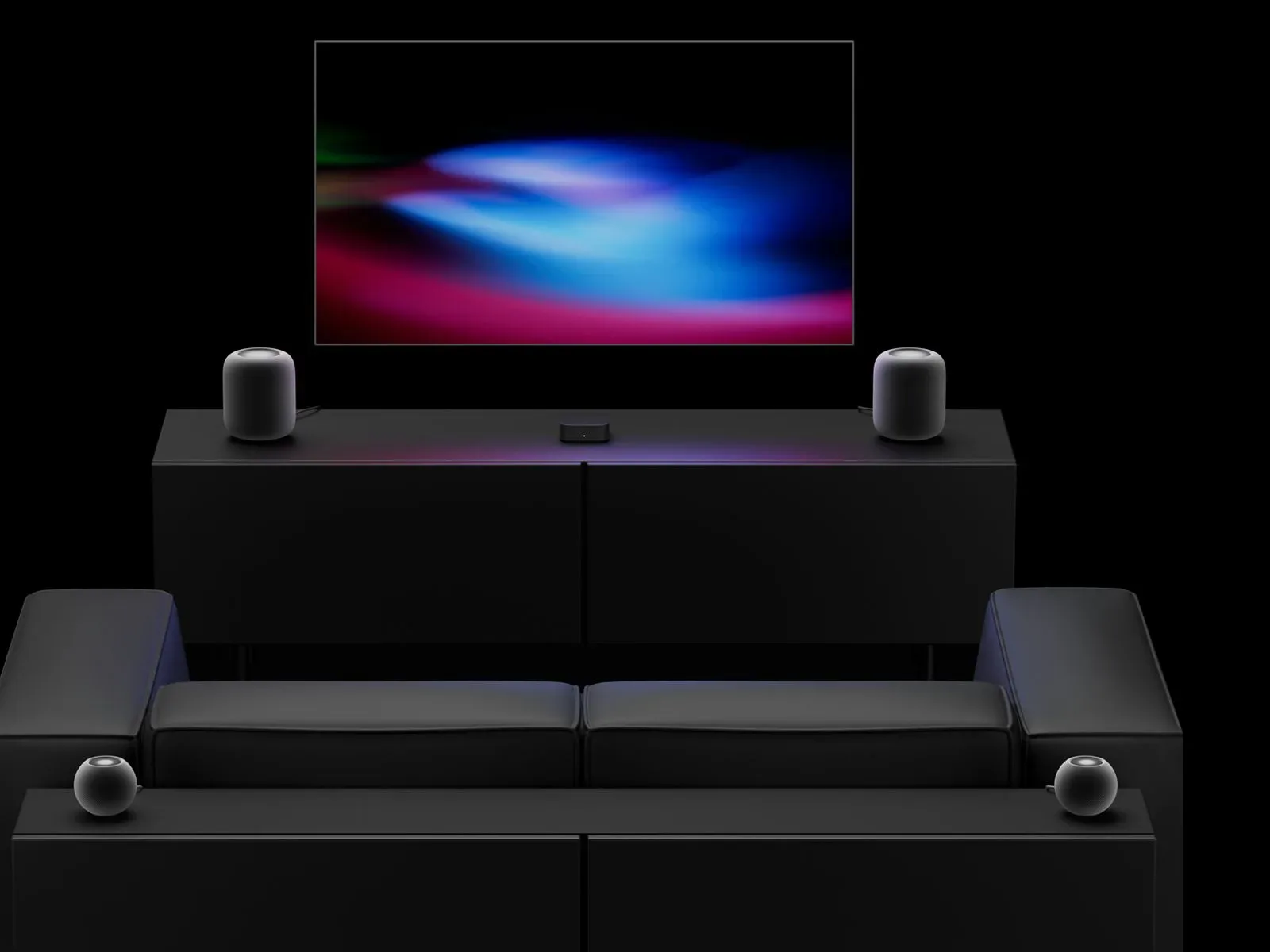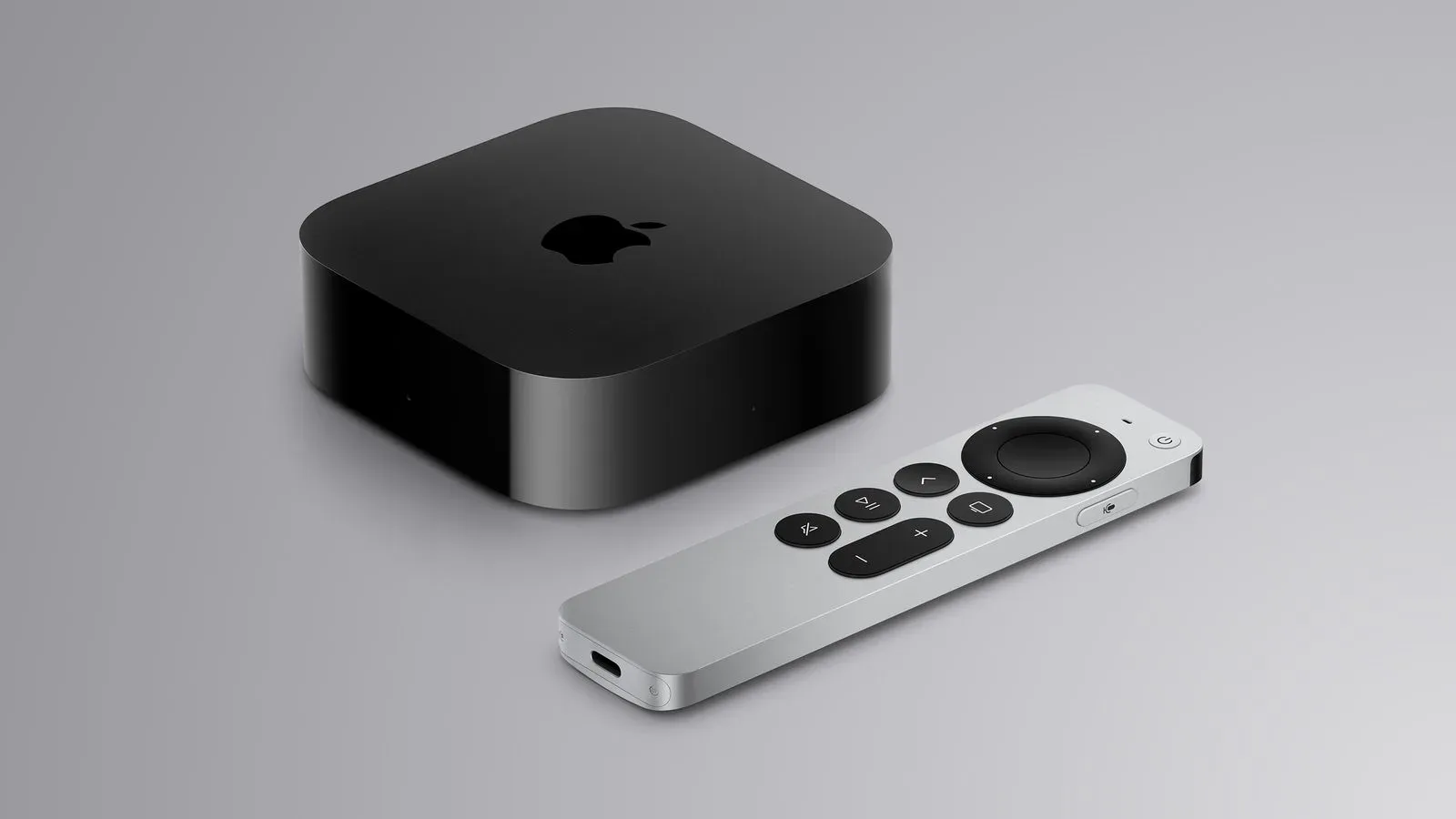
Apple’s next software round is laying the groundwork for a more ambitious HomePod-based living-room setup. tvOS 27.2, iOS 27.2 and HomePod Software 27.2 add support for four-speaker surround sound, but the feature is tied specifically to the forthcoming fourth-generation Apple TV 4K rather than being a broad upgrade for existing Apple TV owners.
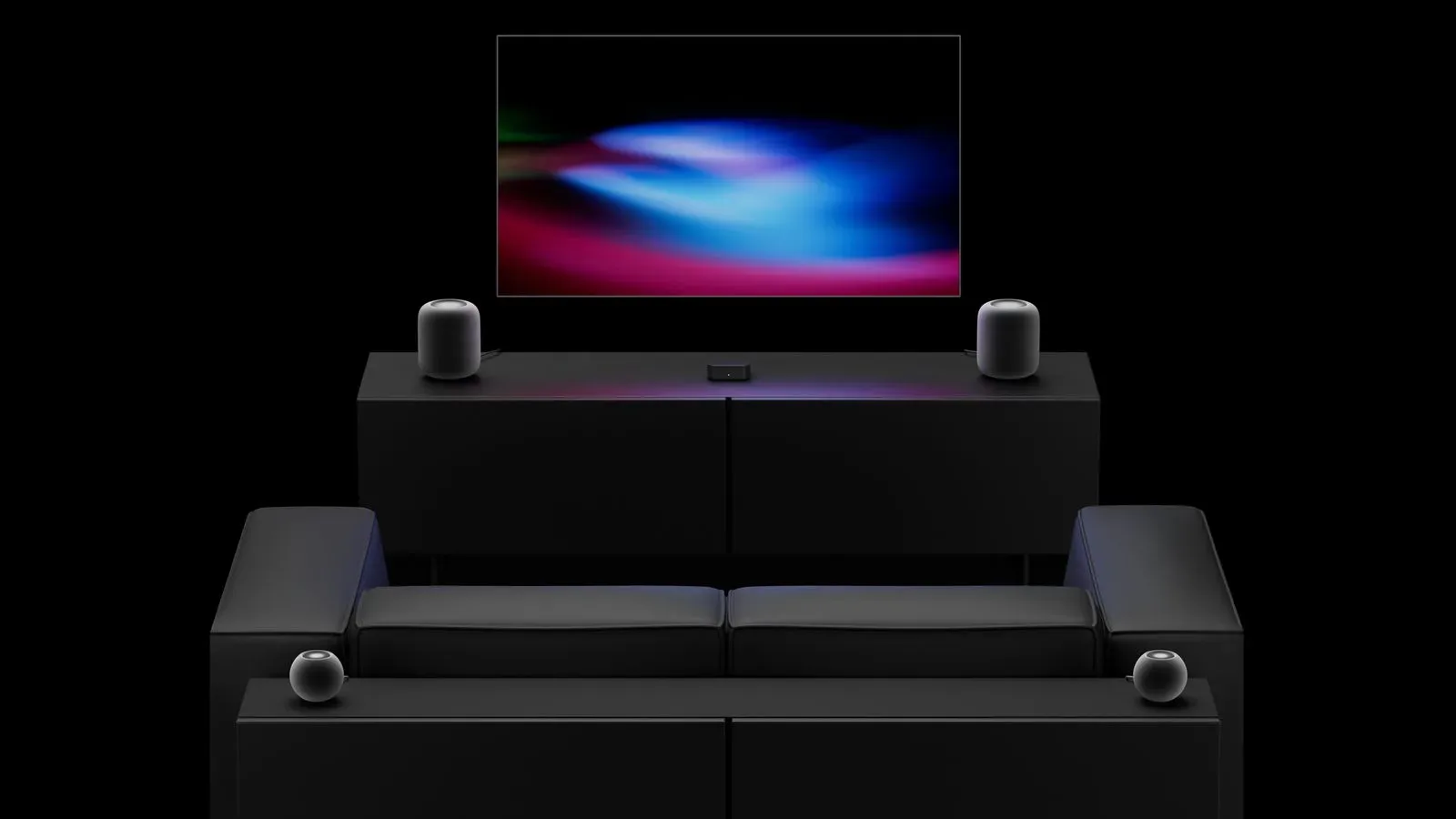
The update is notable because it expands the potential HomePod home-theater arrangement from a conventional paired-speaker approach into a four-speaker configuration. In practical terms, that creates a setup intended to place sound around the room, with speakers acting together as one Apple TV audio system rather than as a collection of individually managed smart speakers.
There are important compatibility limits, however. The new surround option will require the new Apple TV 4K and supported newer HomePod hardware. Owners of the original HomePod, the original HomePod mini, or an older Apple TV will not be able to use this four-speaker surround feature.
Which Apple hardware can form the four-speaker system?
The supported arrangements are tightly defined. A compatible fourth-generation Apple TV 4K can use one of the following:
- Four HomePod mini 2 speakers
- Four second-generation HomePod speakers
- Two second-generation HomePods plus two HomePod mini 2 speakers
The mixed arrangement comes with a meaningful condition: each pair must match. Put another way, the setup can combine a pair of second-generation HomePods with a pair of HomePod mini 2 units, but it is not presented as a free-form system for combining any four Apple speakers in a room.
That pairing restriction matters for people planning a gradual upgrade. A household can potentially use two speakers of one supported model alongside two of the other supported model, but a collection of mismatched individual speakers does not automatically become a surround package. Buyers should therefore treat the system as two matched pairs coordinated by the new Apple TV 4K.
Just as important is what is excluded. First-generation HomePods and first-generation HomePod minis are not eligible for surround sound here. The limitation is also platform-based: even a supported newer speaker cannot unlock the feature when connected to an older Apple TV model. The fourth-generation Apple TV 4K is the hub requirement.
What “home theater grouping” means
Apple’s implementation groups the HomePods with the Apple TV into a home-theater grouping. Rather than leaving each speaker exposed as a separate audio destination, the system treats the assembled speakers as a single accessory.
That distinction is more than a tidier label in a device list. Surround sound depends on coordinated output. Dialogue, music, effects and ambience need to arrive at the listener in an organized relationship, not as four independently timed sources. Managing the speakers as a single system gives the Apple TV a defined audio group to work with when sending sound from television apps and other content on the box.
The speakers are also able to detect their positions in the room for timing and level calibration. Timing calibration refers to the system adjusting when audio is played from each speaker so that sound is synchronized at the listening area. Level calibration means balancing output levels, helping prevent one speaker from overwhelming another simply because of where it sits in the room.
Neither point means placement stops mattering. The supplied details describe position detection and calibration, not a guarantee that every possible room shape or speaker location will produce the same result. A four-speaker arrangement still implies deliberate placement around the viewing space. The practical value of calibration is that the system can account for where the speakers are located when managing timing and loudness.
Setup happens on Apple TV, with an iPhone starting option
The core setup process takes place directly on the Apple TV. That makes sense given that the Apple TV is the required device and the component creating the home-theater grouping.
There is also an option to begin the process through the Apple TV Remote app on an iPhone. That is a useful distinction for people who use their phone as their everyday Apple TV controller: iPhone participation can start setup, but the configuration is still fundamentally centered on the Apple TV rather than being a standard Home app-style speaker grouping described in the available details.
For prospective owners, the sensible checklist is straightforward:
- Confirm the Apple TV is the fourth-generation Apple TV 4K.
- Use supported speaker models only: HomePod mini 2, second-generation HomePod, or a permitted combination of both.
- Make sure the four speakers form matching pairs where models are mixed.
- Install the relevant Apple software updates once available.
- Set up the home-theater grouping on the Apple TV, or initiate the process with the Apple TV Remote app on iPhone.
This is also a situation where buying based on a product name alone could cause frustration. “HomePod” is not sufficient as a compatibility check, because the original HomePod and original HomePod mini are explicitly outside the new surround system. “Apple TV 4K” is not sufficient on its own either, because the feature is not supported by older Apple TV models.
Release timing and why the software arrives first
HomePod mini 2 is scheduled to launch on October 30, while the fourth-generation Apple TV 4K is scheduled for release on November 13. Both products are available for preorder from Apple.
The associated iOS 27.2, tvOS 27.2 and HomePod Software 27.2 updates are expected to arrive next week. Seeding the release-candidate software ahead of the new Apple TV 4K’s November launch gives Apple’s device ecosystem the necessary support before the hardware reaches customers.
A release candidate, often shortened to RC, is a software build that is generally positioned close to public release. It is not the same as a guarantee that every detail is final, but it signals that the supporting feature is approaching consumer availability. In this case, the timing indicates that the software pieces for four-speaker surround are being readied in advance of the hardware they require.
What this changes for TV and game-room planning
For households already invested in current-generation HomePods, the announcement creates a clearer path to a single Apple-centered TV audio arrangement. The appeal is not merely adding more speakers; it is the ability to have the Apple TV coordinate them as one calibrated home-theater accessory.
For a game room, media den or main television area, the requirement to use matching pairs has a practical upside: it makes the supported layout easier to understand. The system is not asking users to invent a bespoke mix of every speaker they own. It specifies the allowable four-speaker combinations and the Apple TV model responsible for running them.
There are still purchasing implications. Someone with older HomePods cannot add only the new Apple TV 4K and expect four-speaker surround to appear. Someone with a current pair of second-generation HomePods may be positioned to add a pair of HomePod mini 2 speakers, provided the new Apple TV 4K and software are also in place. Conversely, a setup built entirely around first-generation models will need a more substantial hardware change to participate.
The news also reinforces an increasingly common reality of connected entertainment hardware: a feature can depend on the interaction of multiple device generations, not simply on a single app update. The Apple TV model, speaker generation, speaker count, pair matching and software version all matter here. Before rearranging a room or placing an order, it is worth checking each part of that chain.
That same kind of compatibility-first thinking applies elsewhere in a gaming setup. For a separate look at which security tools are worth considering around a PC play space, see our guide to paid antivirus on a gaming PC.
The key limitation: this is not an upgrade for every existing setup
The most consequential detail is the boundary Apple has drawn around eligibility. Four-speaker HomePod surround is a feature for the new Apple TV 4K ecosystem, paired with the newer HomePod mini 2 and second-generation HomePod models. It does not extend backward to all HomePod owners or all Apple TV 4K generations.
That makes the October 30 and November 13 dates especially relevant. The software support is expected first, the HomePod mini 2 follows on October 30, and the required fourth-generation Apple TV 4K arrives November 13. Once those pieces are available, buyers will have a defined set of supported routes to a four-speaker arrangement, with the Apple TV handling grouping and speaker calibration.
For anyone considering the setup, the best takeaway is simple: plan around a complete compatible system, not a single upgrade. The potential result is an Apple TV-led, four-speaker HomePod home theater; the prerequisite is making sure every component belongs to the supported generation and configuration.