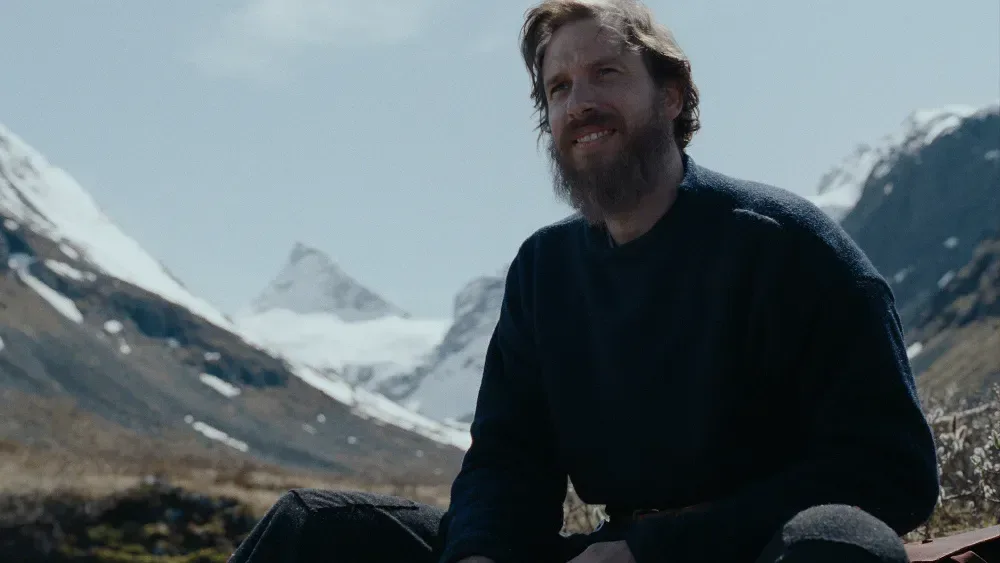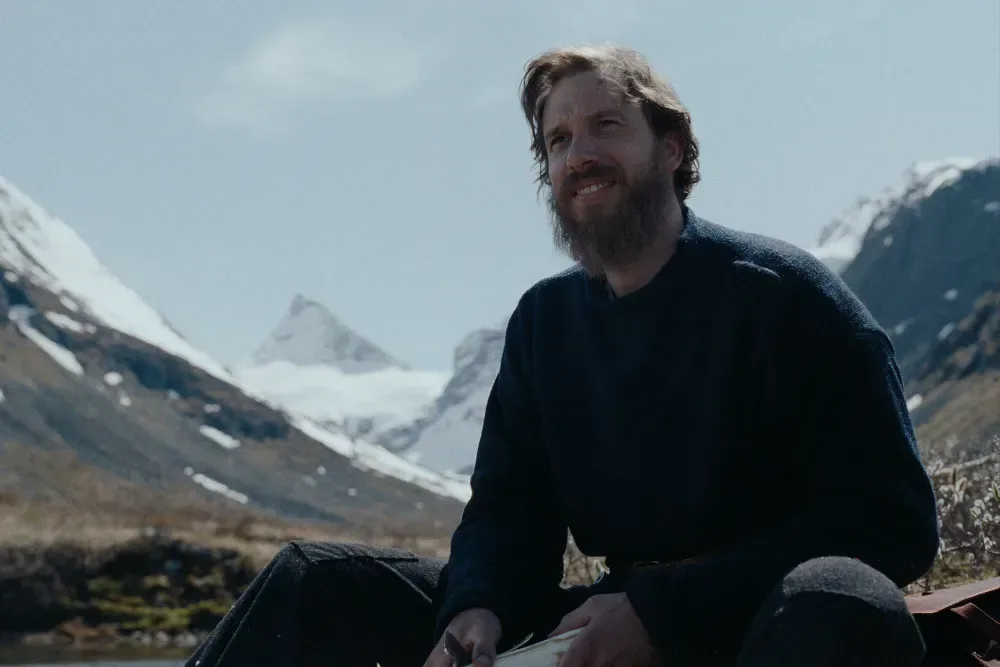
Hans Petter Moland’s Growth of the Soil is built around a deceptively direct premise: two strangers find each other in the harsh mountains of northern Norway and try to make a home where there is almost nothing. But the new film, Norway’s international Oscar submission, expands that simple beginning into a 155-minute rural epic about endurance, isolation, family and the unwelcome arrival of modern systems.
Adapted by Moland and Gard B. Eidsvold from Knut Hamsun’s 1917 two-volume novel, Growth of the Soil takes a deliberately classical approach to its material. It is not presented as a brisk survival story or a sentimental pastoral romance. Its attention is on accumulation: seasons turn, a makeshift shelter becomes a stone house, a household grows, and what initially appears to be open country becomes a place governed by boundaries, contracts and taxes.
That makes the landscape more than a backdrop. The wind, snow and difficult terrain establish the terms on which Isak and Inger must live long before any larger community reaches them. Oskar Dahlsbakken’s cinematography is described as rugged rather than prettified, while the sound design gives scratching and howling environmental sounds a prominence comparable to the score by Kaspar Kaae. The effect is an epic whose scale comes not only from running time or changing scenery, but from the persistent pressure of the physical world.
A homestead story with the weight of a changing society
Herbert Nordrum plays Isak, a practical, taciturn man looking to establish himself on still-unclaimed land. Asta Kamma August is Inger, who has a cleft palate and has felt estranged from the outside world. When the pair meet amid bitter snowfall, neither is furnished with a detailed history. Their connection is immediate and pragmatic: warmth, companionship and the chance to create a future together.
That absence of exposition matters. Rather than defining Isak and Inger through elaborate backstory, the film defines them through labor, proximity and the choices required to survive. They build from the ground upward, first in a temporary structure and then in a handmade stone home. Over time, the land becomes a working farm, and the couple raise two sons there.
In this context, “period epic” does not simply mean a film with historical clothing and expansive natural locations. The period setting shapes the central conflict. Isak and Inger begin in a comparatively self-contained life, but their region does not remain outside formal society. A surrounding community develops, and with it come legal and economic mechanisms that the illiterate couple are poorly equipped to navigate.
What the film’s title suggests: “growth” has a double meaning here. It is literal growth—the construction of a home, the establishment of a farm and the expansion of a family. It is also social growth, as a marginal settlement becomes subject to institutions. The film’s tension lies in the fact that development is not automatically liberation. New structures can bring order and recognition, but they can also bring obligations, judgments and consequences that Isak and Inger cannot control.
Nature is not scenery in Moland’s approach
The strongest stylistic thread is the centrality of the elements. Before the couple can benefit from the land, they must endure it. This is a meaningful distinction: farming stories often focus on harvest, property or prosperity, whereas the opening situation here is closer to exposure. The characters are not immediately masters of their environment. They are inhabitants trying to avoid being overwhelmed by it.
Sound is key to making that premise felt. Environmental audio can do narrative work beyond realism. Wind that rattles, wheezes or moans through otherwise quiet scenes places an ongoing reminder of vulnerability around the characters. It also prevents the Norwegian wilderness from becoming a postcard image. Even moments of calm retain an audible instability.
Dahlsbakken’s visual approach similarly seems geared toward austerity rather than cosmetic grandeur. That does not make the setting less transporting; it gives the environment dramatic force. The mountainscapes and seasonal shifts track the household’s progress, while the roughness of the landscape keeps that progress contingent. The farm is an achievement, not a natural entitlement.
Nordrum and August carry the interior drama
The film’s broad historical canvas depends on a close two-person center. Nordrum and August previously appeared together in the 2023 black comedy The Hypnosis, where Nordrum won Best Actor at the Karlovy Vary festival. Their reunion in Growth of the Soil shifts their pairing into much more severe territory, but their connection remains essential to the film’s momentum.
Nordrum, recognized internationally after The Worst Person in the World, gives Isak a stoic, utilitarian foundation. Isak’s drive is to make a claim on the land through work. August’s Inger has a more visibly articulated distance from the world around her: her cleft palate has contributed to her isolation, and her bond with Isak offers a form of acceptance. Their relationship is thus both emotional and material. Each becomes part of the other’s possibility of belonging.
The film’s later movement tests the limits of that enclosed partnership. When their third child is born, Inger commits a desperate act that breaks the couple’s insulated existence. The story then pivots from the challenge of making a life apart from society to the damage that follows when society enters that life. This is the film’s most serious turn, and viewers who prefer to know little beyond the premise may want to approach the latter part of the film with that tonal shift in mind.
Why the conflict has wider resonance: Isak and Inger are not merely confronting a single personal crisis. The crisis exposes how precarious their independence has always been. A way of life may feel protected while it is isolated, but isolation can also mean a lack of knowledge, support and power when outside authority eventually arrives.
A literary adaptation that keeps its patience
At 155 minutes, Growth of the Soil has room to observe gradual transformations rather than reduce its story to a chain of major plot points. Its form mirrors the source novel’s breadth: the characters change internally while their home, family and community visibly change around them. Linda Man’s editing has the task of maintaining that long-view structure, allowing time itself to be one of the story’s active forces.
The result is described as stately, old-fashioned and engrossing—terms that point to both its likely appeal and its demands. This is a film for audiences open to a measured pace and a substantial emotional build. Its drama is rooted in repetition, labor and environmental hardship before it is rooted in conventional spectacle.
Moland has worked across thrillers and literary adaptation, including In Order of Disappearance, its English-language remake Cold Pursuit, and the decades-spanning Out Stealing Horses. Growth of the Soil fits especially naturally alongside the latter: another adaptation with romantic heft and a narrative concerned with lives formed over time. Yet the newer film’s focus on homesteading, social expansion and a couple’s sealed-off world gives it its own distinctive shape.
Festival path and key details
The Norwegian-language production, also known by its original title Markens Grøde, is screening in the Toronto Film Festival’s Special Presentations program and in competition at the San Sebastian Film Festival. The cast also includes Gard B. Eidsvold, Anders Baasmo, Bjørn Sundquist and Sur Vatne Brean.
Its Oscar-submission status gives the film an additional international platform, though its proposition remains resolutely local: a story situated in northern Norway and deeply connected to its land, climate and changing social order. The very qualities that make it specific are what give the drama its scale. A household is built. A landscape is altered. The outside world arrives. And a relationship that seemed capable of surviving the elements must confront forces that weather alone cannot explain.
For more entertainment coverage, see our report on the new additions to Saturday Night Live’s Season 52 cast.