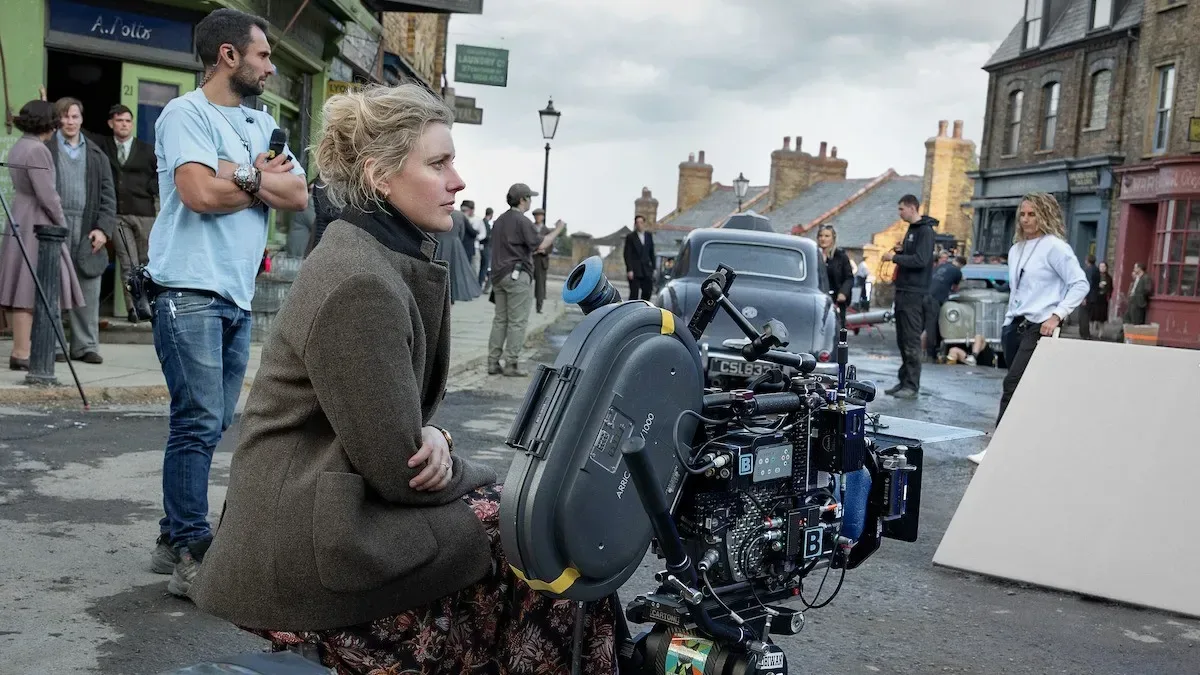
Greta Gerwig’s Narnia: The Magician’s Nephew is setting out to be an unusual doorway into C. S. Lewis’ fantasy world. Rather than revisit the best-known Narnia tale, The Lion, the Witch and the Wardrobe, the film starts with the series’ chronological origin story—and does so with a visual and musical vocabulary drawn from British rock, particularly the glam-era persona of David Bowie’s Ziggy Stardust.
The first revealed look at Aslan makes that creative intent unmistakable. The cosmic lion has a red-striped face and differently coloured eyes, a condition called heterochromia. Gerwig has identified Ziggy Stardust as the direct inspiration for the design. Meryl Streep voices Aslan, while the wider cast includes Carey Mulligan, Daniel Craig, Emma Mackey and Ciarán Hinds. Newcomers David McKenna and Beatrice Campbell play the young leads.
The film is due to open exclusively in theaters on February 12, following IMAX previews beginning February 10, before arriving on Netflix on April 2.
A creation story instead of a familiar wardrobe
The Magician’s Nephew occupies a distinctive place in the Narnia canon. It is the first story chronologically, but not the first one published. That distinction matters. Most screen adaptations have begun with The Lion, the Witch and the Wardrobe, the franchise’s most famous published entry, while The Magician’s Nephew has not previously been brought to the screen.
Choosing it as the opening move gives this adaptation a different starting point. This is not simply another trip back to an already established Narnia. The material concerns the world’s beginning, including Aslan singing it into existence. Gerwig’s stated creative connection is that Narnia is a world made through music, while rock ’n’ roll likewise suggests a world made out of music.
That framing explains why the production’s rock influence is more than a costume flourish. A rock opera, in this context, describes an artistic scale and sensibility: grand, emotionally heightened, theatrical, and structured around the expressive force of music. Gerwig has been clear that The Magician’s Nephew is not a musical. Audiences should not take the label to mean a conventional string of character-performed songs. Instead, it points to the film’s tonal and design inspiration, especially British rock of the 1960s and 1970s.
“I wanted a rock opera. I wanted it to be big and transporting,” Gerwig said of her approach.
The word “transporting” feels especially apt for Narnia. Lewis’ setting has always depended on the sensation of crossing out of an ordinary world into somewhere governed by stranger, larger rules. Gerwig’s version shifts the British setting to post-war 1950s Britain rather than the early-20th-century period many viewers may associate with earlier Narnia adaptations. That time shift, paired with later rock influences, signals a ground-up retelling rather than an attempt to recreate a previous screen template.
Related coverage includes Meryl Streep Will Voice Aslan in Greta Gerwig’s ‘Narnia’ Film.
Why Ziggy Stardust is an especially striking Aslan reference
Ziggy Stardust is David Bowie’s celebrated glam-rock character: a knowingly artificial, flamboyant and otherworldly stage persona. The visual shorthand is instantly legible even in a lion’s face—high-contrast striping, mismatched eyes and a look that resists naturalism. It offers a version of Aslan that is mythic without aiming for an ordinary wildlife-documentary realism.
That is a consequential choice because Aslan is not presented here as merely an animal who speaks. He is the powerful being associated with Narnia’s creation, and the story describes his song as bringing the world to life. A Bowie-influenced design connects that cosmic role to a performer’s visual language: colour, persona, stylisation and a suggestion that music itself can transform a space.
It also establishes an aesthetic boundary for viewers. This Aslan may be recognizable as a lion, but the revealed concept is deliberately not restrained to a natural lion’s appearance. The red striping and heterochromia invite the audience to meet him as an imaginative figure shaped by glam’s heightened visual grammar. Whether that becomes a full production-wide style or remains most pronounced in Aslan’s design is not yet known.
There is a sensible caution here. A first-look image can communicate a character concept, but it cannot show how that design will function across an entire feature—particularly in scenes involving movement, scale, dialogue and the contrast between Britain and a newly formed Narnia. The confirmed material supports the glam influence and the rock-opera aspiration; it does not yet define every element of the movie’s visual approach.
Meryl Streep’s role and the voice behind the image
Gerwig’s reasoning for casting Streep is just as revealing as the character design. She described looking for a performer capable of depth and pathos as well as joy and delight: someone with experience and wisdom, but also the fresh wonder of a child. Gerwig also specified that she wanted an actor older than 70, a requirement that narrowed an already formidable target.
“I wanted someone who was profound but not pretentious, who had gravitas but not morose self-seriousness,” Gerwig said.
That description gets at the balancing act facing an Aslan performance. Gravitas means a sense of weight, dignity and authority. But Gerwig’s comments also reject a purely solemn interpretation. In a creation story whose central idea is a world sung into being, joy and wonder are not decorative extras; they are part of the character’s dramatic function.
Streep’s casting therefore fits the film’s effort to reconcile enormous mythic stakes with a less rigidly dour mood. The voice must carry the authority of a cosmic creator while leaving room for delight. It is a meaningful departure in presentation, but it should not be mistaken for evidence of every narrative or theological choice the adaptation will make. Those details have not been outlined in the available information.
The practical stakes of a new Narnia entry point
For Netflix, launching this project with The Magician’s Nephew is a clear attempt to make the series approachable from its earliest internal point in the timeline. New viewers can begin with the formation of Narnia rather than arriving after its mythology has already been established. Long-time readers, meanwhile, have the prospect of seeing a major Lewis story reach the screen for the first time.
That does not make the choice risk-free. The Lion, the Witch and the Wardrobe remains the Narnia story with the greatest public recognition, and its screen versions have shaped expectations for the fantasy world. Beginning elsewhere asks audiences to accept an unfamiliar route in. The reward is that Gerwig can introduce Narnia through discovery and origin rather than through a retread of its most frequently adapted events.
The theatrical-first release plan adds another layer to that ambition. The February 10 IMAX previews and February 12 exclusive theater opening position the film as a large-format fantasy event before its April 2 Netflix debut. IMAX is a premium cinema format associated with oversized presentation, so the choice is compatible with Gerwig’s stated desire for something big and transporting. Still, the schedule confirms the release sequence, not the exact extent to which any particular scene has been created for IMAX.
What has been confirmed—and what remains open
- Confirmed: Gerwig is directing Narnia: The Magician’s Nephew.
- Confirmed: The film adapts Narnia’s chronological origin story, not The Lion, the Witch and the Wardrobe.
- Confirmed: Its British setting is post-war 1950s Britain.
- Confirmed: The project is not a musical, but draws inspiration from rock opera and British rock of the 1960s and 1970s.
- Confirmed: Aslan’s revealed design takes direct inspiration from Ziggy Stardust, including heterochromic eyes and red facial stripes.
- Confirmed: Meryl Streep voices Aslan; Mulligan, Craig, Mackey, Hinds, McKenna and Campbell are also in the cast.
- Not established by the current details: the film’s soundtrack, its full plot changes, the complete visual design of Narnia, or the roles played by each cast member beyond Streep’s Aslan.
For viewers tracking ambitious fantasy adaptations, the most important takeaway is not merely that another Narnia film is coming. It is that Gerwig is using the creation-story premise to justify a bold tonal reset: post-war Britain, glam-inflected cosmic imagery and a lion whose look is tied to one of rock’s most enduring alter egos. That combination will make this Narnia immediately distinct from the wardrobe-first approach audiences know.
It also arrives amid a busy period for large-scale genre storytelling on screen; readers following another high-profile DC television adaptation can see how the Lanterns trailer is framing its own mystery and time jump. For Narnia, though, the immediate image is simpler and stranger: a cosmic lion in red stripes, singing a new world into being.