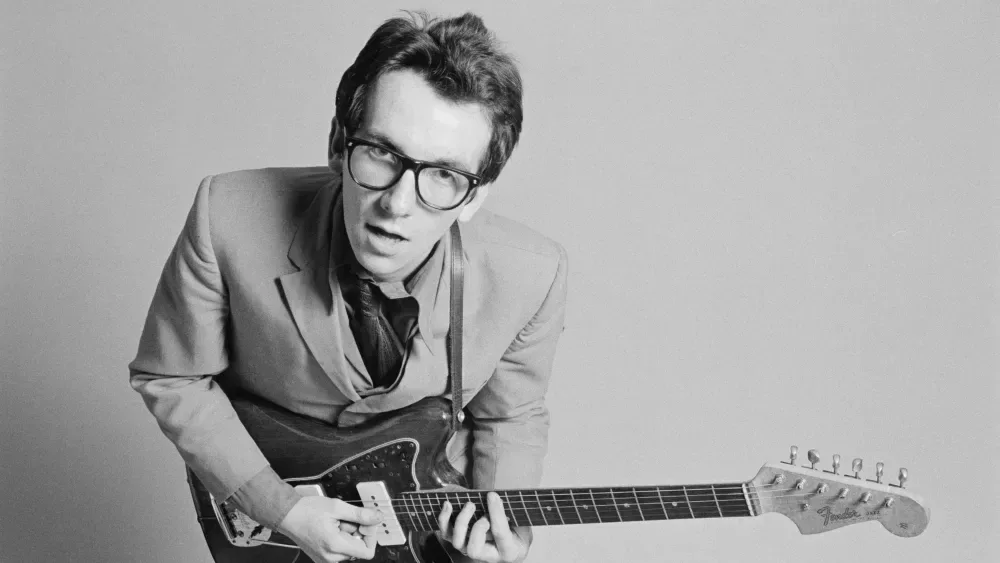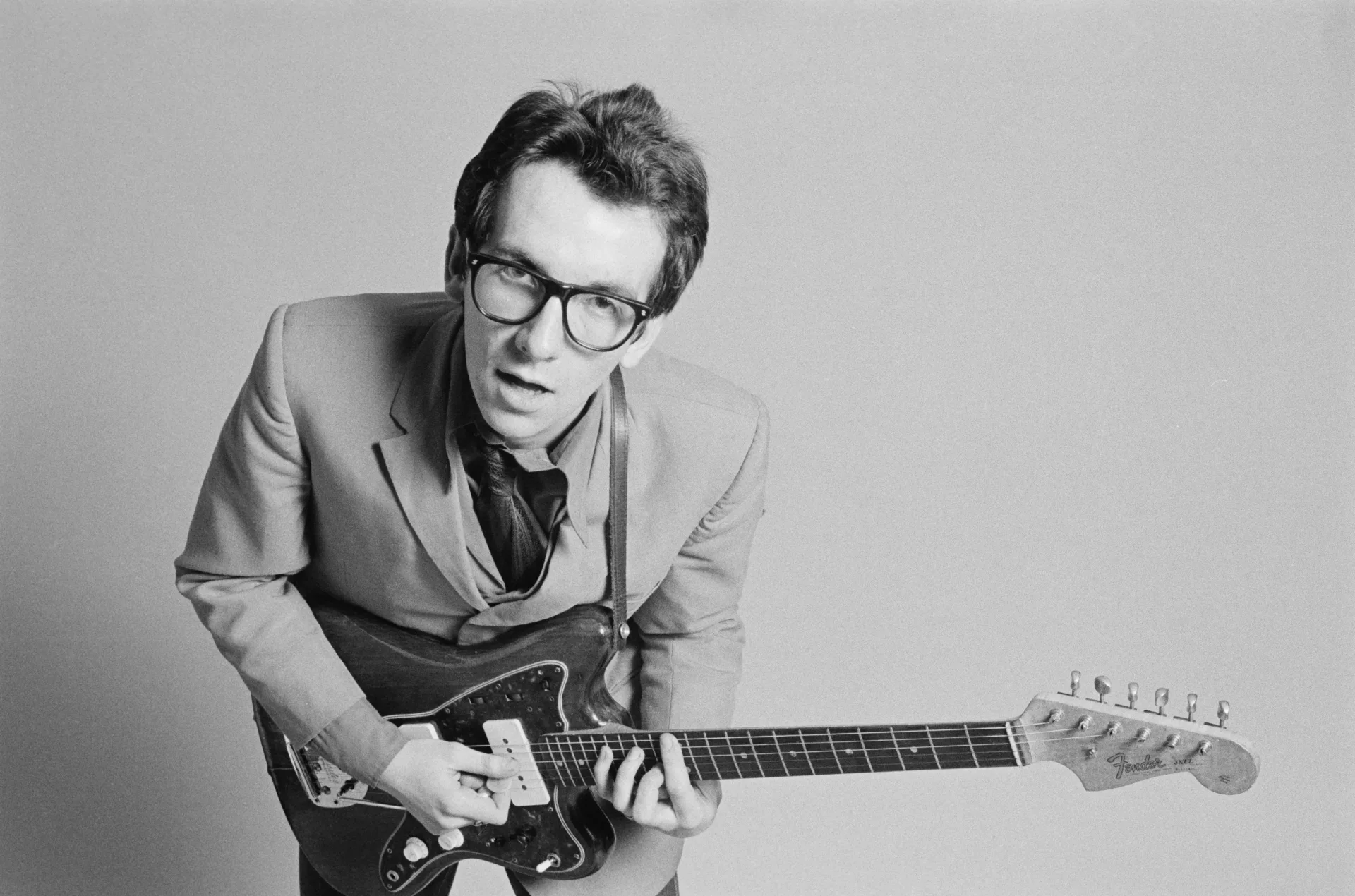
Elvis Costello’s My Aim Is True (49th Anniversary Edition) does not treat a classic debut as a museum piece. Its five CDs trace a far messier, more revealing route: bedroom recordings and early studio experiments; an alternate country-facing path; the rapid ignition of the Attractions onstage; and a 2007 reunion performance with Clover, the California musicians who played on the original album.
That makes the set less an expanded edition in the usual “here are some leftovers” sense than a document of artistic momentum. The core album, recorded in 1977, remains the center. But the new collection looks both backward to material written as early as 1974 and forward to the way its songs mutated almost immediately in concert. It is a useful corrective to the neat version of a debut album story, where an artist arrives fully formed, releases one decisive record, and proceeds in a straight line.
Costello’s account is considerably more interesting. He describes a songwriter trying out voices, shelving material that seemed too diffuse or too beholden to the music he loved, then discovering that he could write and sing with a sharper, more confrontational edge. The box’s unreleased recordings make that process audible rather than merely explanatory.
What the five discs contain
The first disc is a 2026 remaster of My Aim Is True, with “Watching the Detectives” included in its single version. A separate vinyl edition of the remastered album is also planned, while the larger physical box is CD-only. Costello said the full collection would require roughly 10 LPs if it were issued on vinyl, making it difficult to price accessibly.
The remaining discs divide the wider story into distinct chapters:
- The Blueprint: early demos and recordings, many previously unreleased, including “I Turn Around,” “Losing You,” “Leverman,” “Poison Moon,” “Wave a White Flag,” “Radio Soul,” and “I Can’t Turn It Off.”
- The Stranger in the House: outtakes, bedroom versions and studio material that foreground a country and country-rock possibility, including “Radio Sweetheart” and “Stranger in the House.”
- Becoming the Attractions: broadcasts, soundchecks, studio recordings and live performances that capture the group becoming progressively less cautious and more explosive.
- Covered in Clover: a previously unreleased November 8, 2007 show at San Francisco’s Great American Music Hall, where Costello and Clover performed the album material together.
For listeners deciding where to begin, the live Attractions disc may be the most direct illustration of why the box exists. The first album was made with Clover, while the Attractions became the band that took much of its material into a different gear. Costello says there was never a full Attractions remake of My Aim Is True, despite a rumor that circulated in 1977. The group did make an early studio attempt at a few songs, but he considers the tape poor and overly careful.
The learning happened onstage. In the collection’s sequence, early performances at London’s Nashville Rooms initially remain close to the record arrangements. Soon, the band’s approach changes: tempos rise, instrumental personalities emerge and the arrangements turn more aggressive. By the later American shows represented here, the songs are no longer simply being reproduced. They are being pushed, sometimes to deliberately unreasonable speeds.
Why the demos matter more than completists might expect
A demo is an early recording used to capture or present a song before its final form is established. That can mean a bedroom tape, a basic studio performance, or a recording made to show publishers, labels or potential collaborators what a songwriter has in hand. Demos can be revelatory, but they can also be redundant. The notable point here is that Costello’s early material appears to document roads not taken, rather than merely rough drafts of familiar tracks.
He identifies songs such as “Poison Moon” and “I Turn Around” as more introspective than the direction the debut eventually followed. The material on The Blueprint also shows him sorting through influences that do not neatly fit the later shorthand of “new wave.” He has pointed to early Bruce Springsteen and Van Morrison as important reference points, while emphasizing that he was still testing possibilities at 21 rather than setting out to imitate anyone.
That distinction changes how the archival material can be heard. It is not evidence that the better-known persona was fake; it shows that the persona was only one part of a larger songwriting range. Costello later became associated with acid delivery, tightly wound arrangements and the so-called “revenge and guilt” image, but he now describes some of that public posture as a protective barrier that let him concentrate on writing.
The songs themselves complicate that image. He has argued that “Alison” has often been misread, and that “Watching the Detectives” is about someone captivated by television’s imagined reality rather than a literal violent narrative. “(The Angels Wanna Wear My) Red Shoes,” in his view, also contains a deeper anxiety about time running out. The new material gives that sense of uncertainty more room to breathe.
There are also direct evolutionary links for devoted listeners. “Radio Soul” became “Radio Radio” with different lyrics. Costello connects “Leverman” in sentiment to “Accidents Will Happen,” though the music is entirely different, and identifies “I Can’t Turn It Off” as an earlier version that eventually became “Watch Your Step.” These connections show a working method: ideas were not always discarded when a recording remained unreleased; they could be rewritten until they found a more memorable musical hook.
The country path hiding beside the punk-era narrative
The Stranger in the House may be the collection’s most surprising chapter for listeners who know Costello mainly through the nervy attack of the Attractions. It gathers recordings that reveal how plausibly he might have developed as a country songwriter or country-rock writer.
“Radio Sweetheart” and “Stranger in the House” were not included on the original album, and Costello believes that was the right choice: their presence would have disrupted the album’s cohesion. Yet their inclusion here explains a current that was present from the beginning. He notes that the wild guitar sound on “Waiting for the End of the World” was actually pedal steel guitar played through a fuzz effect. In other words, one of the debut’s most abrasive textures came from an instrument strongly associated with country music.
That detail is a helpful reminder that genre markers can mislead. A pedal steel does not automatically make a song country, just as fast tempos do not automatically make a band punk. The sonic context and the role an instrument plays matter. Here, the steel was transformed into a distorted color within a rock arrangement, while songs such as “Stranger in the House” showed the more traditional direction Costello could have pursued.
The song later helped lead to a duet with George Jones on Jones’ 1979 album My Very Special Guests. Costello sees that invitation as the beginning of a decades-long chain of collaborations in country-related music. The archival material therefore does more than expand a track list: it identifies an early fork in the road that still shaped the catalog that followed.
‘Watching the Detectives’ as a hinge point
“Watching the Detectives” occupies an unusual position in the story. It was recorded after the original album sessions and was added to the U.S. edition, but Costello regards it as a separate piece rather than an intrinsic part of the album sequence. It was also a transitional recording in personnel terms: Clover did not play on it, and it was not fully the Attractions either. Steve Nieve played keyboards, while the rhythm section came from the musicians helping Costello conduct auditions for his live band.
Nieve’s appearance was his first recording session. The song emerged while Costello was tired of rehearsing the same few numbers for auditions and taught the musicians something new. Producer Nick Lowe heard the result and pressed for it to be recorded.
That accidental-seeming origin suits the record. Costello credits Lowe and the engineers with helping create its dramatic entrance and distinctive atmosphere. He notes that, beneath the large drum fills and ominous opening, the performance is comparatively restrained: the song sits in a groove while the vocal delivers the story. The balance matters. “Watching the Detectives” is not just fast or loud; its impact comes from tension, space and sound design.
In recording terms, a remaster is a new mastering pass made from existing recordings. Mastering is the final stage that prepares audio for release and determines elements such as tonal balance, level and consistency across an album. It does not turn an eight-track recording into something it never was. Costello’s view is that My Aim Is True should retain its raw, immediate character rather than be treated as an audiophile showcase with elaborate dynamics.
That approach is especially relevant because he says earlier CD transfers did not receive enough care. A remaster is not automatically better simply because it is newer, but it can address the limitations of a prior transfer and present an older recording with more attention to how its parts flow together. This edition’s value will therefore rest not only on the quantity of unheard material, but on whether the original album keeps the directness Costello associates with it.
A box set designed as listening choices, not homework
The project arrives with extensive liner notes informed in part by Costello’s 1976 appointments book, found by his son Matt. It documents meetings with publishers and record companies that showed no interest, along with the date he went to Stiff Records, the first session with Lowe, and even the appointment for the glasses that became central to his early public image.
Those glasses, obtained from Curry & Paxton and similar to the pair Michael Caine wore in The Ipcress File, were not initially part of a grand visual plan. Costello describes the name, pose and look as circumstantial elements that also offered cover to a shy performer. He compares the persona to Superman in reverse: an image that allowed him to disappear rather than stand out as himself.
That tension between constructed persona and private work is the thread connecting the whole set. The debut’s public face was concise and instantly recognizable. The archive behind it is less tidy: country songs withheld for strategic reasons, demos that waited decades, a band that changed the songs beyond recognition in months, and a later Clover performance that restores the original musical temperament.
Costello does not prescribe a single route through it. Some people may treat the collection as a book, following the five discs in sequence. Others may stream individual tracks, moving from a favorite song to a demo or a live version. That flexibility is sensible. An archival release succeeds when it creates a reason to hear known songs anew, not when it demands that every listener become an archivist.
For more music-world coverage beyond this archive deep dive, see our report on Lil Baby’s planned “Fresh Prince of Atlanta” birthday show.
My Aim Is True (49th Anniversary Edition) ultimately makes the debut feel less fixed. It contains the finished statement, certainly, but also the abandoned angles, altered lyrics, divergent arrangements and subsequent performances that show how a songwriter’s first major record continued to move long after its original release.