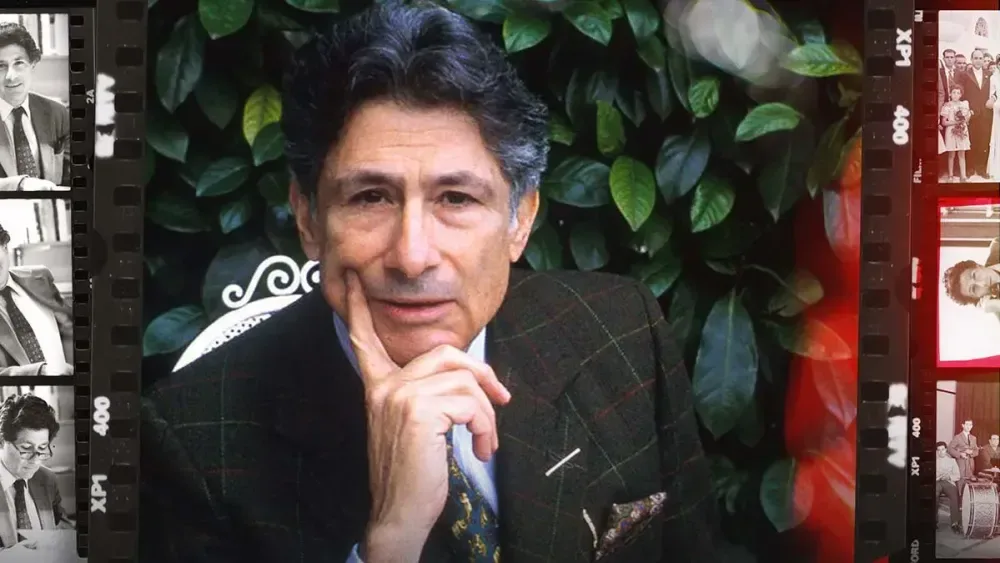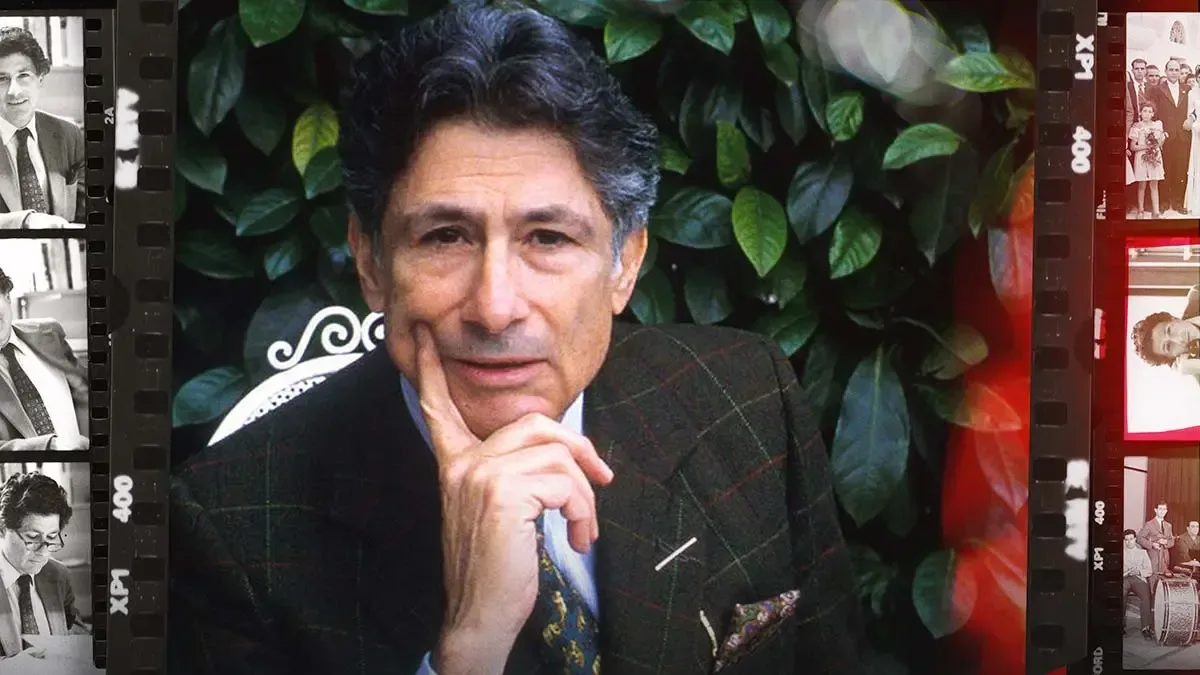
Edward Said: Between Worlds takes an unusually disciplined route through the life of one of the most consequential Palestinian literary and cultural critics. Director Maiken Baird does not build the film around a conventional stream of talking heads, expert testimony, dramatic re-enactments or an attempt to summarize every stage of a celebrated academic career. Instead, the 107-minute documentary is assembled entirely from archival footage of Said speaking for himself.
That formal decision is the film’s central argument as much as its method. Said was an intellectual whose work concerned representation, power, culture and who gets to describe whom. A portrait that gives him control of the voice track therefore has a particular force. The documentary’s material lets Said recount his life, articulate his political awakening and reflect on Palestine in his own words. It becomes both a biography and an oral history shaped by a person who experienced displacement, migration and the long political struggle to make Palestinian perspectives heard in Western public life.
The film screened in the TIFF Docs program at the Toronto Film Festival and in the Spotlight section of the New York Film Festival. Its dialogue is in English and Arabic, with music by Kareem Roustom. Baird directs; Jay Arthur Sterrenberg, Plummy Tucker and R.A. Fedde are credited as editors.
An archive-led biography, not a life-summary checklist
Biographical documentaries often approach their subject as a puzzle to be solved by others. Friends, relatives, scholars and critics provide the interpretation, while a narrator connects dates, achievements and turning points. Edward Said: Between Worlds deliberately removes that scaffolding. There are no competing commentators interrupting Said’s account and no outside authority placed above him to explain what his words should mean.
That absence has a practical effect on the viewer. The audience is asked to listen closely, including when the subject is considering uncertainty, shame, assimilation or political change rather than delivering a neat thesis. The editors’ challenge is substantial: footage gathered across decades has to create a coherent progression without reducing a complex life to a list of accomplishments. Here, editing is not just a matter of selecting highlights. It is the structure that allows different interviews and recorded appearances to form an evolving first-person narrative.
The choice also establishes clear limits. This is not presented as a comprehensive survey of every debate around Said, nor as a book-by-book explainer. Its narrower focus is what makes the approach effective. The film uses the archive to trace the relationship between Said’s individual life and the history of Palestine, rather than treating personal details as a detour from politics.
Jerusalem, exile and an education across borders
Born in Jerusalem in 1935, when the city was part of the British Mandate of Palestine, Said lived through defining events in Palestinian-Israeli history. The film begins with his childhood recollections in Palestine and his family’s exile to Egypt. His later life also took him to Lebanon and, for most of his career, the United States.
This geographic movement is not handled as mere résumé material. Said’s experience across Palestine, Egypt, Lebanon and the United States gives the documentary a route into questions of home, language and belonging. He describes studying and working at Harvard, Princeton and Columbia, succeeding within prestigious American institutions while also being marked as an outsider because of his heritage and name.
Assimilation, in this context, means adapting to the norms of a society or institution in which one is not automatically regarded as belonging. The film’s account does not suggest that professional achievement erases that tension. Rather, Said’s academic success and his awareness of being treated as “other” coexist. That friction matters because it helps explain why identity is not a fixed label in the documentary; it is something Said returns to, interrogates and eventually places at the center of his political thought.
For viewers encountering Said’s biography for the first time, this approach offers an important correction to the idea that intellectual work happens outside of lived experience. The film ties his scholarship to a life shaped by dislocation and movement between languages, countries and intellectual traditions. It does not claim that one experience automatically produces one political position. It shows the personal conditions through which Said arrived at his.
1967 and the political awakening at the film’s center
The documentary’s most important stretch concerns the aftermath of Israel’s 1967 victory in the Six-Day War against a coalition of Arab states. In Arabic, this defeat is referred to as Al-Naksa, meaning “the Setback.” Said describes it as the moment that compelled him to confront his Palestinian identity more directly and become politically engaged.
That account gives the film its emotional and intellectual hinge. In later interviews, Said reflects on the shame he associated with the defeat, the way it unsettled his understanding of Arab identity and the questions it raised about how Arab people were viewed in the West. The film does not flatten this process into an instant conversion. It presents radicalization here as a developing recognition: a move from distance and avoidance toward political identification and public commitment.
That distinction is useful. “Radicalization” can become a vague, sensational word when stripped of context. In the film’s framing, it refers to Said’s decision to rethink assumptions about his place in the world and to take Palestine seriously as the subject of his work and advocacy. The archive makes that shift legible through his own retrospective explanation, rather than through a narrator assigning motives to him.
He later went to Lebanon and relearned Arabic, a language he had largely set aside in favor of English. The documentary treats that return to language as connected to a larger return: not a simple recovery of an untouched past, but an active effort to engage more fully with an identity he had previously kept at a distance.
Why Orientalism remains the essential reference point
Said’s 1978 book Orientalism is inevitably central to any account of his career, but Baird’s film reportedly avoids turning itself into a lecture on the text. It introduces its broad premise while concentrating on Said’s state of mind as he wrote it. That restraint may make the documentary more inviting for people unfamiliar with the work, because it leaves space for the book to be encountered on its own terms.
Orientalism, as the film’s treatment indicates, concerns the ways Western cultural and intellectual traditions have represented Eastern cultures. The question is not simply whether a particular depiction is flattering or hostile. It is also about power: who has the authority to construct an image of another society, what assumptions that image carries, and how those assumptions can influence political and cultural understanding.
This is why Said’s life story and Palestine cannot be cleanly separated in the documentary. The work is linked to the problem of being spoken about by powerful institutions and audiences rather than being heard as a person or people with their own history and perspective. By allowing Said’s recorded voice to govern the film, Between Worlds makes its form echo that concern without needing to announce the point at every turn.
The film’s value is especially clear for a viewer who knows the title Orientalism but not the circumstances that shaped its author. It does not substitute for reading the book, and it does not pretend to. What it can do is make the intellectual stakes feel connected to a specific life: a Palestinian born in Jerusalem, displaced with his family, educated in elite American institutions and pushed by historical events to rethink the relationship between scholarship and politics.
A singular voice and the productive limits of that choice
The absence of other speakers is the documentary’s defining strength, but it also establishes a very particular kind of film. This is Said’s self-narration, curated through editorial choices, not an all-purpose account designed to stage every possible disagreement around his legacy. The benefit is intimacy and clarity. Said is not reduced to a subject discussed in the past tense by admirers or detractors; he remains an active presence, reasoning through the material.
For people beginning to learn about Palestinian history and the struggle for Palestinian self-representation, that first-person focus makes the documentary a potentially significant entry point. For audiences already familiar with Said, it offers the opportunity to see connections between the personal and political drawn directly from his speeches and interviews.
Its approach may also be relevant to viewers interested in documentaries that prioritize testimony over imposed narration. A separate recent documentary item, “Watch You Rise”, is another example of nonfiction film appearing in the pop-culture conversation, though Baird’s archival construction gives Between Worlds a distinctly voice-centered identity.
What the film asks audiences to reconsider
Edward Said: Between Worlds arrives amid renewed scrutiny of the cultural lenses through which Arab societies and Palestine have been interpreted in the West. Its timely quality does not rest on adding a new external voice to current events. Instead, it returns to the recorded words of an intellectual who spent decades articulating why representation itself is politically consequential.
The documentary’s achievement is therefore not the discovery of an unknown subject, nor the claim that one film can settle a vast historical and cultural debate. It is a carefully bounded work that lets Said explain the links among exile, education, language, Palestinian identity and intellectual responsibility. The use of archival material creates a portrait that is both personal and historical, attentive to how an individual life can be shaped by forces larger than any one person.
For an audience looking for a conventional cradle-to-grave biography, the film’s refusal to cover everything may initially seem spare. But the concentration is purposeful. By giving Said’s own voice precedence and keeping Palestine at the center of the narrative, Baird’s documentary frames him not merely as the author of a famous book or a prominent professor, but as a thinker whose life and arguments remained inseparable from the question of who is allowed to tell a people’s story.