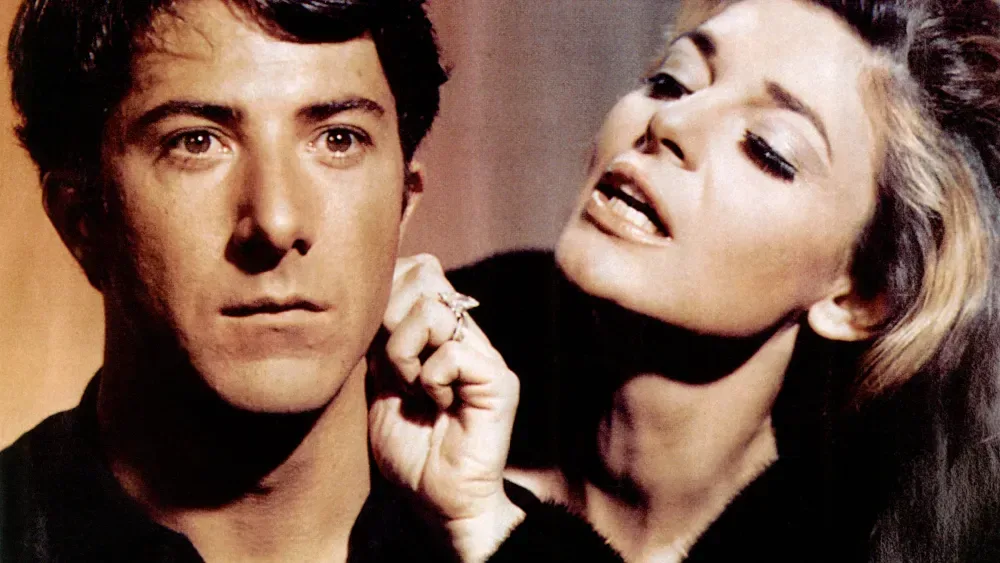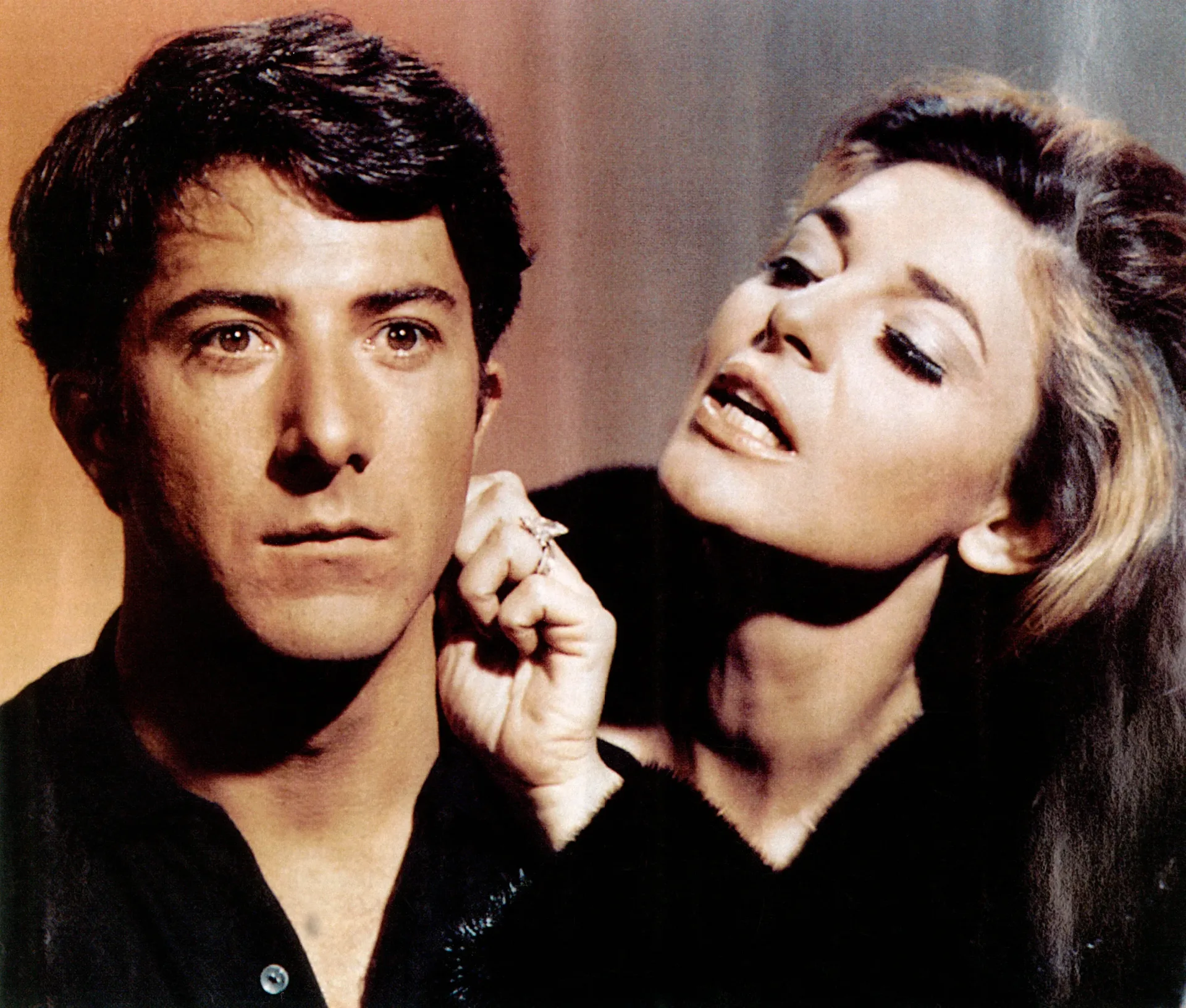
Dustin Hoffman’s role as Benjamin Braddock in The Graduate made him a star, but the actor now describes the production itself as a painful and deeply anxious period. In a recent personal essay, Hoffman calls making the 1967 comedy-drama a “terrible experience,” framing that judgment alongside the extraordinary fact that the film changed the course of his life.
The account is significant precisely because it resists the easy version of a landmark movie’s history. A celebrated finished film can obscure what it felt like to make it, particularly for an actor who felt he did not belong in its central role. Hoffman’s recollection is not a reassessment of the movie’s cultural standing so much as a first-person account of self-doubt, fear of dismissal and a physically consequential shoot.
Hoffman felt wrong for Benjamin Braddock from the start
Hoffman writes that his insecurity began before filming. When his agent told him that director Mike Nichols was interested in him, Hoffman did not initially want to audition. He had read Charles Webb’s novel, which Nichols was adapting, and believed the character on the page was plainly unlike him.
Hoffman describes Benjamin as an affluent, conventionally all-American young man: a track athlete, an excellent student and a debate-team leader. The surname Braddock, he felt, reinforced that image. Hoffman questioned why he would be cast as what he termed the “ultimate Wasp,” a reference to the social shorthand for White Anglo-Saxon Protestant. His concern was not merely ordinary audition nerves. He felt his own appearance made him fundamentally unsuitable for the part.
His agent persuaded him to screen-test, and he got the role. But winning the part did not settle the matter in Hoffman’s mind. He says the production intensified every insecurity he carried into it. Rather than feeling newly validated by being chosen for a starring role, he felt unworthy of it.
That distinction helps explain the weight of his memories. Imposter syndrome is a modern term often used for the belief that one’s achievements are undeserved and that eventual exposure as a fraud is inevitable. Hoffman does not present a clinical diagnosis, but his description closely maps onto that feeling: he feared Nichols was upset because the actor was failing, or because the director had realized he had cast the wrong person.
A changed atmosphere between rehearsal and filming
Hoffman recalls Nichols as warm in rehearsal but frequently sour once cameras were rolling. He says that shift was destabilizing. Nichols was, in Hoffman’s recollection, irritable with the wider production, yet Hoffman felt the treatment directed at him had an additional edge. He writes that a “certain sadism” seemed to emerge specifically in their dynamic.
Those are Hoffman’s personal observations, not an attempt here to establish the inner motives of a director who cannot respond. What they establish is how unsafe and precarious the set felt to its lead actor. Hoffman repeatedly believed he might be fired. Even while shooting sequences that would become among the movie’s best-known moments, he remembers thinking he had no idea what he was doing.
Related coverage includes Dustin Hoffman Recalls ‘Terrible’ Experience Making The Graduate.
That perspective complicates a familiar kind of movie mythology: the notion that a great performance necessarily emerges from a confident performer guided by a smooth, harmonious process. The supplied account offers no such neat narrative. It instead describes an actor delivering career-defining work while privately convinced he might lose the job.
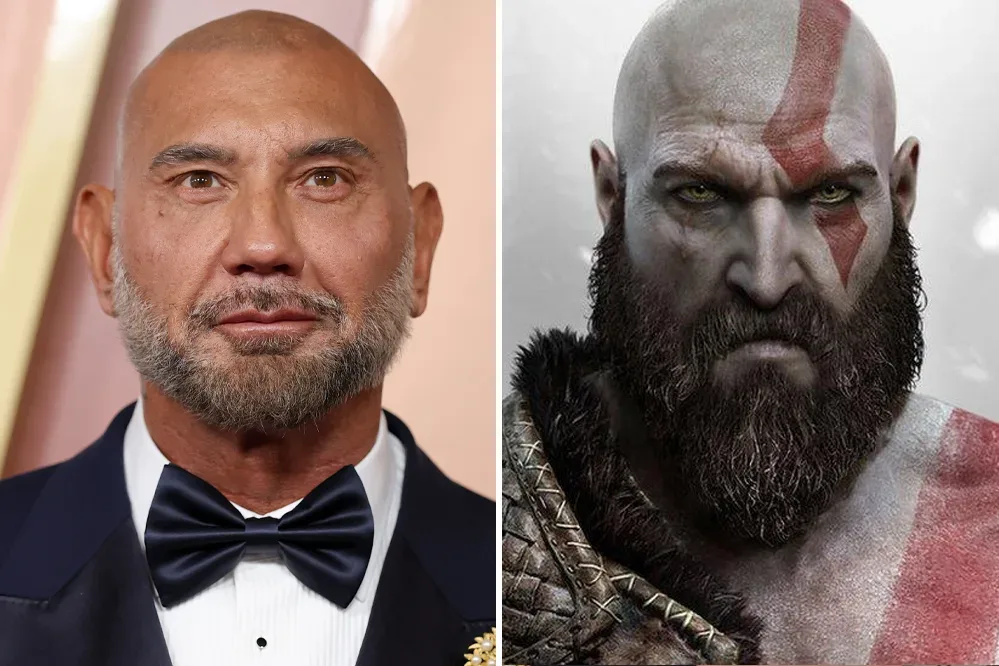
Physical transformation and emotional pressure are often discussed around screen acting, including in contemporary projects such as Dave Bautista’s reported preparation for Kratos. Hoffman’s memories underline a separate point: an actor’s vulnerability on a set can be shaped not just by the demands of a role, but by the working conditions in which a scene is being made.
The repeated slap scene and an ear injury
The most troubling detail in Hoffman’s essay concerns a scene with Katharine Ross, who played Elaine Robinson. In the sequence, Benjamin runs into Elaine’s room while soaked by rain and tells her that he had an affair with an older woman. Elaine soon realizes the woman is her mother.
Ross had to slap Hoffman in the scene. Hoffman says Nichols had them complete 27 takes and repeatedly instructed Ross to hit him harder. Ross reportedly worried that she would injure him; Hoffman told her he was all right, while asking that she avoid his ear. He recalls that some blows missed that target. By the end of the day, he was dizzy.
Hoffman further says that the slap itself did not end up in the finished film. That detail makes the episode particularly stark in his telling. Repetition is a normal part of filmmaking—coverage, performance variations, technical issues and editing choices can all require multiple takes—but repetition does not erase questions about physical risk. A scene involving deliberate contact needs safeguards appropriate to that contact, especially when performers are being asked to increase its force.
The next day, Hoffman filmed an underwater sequence while submerged in a scuba suit. After coming up for air following several takes, he saw blood coming from his ear. He writes that the slapping from the day before, combined with water pressure at the bottom of the pool, had punctured his eardrum.
An eardrum, or tympanic membrane, is the thin membrane separating the outer ear from the middle ear. Hoffman’s account connects the injury to two consecutive shooting demands: impacts near the ear followed by time underwater under pressure. The account does not provide medical records, treatment details or a broader production response, so those details should not be assumed. The central point is Hoffman’s own report that he sustained a punctured eardrum during the shoot.
The movie’s legacy and the experience behind it
The Graduate arrived in theaters on December 22, 1967. Its story follows Benjamin, a disillusioned college graduate caught between an affair with an older woman, played by Anne Bancroft, and a relationship with her daughter Elaine, played by Ross. The film earned seven Oscar nominations. The supplied account also identifies it as the best picture winner at the 40th Academy Awards.
Hoffman’s role as Benjamin became the breakthrough that made him widely known. That outcome coexists uneasily with his description of the work. He does not deny the importance of the film or its impact on his career; he explicitly acknowledges that it changed his life. His point is that transformative professional success did not make the process enjoyable, affirming or even tolerable in the moment.
It is tempting to treat a canonical performance as proof that every difficult choice on a set was worthwhile. Hoffman’s essay argues against that simplification. The performance can matter, the finished movie can endure, and the actor can still remember the process as one defined by insecurity and harm. Those truths do not cancel one another out.
What the account does—and does not—tell us
- It does tell us that Hoffman felt miscast, feared being fired and experienced Nichols’ on-set demeanor as hostile and at times sadistic.
- It does tell us that Hoffman says Ross slapped him across 27 takes, that he was dizzy afterward, and that he later punctured an eardrum while filming underwater.
- It does not tell us the complete production history, the perspective of every person present, or what medical care followed the reported injury.
- It does not reduce the film’s legacy to a single behind-the-scenes story. It adds a candid account of the human cost Hoffman associates with making it.
For audiences revisiting The Graduate, the new recollection changes the context around Benjamin Braddock without changing the film itself. Hoffman’s account asks viewers to hold two ideas together: this was the movie that made him a star, and, by his own description, the experience of making it was terrible.