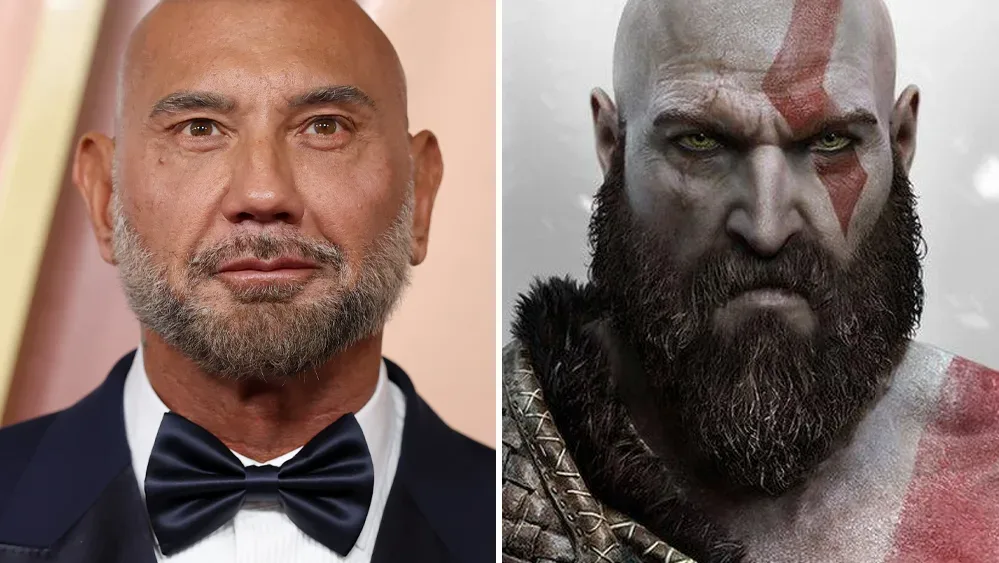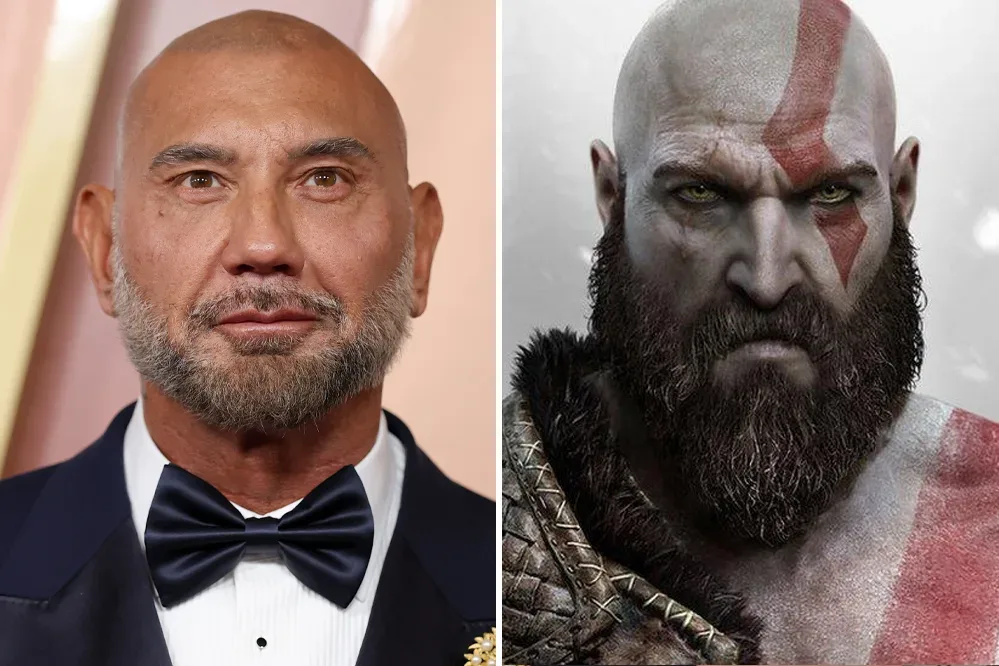
Dave Bautista’s preparation to play Kratos is becoming visible well before Prime Video’s God of War series reaches viewers. The actor shared an Instagram Story indicating that he had gained 20 pounds for the role, alongside a “250” marker that appears to refer to his current weight. He wore a God of War shirt in the video—a fittingly direct bit of wardrobe for a man preparing to carry the Blades of Chaos.
The update follows an earlier look at Bautista’s training. Two months ago, he said he had returned to weight training, while stressing that he still had work to do to reach the physical condition he wanted for Kratos. The newer post makes the scale of that preparation more concrete: the change is not merely a general fitness routine, but body-mass gain specifically connected to the series.
That matters because Kratos is a role whose silhouette is inseparable from the character. The games’ protagonist is not only muscular; he is built and framed as an imposing warrior with a history of impossible conflict behind him. A live-action version will depend on costume, makeup, staging and visual effects as well as performance, but Bautista’s training signals that the production is seeking a physically formidable starting point rather than leaving every aspect of Kratos’ appearance to screen trickery.
A new lead after production had already begun
Bautista joined the project in August, taking over the role from Ryan Hurst. Hurst had been cast as Kratos but suffered an on-set bicep injury that required surgery. The injury would have pushed production into 2027, leading to the recasting.
Filming began in Vancouver in February. Because material featuring Hurst had already been shot, the production will need to reshoot those scenes with Bautista. That makes the change more consequential than a casting adjustment made before cameras roll: scenes have to be recreated so that the lead performance is consistent throughout the finished series.
Reshoots are simply scenes filmed again after earlier footage can no longer be used or needs to be changed. In this case, the stated reason is straightforward—the actor playing Kratos has changed. The practical challenge is preserving continuity, meaning the on-screen consistency of performances, wardrobe, locations and story details from one scene to another. The cast and crew can return to material, but the series ultimately needs to feel as though Kratos has been played by one performer from its opening moments onward.
Bautista’s added weight is therefore part of a larger production reset. He is not stepping into a role that is still entirely theoretical; he is joining an active shoot, preparing for a character whose scenes will be revisited and whose physical presence is central to every father-and-son interaction, confrontation and mythic fight.
The story being adapted
The series will draw from the two most recent God of War games, shifting the focus to Kratos’ Norse-era story. Rather than centering solely on the Spartan warrior’s past, this part of the saga follows him as he raises his 10-year-old son, Atreus. Callum Vinson is set to play Atreus.
Related coverage includes Dave Bautista Says He Added 20 Pounds for Prime Video’s God of War.
Kratos and Atreus set out to spread the ashes of Faye, their wife and mother. Their journey places them against gods from the Norse pantheon, but the emotional premise is deliberately more intimate than the scale of its mythology might imply. Kratos is trying to teach Atreus how to become a better god, while Atreus is trying to teach his father how to become a better human.
That dual lesson is a useful guide to what Bautista’s Kratos will need to communicate. The character must read as powerful enough to face gods, yet the adaptation’s foundation is not muscle alone. Kratos is also a father managing grief, responsibility and a relationship with a child who is learning what he is. The physical transformation may be the most immediately shareable element of Bautista’s preparation, but the story calls for a performance that can move between aggression, restraint and vulnerability.
For players familiar with the games, this is also why the casting of Atreus matters alongside the casting of Kratos. The two characters are the core of the announced premise. Their relationship gives the journey its direction, while the Norse gods supply the larger threats around it.
Why the two-season order changes the picture
Prime Video has ordered two seasons of God of War, with both scheduled to shoot back-to-back. A back-to-back shoot means the seasons are planned to be filmed in one extended production period rather than separating them with the usual long gap. That approach can help retain visual and performance continuity across an ongoing story, especially when the same principal characters are meant to remain at the center of both seasons.
It also raises the importance of establishing the live-action versions of Kratos and Atreus from the outset. Bautista is preparing not just for a single introductory chapter, but for a production that has been ordered as a two-season undertaking. The immediate reshoots add one layer of work; the sustained physical and dramatic demands of shooting consecutive seasons add another.
Nothing in the available details establishes how the games’ events will be divided between the seasons, how closely individual moments will be recreated, or when the show will debut. The confirmed outline is more focused: Kratos and Atreus’ Norse-era journey is the basis, Bautista now plays Kratos, Vinson plays Atreus, and the two seasons are intended to be made back-to-back.
Bautista brings action experience, but Kratos is a distinct assignment
Bautista has appeared in projects including My Spy, Knock at the Cabin and The Wrecking Crew. His upcoming work includes Road House 2 and the Highlander reboot. Those credits explain why a physically demanding genre role is familiar territory, but Kratos comes with a particularly specific set of expectations because the character already has a well-defined game identity and an emotionally focused modern storyline.
The latest training update does not answer every creative question surrounding the adaptation, nor is it supposed to. It does offer a concrete indication of Bautista’s approach: he is changing his body for the role and has put a number on that effort. For a character whose physical authority is part of the drama, that is meaningful preparation rather than empty flexing.
There is a practical gaming-side reminder here, too. While the show’s production moves through its recasting and reshoots, players revisiting Kratos’ adventures may be giving their own hardware a workout. For a useful refresher on keeping a console ready for long sessions, see this practical PS5 cleaning, vent and placement guide.
For now, the clearest update is a simple one: Bautista says he has put on 20 pounds for God of War. With filming already underway, earlier scenes needing to be redone and two seasons planned, the transformation is part of a much bigger effort to put a new Kratos on screen.