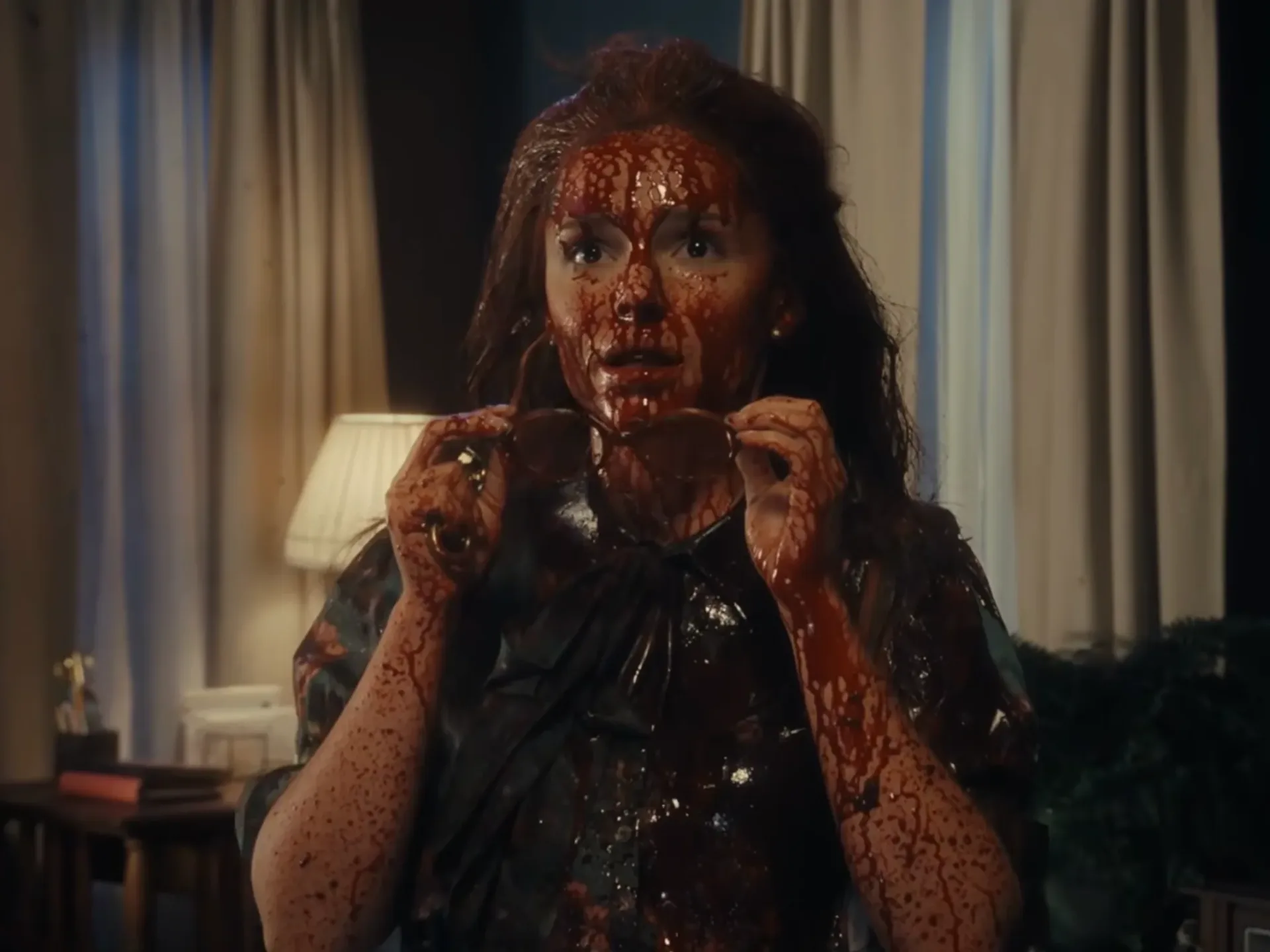
Druski used his Saturday Night Live hosting turn to take on an intensely uncomfortable kind of comedy: a trailer parody built around people watching each other, challenging each other’s sincerity and making an already strange domestic scene even stranger. The result, titled “Druski Sees Everything,” brings Druski into the home of Elizabeth Holmes and Billy Evans, played by Jane Wickline and Ben Marshall, and turns a series of fraught interactions into a steadily more ridiculous sketch.
The piece riffs on You Can See Everything, with the premise placing Nathan Fielder in the orbit of Evans and Holmes. Rather than attempting a broad recap, the sketch zeroes in on a few highly specific moments: a bowl of eggs being taken away because the beating is apparently not forceful enough, a sustained stare-down, and the unnerving language of trying to seem “ordinary.” Those small, rigid beats give the parody its structure. Druski’s character does not merely observe the unsettling atmosphere; he reacts to it with an escalating lack of patience.
That is an effective fit for a trailer format. A parody trailer does not need to explain every plot point or sustain a complete narrative. It needs recognizable rhythms, a clean comic premise and a succession of images that raise the stakes. “Druski Sees Everything” follows that playbook by taking one awkward household encounter and repeatedly pushing it beyond its original social boundaries.
An outsider enters the room
The sketch begins with Wickline’s Holmes welcoming Druski and asking whether he can help people see her as an ordinary person. Wickline plays the line with a deep voice, while Druski replies that what he has seen so far makes that goal unlikely. His response is blunt: the situation has a “weird” and “freaky” vibe. That directness is the comic engine of the scene.
In a docu-style setup, discomfort can often be left hanging for viewers to interpret. The parody changes the equation by introducing someone who says the quiet part out loud. Druski functions as the audience’s increasingly incredulous surrogate. He identifies that the energy in the home is unusual, then makes the situation more chaotic rather than escaping it.
The egg-bowl moment is a clear example. Evans has taken the bowl from Holmes while she is beating eggs, dissatisfied with the effort. Druski initially comments on the dynamic, but then repeats it himself by snatching the bowl and taking over. The gag is not simply that a bowl changes hands. It is that the visitor immediately absorbs the household’s bizarre rules and amplifies them. The sketch turns observation into participation.
Why the egg sequence matters
Physical business—comedy built around actions, props and timing rather than dialogue alone—is central here. The bowl gives the performers a simple object that can establish control, irritation and imitation in seconds. The act of taking it is recognizable and easy to read, but its motivation is absurdly disproportionate to the task. Beating eggs is mundane. Treating it as a serious test of competence is what makes the action feel loaded.
Druski’s decision to duplicate the behavior tells the audience where the sketch is going: no one will restore normality. The guest is not a calming presence, and the parody will not resolve the tension through explanation. It is instead committed to seeing how far an awkward power dynamic can be bent before it becomes outright surreal.
Related coverage includes Druski Takes on Elizabeth Holmes in ‘SNL’ Trailer Parody.
The stare-down becomes the central mechanic
The sketch’s most prominent recurring bit is the stare-down between Druski and Wickline’s Holmes. Druski asks whether she is being real; Holmes replies that she is always being real. That exchange takes the uncomfortable emphasis on authenticity and turns it into a challenge with no useful answer.
Authenticity is a particularly useful target for satire because it is difficult to prove in the moment. A character can claim sincerity, but repetition does not automatically make the claim convincing. The more firmly Holmes insists that she is real, the more the sketch can treat the phrase as an odd performance in itself. Druski’s questioning reframes a solemn-sounding assurance as a conversational dead end.
He then interprets the extended gaze as flirtation, asking whether she is trying to sleep with him. After Holmes gives a slight nod, he announces that he wants to try something and physically closes her eyes with his fingers. It is an abrupt release of tension through intrusion: instead of engaging with the stare as meaningful, he simply ends it. The joke works through disruption, not insight. The scene has built a visual contest, and Druski rejects the premise of the contest altogether.
This is where the trailer’s construction becomes especially clear. Each beat preserves the same emotional temperature—prolonged eye contact, strange certainty, social discomfort—but changes the response. The repetition creates recognition, while the new reaction supplies the surprise.
The double-Holmes escalation
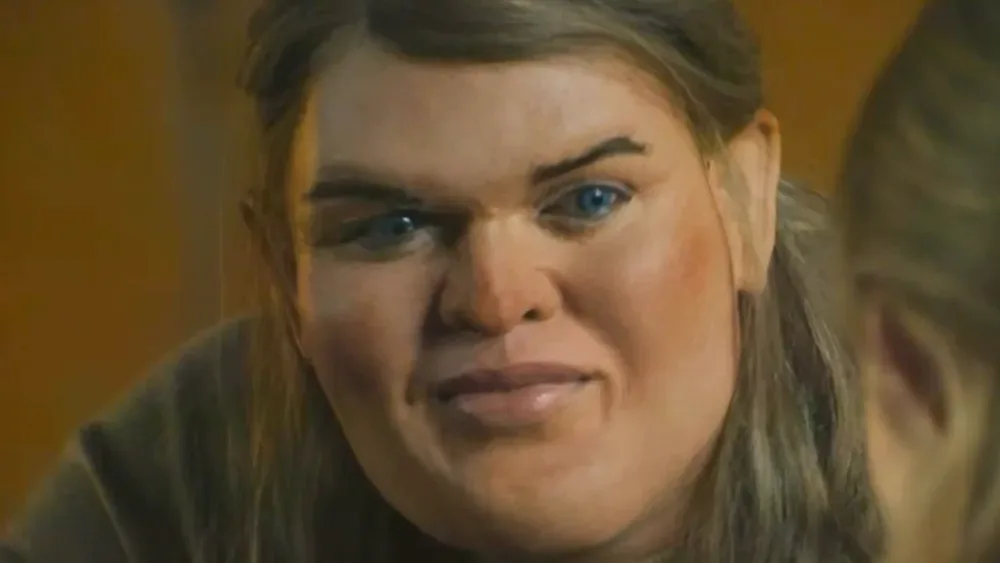
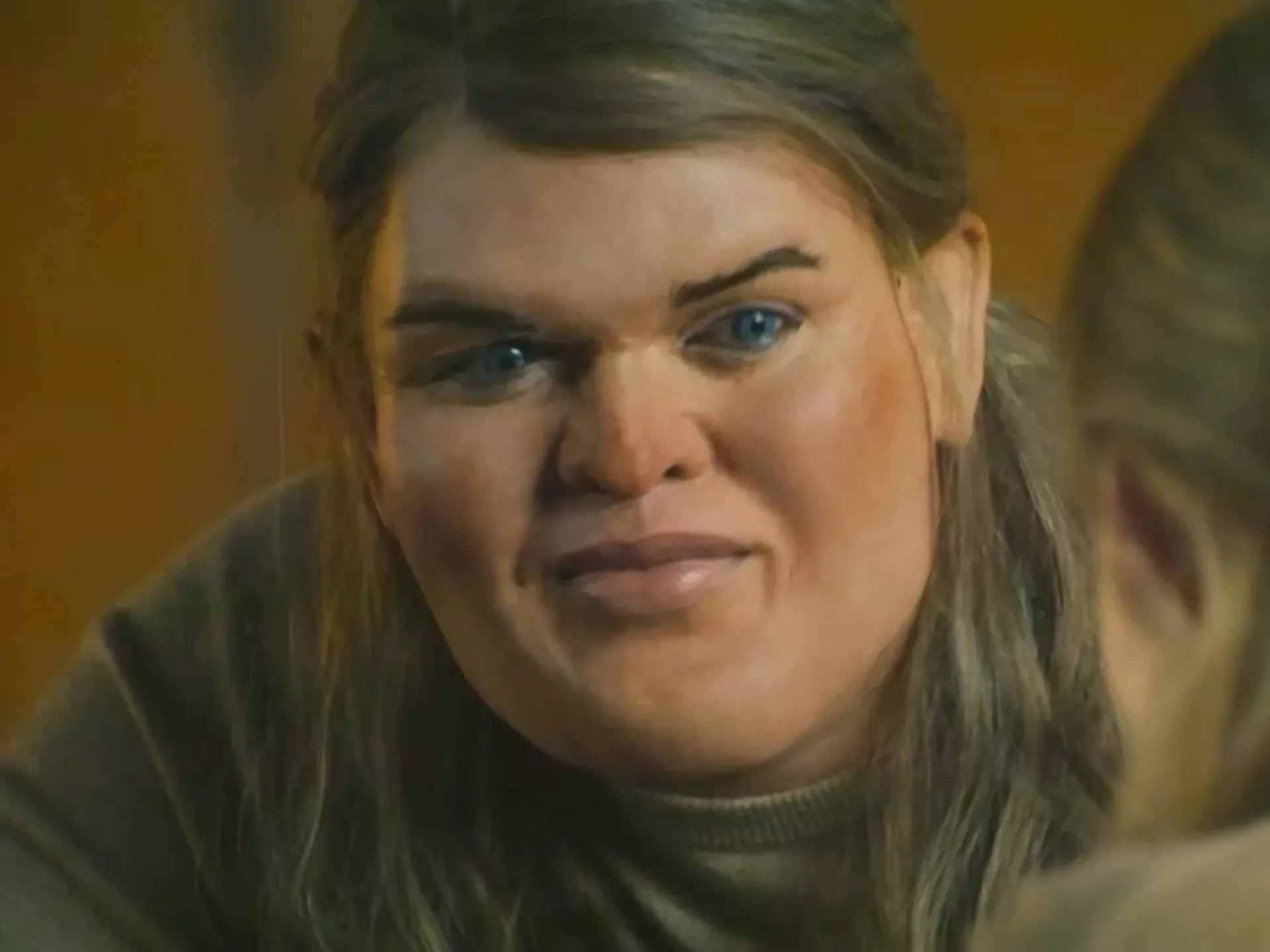
The final escalation places Druski in whiteface as Holmes opposite Wickline’s Holmes. The earlier stare-down returns, but it is no longer between a visitor and the person he finds unsettling. It is now a confrontation between two versions of the same figure, each insisting, “I’m always being real.”
Druski has previously used whiteface in viral sketches, including characters described as a rowdy redneck and Erika Kirk. In this SNL segment, the device is used to make the trailer premise visibly collapse into duplication. The audience is not asked to accept a realistic impersonation; the purpose is plainly heightened absurdity. Druski’s Holmes and Wickline’s Holmes compete over who is the genuine one, a contradiction that lands because both are presenting the exact same defense.
The exchange culminates with Druski’s Holmes declaring, “I could do this all day.” That line makes the loop explicit. The sketch understands that the stare-down can continue indefinitely, so it turns the possibility of endless repetition into the punchline. A scene that began with one guest refusing to play along ends with two Holmes figures locked in a dispute that cannot produce a winner.
There is also a larger parody principle at work. Doubling a character is a quick way to expose the artificiality of a premise. Once two performers are delivering the same declaration of sincerity, sincerity becomes less a quality than a catchphrase. The trailer takes its own central question—who is being real?—and makes it impossible to treat seriously.
A trailer that spoofs trailer language, too
“Druski Sees Everything” does not only borrow scenarios. It also leans into the packaging of prestige-documentary promotion. A faux review pull quote appears in the trailer, credited to Variety: “Somehow, this makes Nathan Fielder seem like the reasonable choice.” The line has a practical comic role. It gives the chaos an outside stamp of approval while suggesting that the parody has made an already unusual situation even harder to process.
Review pull quotes are normally used to condense praise into a marketable sentence. Here, the format is repurposed as a final jab. Rather than selling the viewer on a polished experience, it presents “reasonable” as the most surprising possible assessment. It is a small detail, but it completes the trailer illusion: the parody has characters, dramatic beats, a title and even its own approving blurb.
That focus on form is important. A sketch can parody a recognizable public figure or a particular scene, but it gets more mileage when it also parodies the way a project is framed and sold. The mock-trailer structure lets the segment jump quickly among its biggest images without needing to establish the full logic of the fictional production.
What Druski’s hosting slot brings to the sketch
The episode framed Druski as the first digital content creator to host Saturday Night Live without the kind of prior crossover path associated with hosts such as Issa Rae and Quinta Brunson. His appearance came after a cold open involving Texas Senator-elect James Talarico and Donald Trump, as well as a monologue interrupted by his future movie co-star Emma Stone.
Within that busy episode, “Druski Sees Everything” gives its host a particularly useful showcase. The material is not dependent on a detailed impersonation from Druski at the outset. He can play the skeptical interloper first, relying on delivery and reaction, before taking on the more visibly transformed Holmes role later. That progression allows the sketch to show two complementary modes: Druski the straight-talking disruptor and Druski the exaggerated duplicate.
It also gives Wickline a defined comic assignment. Her Holmes is not just a reference point for the host’s jokes; she anchors the repeated phrases and fixed gaze that the rest of the sketch keeps upsetting. Marshall’s Evans, meanwhile, helps establish the peculiar domestic environment with the egg-bowl beat. The three-person setup makes the trailer feel populated rather than like a one-note monologue.
Why the gag has a clear replay value
The segment is built from concise, visual moments that are easy to revisit individually: the bowl being taken, the staredown interrupted by Druski closing Holmes’s eyes, and the two-Holmes confrontation. Those are strong clip-friendly units because each has an immediate premise and a distinct payoff. They do not require extensive background knowledge to understand the basic joke, even though familiarity with the material being parodied adds another layer.
For viewers catching comedy sketches through streaming clips rather than a full broadcast, that economy matters. It is also worth considering the practical tradeoffs of mobile or at-home viewing, including data and storage, in this guide to streaming versus downloads.
Most importantly, “Druski Sees Everything” finds a simple way to convert discomfort into an escalating comic pattern. It begins by asking whether someone can be seen as ordinary. It ends by putting two competing versions of that person in the same frame, each insisting on being real. The parody’s answer is not subtle, and it is not meant to be: the situation is far too strange for ordinary to survive.