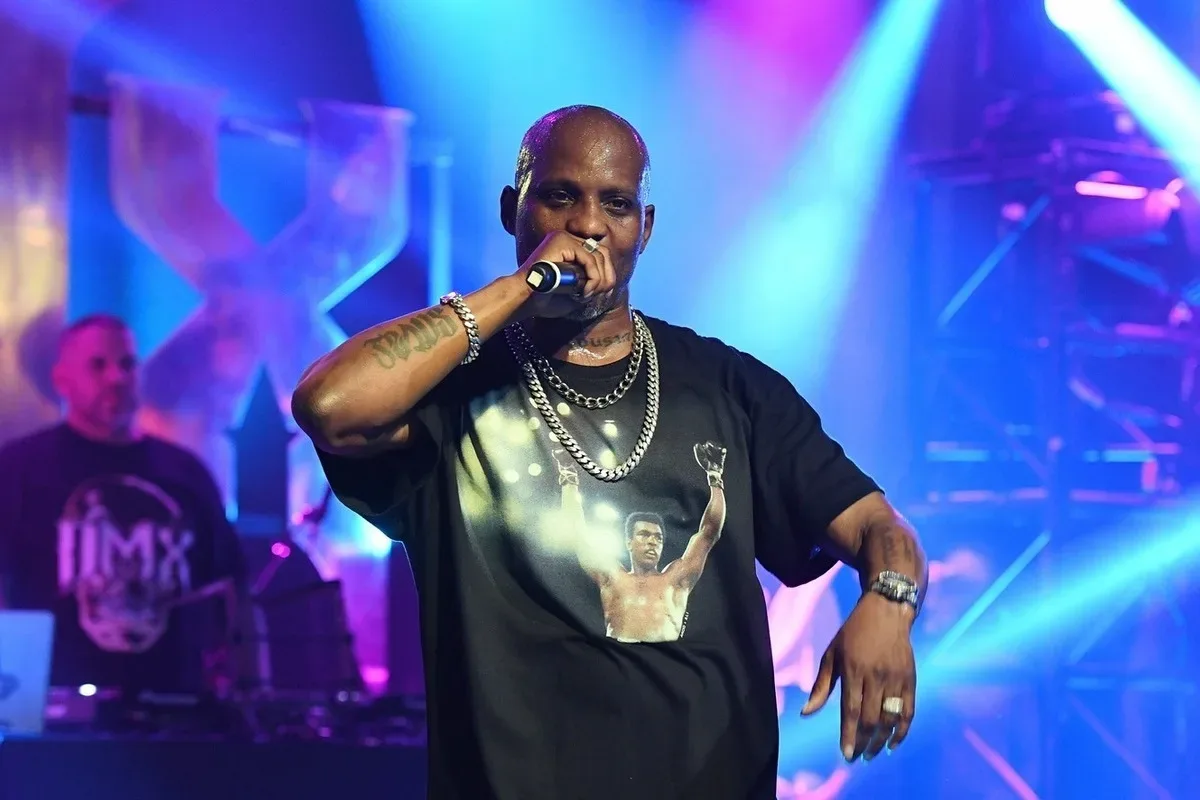
DMX’s voice was never designed to sit quietly in the background. Whether he was recording a hard-edged rap record, speaking directly to a crowd or offering a prayer, Earl Simmons delivered his words with a force that made private conviction feel public. The Gospel According to DMX, a new 208-page hardcover collection curated by his estate, shifts attention toward the spiritual writings he left behind: prayers, sermons, reflections and handwritten fragments preserved on everyday materials including hotel stationery, receipts and napkins.
The volume is a posthumous archive project, rather than a newly authored autobiography or a conventional lyrics book. Its material was created by DMX during his lifetime, then assembled by his daughter Sasha Simmons and fiancée Desiree Lindstrom, who serve as co-administrators of his estate. The book also includes selected lyrics and reproductions of handwritten pages that had not previously been made public.
For readers familiar with DMX chiefly through the snarling urgency of records such as It’s Dark and Hell Is Hot, the premise may initially seem like a different menu item entirely. But faith was not an add-on to his artistic identity. It was an element of the way he spoke about his life, including its most difficult passages. The collection’s title frames those writings as central material, not bonus-track ephemera.
An archive built from personal pages
The book draws from unusually informal physical documents. Hotel stationery, receipts and napkins are not the polished tools normally associated with a finished manuscript; they are surfaces used when a thought needs a place to land before it disappears. Their inclusion gives the project a particular archival character. Rather than presenting the writing only as transcribed text, the estate has retained the archival pages in their original form and included handwritten reproductions.
That distinction matters. A transcription makes words easy to read, search and quote. A page image also preserves the visible circumstances of the writing: handwriting, spacing, crossing-out, the limits of the paper and the sense that these were working reflections rather than material prepared for publication. The collection includes both prayers and sermons, terms that describe related but distinct forms of religious writing. A prayer is generally directed to God; a sermon is generally constructed to communicate spiritual teaching or exhortation to an audience. Together, they suggest a wider set of expressions than a single private journal.
The hardcover presentation is deliberately formal. It uses a faux-leather cover, gold-like page edges and a ribbon bookmark. Those details place it closer to a keepsake edition than a disposable paperback, although the essential point is the material within: DMX’s own retained writings, presented alongside selected lyrics and an appendix of passages from the Book of Psalms.
The Psalms appendix provides an explicit textual connection to a biblical book long associated with prayer, praise, grief, fear, confession and endurance. It does not mean every piece in the archive is a direct adaptation of scripture. Rather, it gives readers a clear reference point for part of the religious tradition that informed his writing.
Rakim and Pastor Apostle Barbara King contribute forewords
The book’s front matter brings two different relationships to DMX’s legacy into the same project. Rakim contributes a foreword, linking the collection to hip-hop’s creative lineage. Pastor Apostle Barbara King, identified as DMX’s spiritual adviser, also writes a foreword, bringing a perspective rooted in the faith dimension foregrounded by the book.
Related coverage includes DMX’s Archive Opens in The Gospel According to DMX.
A foreword is not the same thing as an author’s introduction. It is typically written by someone other than the book’s principal author or compiler and offers readers a frame for approaching the work. In this case, Rakim and King’s contributions can help establish why the archive should be understood through more than one lens: as part of a major rapper’s personal record and as an expression of religious life.
That dual frame fits a performer whose career was full of contrasts that were never especially tidy. DMX could make his music sound confrontational, wounded, devoted and searching—sometimes within the same body of work. A collection focused on prayers and sermons does not erase the rest of that story. It offers a different route through it, using pages he personally wrote instead of a retrospective narrator trying to turn a complex life into a clean, uncomplicated lesson.
“I’m gonna look back on my life just before I go and thank God for every moment,” DMX said in an interview for TV One’s Uncensored.
That statement is a useful piece of context for the collection, though it should not be treated as a summary of every page in it. It shows that he publicly considered faith and accountability when discussing his life. The book’s value lies in letting readers encounter a more direct record of that inward-facing writing.
Where the book sits in DMX’s published legacy
DMX had already told parts of his story in other formats. His autobiography was published in 2003, and BET later followed him for the 2006 reality series DMX: Soul of a Man. Those projects put his experiences into a public narrative while he was alive. The Gospel According to DMX differs because it is estate-curated and posthumous, built around surviving writings instead of a new on-camera or first-person account shaped for a contemporary release.
That also requires a careful way of reading it. Estate curation means living representatives select, organize and present material from an artist’s archive. It can make documents accessible that would otherwise remain private or scattered. At the same time, the order and accompanying context inevitably shape how readers meet the work. The book’s stated choice to retain the writings in their original form is therefore significant: it emphasizes the physical documents as documents, not solely as text cleaned up for a new audience.
DMX died on April 9, 2021, at age 50. His legacy, however, remains inseparable from a period when he was one of rap’s most commercially dominant artists. His first five albums debuted at No. 1 on the Billboard 200, beginning with 1998’s It’s Dark and Hell Is Hot. Later that same year, Flesh of My Flesh, Blood of My Blood became his second chart-topping album.
Those achievements helped define his place in the Ruff Ryders movement, alongside artists including Eve and The LOX. The commercial record is important context, but it is not the book’s subject. A chart debut measures release-week performance; an archive collection operates on a different scale. One tells us how broadly an album reached in a particular moment. The other allows a reader to encounter materials that were initially made without an audience in mind.
The later posthumous album Exodus was named after DMX’s youngest son. That release and this book reflect two different ways an artistic legacy can continue after death: one through recorded music prepared for album form, the other through selected documents kept in an estate archive. Neither format replaces the other, and neither is simply a nostalgia product. They ask audiences to engage with different parts of a creative life.
What readers can reasonably expect
Based on the book’s described contents, readers should expect a devotional and archival collection, not a newly uncovered full memoir or a definitive chronological history of DMX’s life. Its core components are prayers, sermons, handwritten pages, selected lyrics and Psalms passages. The material is presented in a 208-page hardcover format with collector-minded physical touches, but the defining feature is the estate’s decision to share personal documents that were not previously public.
- Previously unpublished writing: handwritten pages from DMX’s archive are reproduced in the volume.
- Faith-centered material: prayers and sermons form the book’s central content.
- Music-related context: selected lyrics appear alongside the spiritual writings.
- Contributing voices: Rakim and Pastor Apostle Barbara King provide forewords.
- Scriptural appendix: passages from the Book of Psalms are gathered at the back of the book.
For longtime listeners, that may make the book less about discovering a hidden “other” DMX than recognizing a current that was always present. His public persona could be volcanic, but it also made room for vulnerability and appeals for grace. The found-paper quality of the archive may be especially revealing because it sidesteps the expectation that every meaningful thought must arrive as a perfected lyric, a press-ready statement or a television scene.
It is also a reminder that an artist’s legacy has more than one shelf. Albums, videos, interviews, reality television, autobiography and handwritten scraps all preserve different versions of a person. In a cultural moment that often treats an artist’s catalog as an endlessly refreshable feed, an estate-curated book offers a slower form of access: sit with the page, read the handwriting, and consider the difference between words built for performance and words initially written for reflection.
That broader music-and-memory conversation continues elsewhere in pop culture, including this report on Marvin Sapp’s discussion of retaining his masters. DMX’s new collection is not a catalog-ownership story, but both subjects point to how closely stewardship can shape what audiences are able to hear, read and preserve.
The Gospel According to DMX ultimately gives physical form to writing that existed outside the stage lights. Its design may make it a handsome hardcover, but its importance is more personal than ornamental: a curated set of documents from an artist who spoke often, and intensely, about faith, struggle and gratitude.