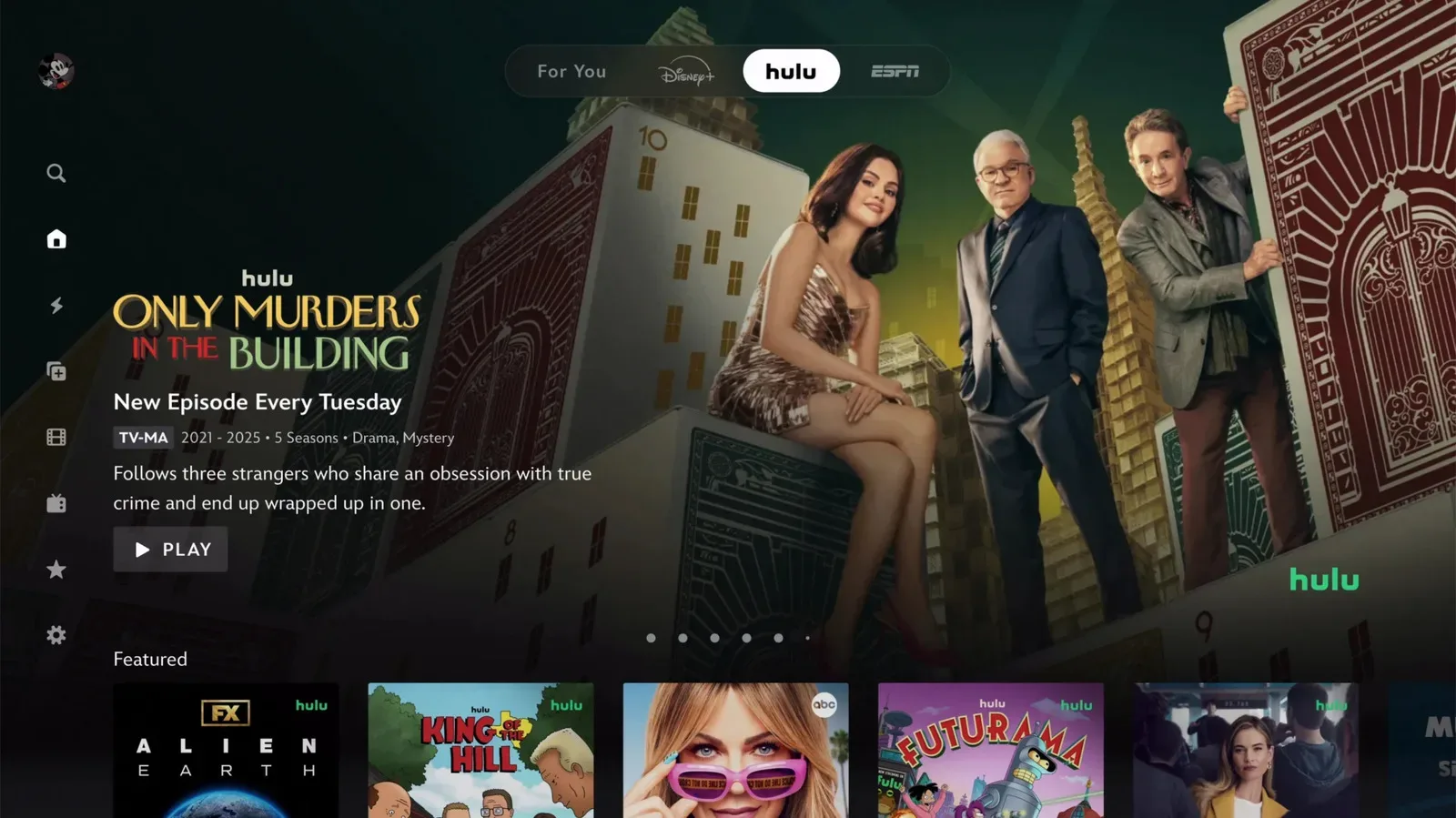
Disney says the long-running effort to combine Disney+ and Hulu will reach its intended destination in December: a fully unified experience inside the Disney+ app. The planned setup will incorporate Hulu, Hulu Live TV and premium add-ons into Disney+, putting a much wider range of entertainment under a single app roof.
That does not automatically mean every question around the two services has been answered. Disney still offers Disney+ and Hulu as individual subscriptions, alongside bundles containing both, and it has not said whether the standalone Hulu app will eventually disappear. For viewers, then, December is best understood as an app-platform milestone rather than a confirmed end to Hulu as a separately sold service.
The company presented the update in its fourth-quarter earnings materials and framed the unified app as a discovery improvement: a way for customers to find programming across its brands and franchises more easily. That may sound like a small user-interface adjustment, but it is a consequential change in the everyday streaming experience. An app is not merely a video player; it is where a service organizes recommendations, search results, subscriptions and the choices that decide what audiences actually see.
What Disney is promising for December
The core promise is a fully unified experience on Disney+. In practical terms, the Disney+ app is set to become the place where eligible customers can access Disney+ programming alongside Hulu content, Hulu Live TV and premium add-ons.
“Unified” is worth separating from “bundled.” A bundle is principally a billing arrangement: customers pay for access to more than one service, often at a combined rate. A unified app goes further by bringing those services into one software environment. Instead of moving between dedicated apps to browse separate libraries, the goal is to make discovery and viewing happen in one place.
The supplied details do not specify precisely how account management, subscription selection, app profiles, live-TV navigation or add-on controls will work. They also do not establish whether every plan will provide the same in-app access. Those are important distinctions, particularly for existing subscribers, but they remain unconfirmed. The firm point is that the Disney+ app is expected to host the combined experience in December.
A project more than three years in the making
The route to this moment has been unusually long for what can superficially sound like a simple app merger. Disney first announced plans to combine Disney+ and Hulu into one streaming service in May 2023. By the planned December completion, the process will have taken more than three years.
That duration reflects why “put both catalogs in one app” is an incomplete description of the job. A streaming platform must coordinate content discovery, customer entitlements and the different products attached to the service. Adding live television and premium add-ons increases that complexity beyond a straightforward on-demand library combination.
Disney has controlled Hulu since 2019. Its ownership position was later consolidated through a roughly $9 billion buyout of Comcast that closed in 2025. Those business steps provide the backdrop for the eventual app integration: Disney moved from controlling Hulu to owning it outright, then continued toward the stated goal of a single, more unified consumer experience.
The update is also notable because it turns a broad strategic direction into a near-term operational target. A merger plan can exist for years without customers seeing a final version of it. December is when subscribers are expected to encounter the completed app approach Disney has been building toward.
Why the app itself matters
Streaming audiences often think first in terms of individual shows, movies and live channels. The app’s structure matters because it determines how all of that material is presented. Search, home-screen recommendations and category hubs can make a large catalog feel approachable—or make it feel like content is technically available but difficult to locate.
Disney’s stated rationale is that the unified app will improve content discovery across its brands and franchises. That is an intentionally broad objective, but it has a clear user-facing meaning: someone arriving to watch one kind of programming could more readily encounter another title available through their subscription.
For households that already have both services, the appeal is easy to understand. A single starting point can reduce the friction of remembering which app contains what. It can also create a more continuous browsing experience between Disney’s family and franchise-oriented programming, Hulu’s broader entertainment lineup, live TV and subscribed premium channels.
For Disney, the same design can make the overall subscription proposition easier to present. Rather than asking a customer to consider multiple destinations, the company can emphasize one app that spans several kinds of viewing. That does not guarantee that every customer will prefer the new arrangement, but it explains why a technically demanding integration has remained a strategic priority.
Live TV and premium add-ons raise the stakes
Two elements in Disney’s description deserve special attention: Hulu Live TV and premium add-ons. On-demand programming generally means a viewer picks a title from a library and starts it whenever they choose. Live TV is different: it is built around linear channels and schedules. Bringing both models into a single app can make Disney+ a broader entertainment hub, but it also means the interface must serve viewers looking for very different things.
Premium add-ons are subscriptions available on top of a base service. Their inclusion in the unified experience signals that the integration is not being described solely as a catalog-sharing effort. It extends to the wider set of paid options connected to Hulu.
What has not been detailed is just as important as what has. There is no supplied information on changes to the price of an individual plan, whether particular add-ons will be treated differently, or whether account holders need to take any action. Subscribers should avoid assuming a specific migration process until Disney provides those particulars.
More broadly, a unified app does not necessarily equal a unified price. The available plans still include standalone Hulu, standalone Disney+ and a combined bundle. As of the provided pricing, the ad-supported bundle costs $12.99 per month and the ad-free version costs $21.99 per month. Those are the current stated bundle prices, not a newly announced December rate.
What remains unchanged—and what remains unknown
For now, Disney continues to sell standalone Hulu and Disney+ subscriptions as well as the bundle. That is the clearest reason not to characterize the December move as the immediate retirement of Hulu’s separate identity. Disney has offered no determination on whether it will eventually stop offering the standalone Hulu app.
That unresolved point matters to people who subscribe to only one service. A single application can be the central destination for a combined offering while distinct plans remain on sale. The eventual fate of the Hulu app, however, is a separate product decision that has not been disclosed.
It is also helpful to distinguish platform consolidation from content availability. The announced integration concerns where the experience is delivered and how programming is surfaced. It does not, based on the available information, provide a title-by-title inventory or promise that every viewer will receive every category of content regardless of their plan.
Television distribution is increasingly shaped by both direct-to-consumer apps and wider market arrangements; for another example of how programming reaches audiences across territories, see this report on distribution deals for NCIS: New York. Disney’s December change is specifically about consolidating its own streaming destinations, not a newly disclosed international distribution deal.
What subscribers should watch for next
December is the expected completion window, but the most useful updates for customers will be the practical ones that accompany the rollout. Those include any explanation of eligibility, the handling of existing subscriptions, navigation for Hulu Live TV, premium add-on management and the status of the standalone Hulu app.
Until then, the immediate takeaway is straightforward. Disney+ is being positioned as the central app for Disney+ and Hulu, with live TV and premium add-ons included in the planned unified experience. The company believes the shift will make its programming easier to discover across brands and franchises. It has also left its current menu of standalone and bundled subscriptions in place, while keeping the Hulu app’s longer-term future undecided.