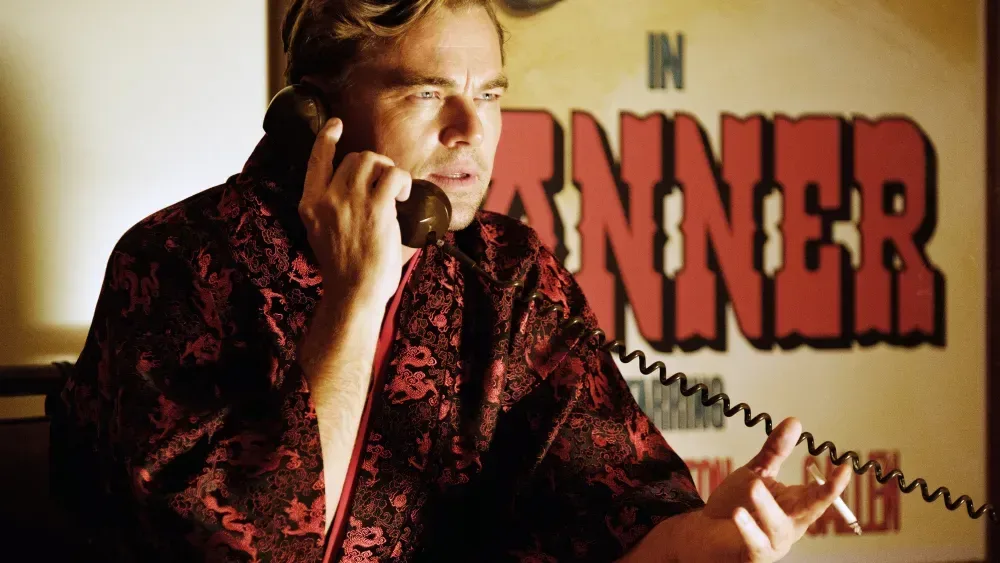
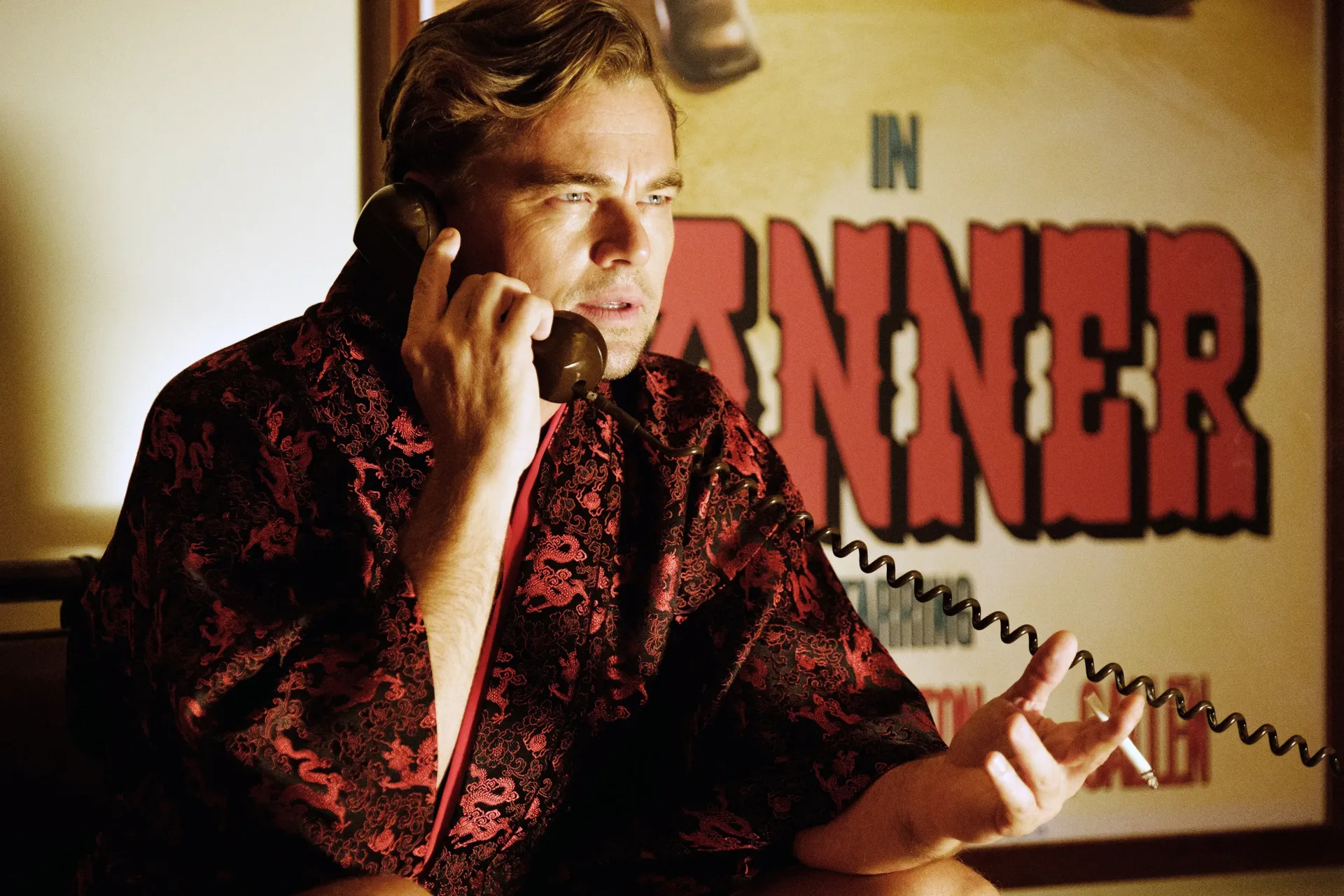
Leonardo DiCaprio’s Rick Dalton was originally going to appear in The Further Mis-Adventures of Cliff Booth, but David Fincher says the character’s brief return depended on a physical transformation DiCaprio elected not to take on.
Fincher explained in a recent interview that Dalton had a limited but meaningful role in an earlier version of the screenplay for the 1977-set continuation of Quentin Tarantino’s Once Upon a Time in Hollywood. The plan called for DiCaprio to wear prosthetic padding so Dalton would look heavier. Once DiCaprio chose to sit the project out, Fincher and Tarantino removed the character’s material rather than recast him.
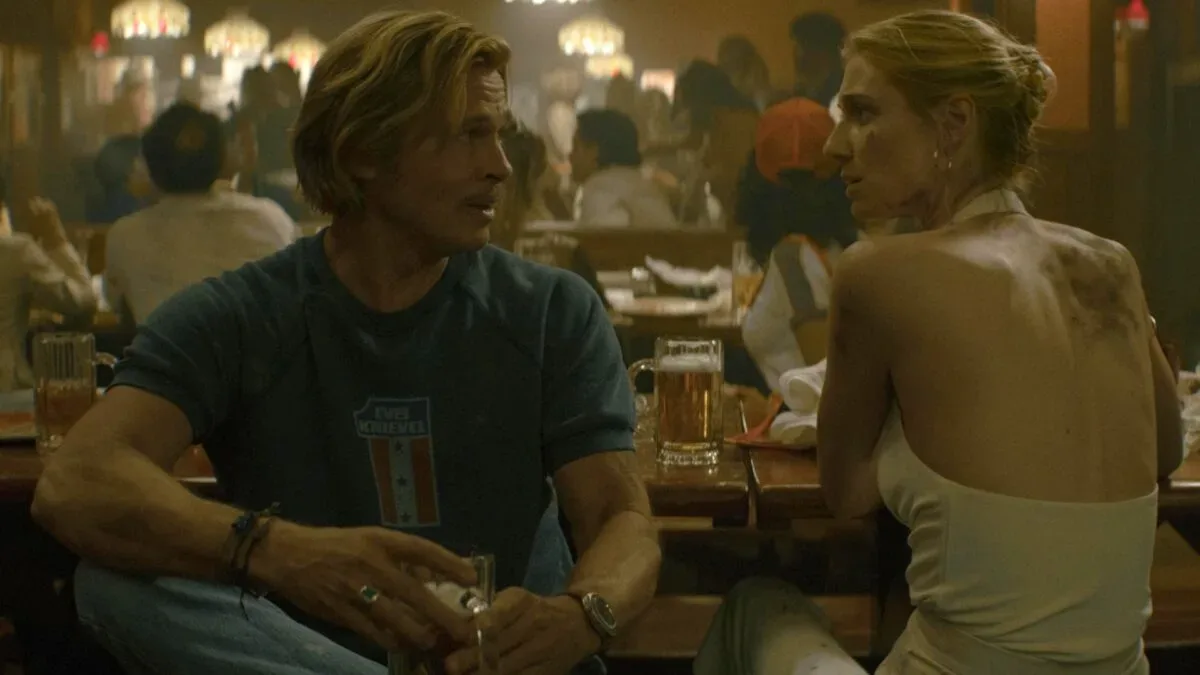
That means the new film remains connected to Tarantino’s 2019 story through Brad Pitt’s Cliff Booth, but not through an on-screen reunion between Booth and Dalton. It is a notable creative adjustment because the two characters’ friendship was at the heart of the earlier film: Dalton was the insecure actor, while Booth was his stuntman, driver and close companion. In the continuation, Booth instead moves into a different role, working as a Hollywood studio fixer and landing in trouble while assisting a popular movie actor.
Rick Dalton’s planned role was larger than a cameo
Fincher described Dalton’s part as roughly three scenes, amounting to around 30 pages in the script. That is still a contained commitment in feature-film terms, but it was more substantial than a quick wink to the previous movie. Dalton would reportedly have appeared as a “chubby returning warrior,” with the story making room for scenes involving Mexican food at Lucy’s El Adobe.
The director’s description also suggests that Dalton’s function was meant to evolve beyond those initial appearances. Fincher compared the character’s later presence in the narrative to Obi-Wan Kenobi: less an active participant in every event than a figure whose influence or memory hangs over subsequent scenes. That framing matters because it indicates Dalton’s removal was not simply a matter of deleting an introductory gag. The script apparently had to account for the absence of a character who would have echoed through later moments.
Still, Fincher’s explanation makes clear why the rewrite was feasible. Dalton was not the title character, and the film’s central path belongs to Cliff Booth. Once the production no longer had its original Rick Dalton, the pages could be cut without replacing DiCaprio with another performer. Recasting would have introduced a far bigger distraction: audiences already associate Dalton specifically with DiCaprio’s performance in Once Upon a Time in Hollywood.
Why the padding became the deciding factor
Prosthetics are makeup appliances or body additions used to alter an actor’s visible appearance. In this case, Fincher said the request amounted to about 12 days of DiCaprio wearing padding to portray a heavier version of Dalton. The practical requirement may sound small when reduced to a shooting-day count, but it affects every part of an actor’s work on those days: costume fitting, makeup application, comfort, movement and the performance itself.
Fincher characterized the material as funny and workable, but said the calculation became very simple once the role was distilled to its production requirements: a short engagement, several scenes, and padding. DiCaprio decided against participating, and Fincher relayed that choice to Tarantino. Fincher said Tarantino had anticipated the possibility, after which Dalton’s roughly 30 pages were removed.
Related coverage includes Why Leonardo DiCaprio Sat Out the Cliff Booth Sequel.
There is an important distinction here between a performer declining a particular version of a role and a character being deemed unimportant. Nothing in Fincher’s account suggests that Dalton was excluded because the filmmakers no longer valued the character. The account instead describes a collaboration adapting to the practical limits of casting. Rather than force the issue, extend the part, or put another actor in a role made famous by DiCaprio, the team changed the story’s shape.
A sequel built around Cliff Booth, not a full ensemble return
The Further Mis-Adventures of Cliff Booth brings Pitt back as the stuntman first seen alongside DiCaprio’s Dalton. The 1977 setting moves the action forward from the earlier movie’s late-1960s backdrop, while the premise puts Booth in the world of studio problem-solving. A fixer is generally someone brought in to handle sensitive, difficult or potentially damaging problems behind the scenes. The description of Booth getting in over his head signals that his new job is not merely administrative; it is the route into the film’s central conflict.
The supporting ensemble includes Elizabeth Debicki, Scott Caan, Yahya Abdul-Mateen II, Carla Gugino and Peter Weller, alongside Pitt. Their presence underscores that this is not being positioned as a two-hander trying to replicate the Dalton-Booth dynamic exactly. It is a continuation with Booth as the point of focus and a new group around him.
For viewers, DiCaprio’s absence may initially read as a missing piece of the original pairing. But Fincher’s account provides a more specific explanation than the usual vague scheduling language: Rick Dalton was written for a version of the film, the role involved an intentionally heavier look, and its actor chose not to do it. The resulting film is therefore not simply a version of the original story with one star unavailable. It is a rewrite that takes Dalton out of the on-screen action altogether.
What the rewrite can mean for the story
Removing a recognizable character can clarify a sequel’s identity. In the earlier film, the emotional and comic rhythm often came from the contrast between Dalton’s career anxieties and Booth’s calm capability. A continuation centered solely on Booth has less reason to return to that same setup. The fixer premise gives him an independent professional purpose, while the 1977 setting establishes a different period and a different phase of Hollywood.
Fincher’s comments also point to an intriguing gap between the screenplay that existed and the finished direction of the movie. The deleted material apparently gave Dalton a physical change, a few active scenes, and a lingering, almost spectral relevance afterward. Without it, the movie can treat the character as absent rather than asking audiences to adjust to a substitute portrayal. That is often cleaner for a character so strongly tied to one performer.
It is also worth separating what is known from what remains unstated. Fincher has explained that the padding was the reason DiCaprio declined the appearance and that the scenes were subsequently removed. The available details do not establish how every remaining plot beat changed, whether any of Dalton’s story function was reassigned to someone else, or whether the completed movie references him beyond the broad connection to the earlier film. Those are questions for the film itself, not facts established by the production anecdote.
For pop-culture sequel watchers, this is a reminder that a returning character is not always a fixed promise even when a script initially includes one. Scripts change for creative and logistical reasons, and body-altering makeup can be a meaningful part of that calculation. Another upcoming continuation, a planned sequel to The Family Stone, illustrates how follow-ups can arrive with their own evolving casts and timelines; in Cliff Booth’s case, the evolution is especially visible because the omitted role belonged to such a closely associated character.
Where to watch The Further Mis-Adventures of Cliff Booth
The Further Mis-Adventures of Cliff Booth opened exclusively in IMAX theaters on Wednesday. It is scheduled to begin streaming on Netflix on Dec. 23. Pitt leads the film as Booth, while DiCaprio’s Rick Dalton does not return on screen.
The most revealing part of Fincher’s explanation may be its plainness. The filmmakers had pages for Dalton, a specific comic visual idea, and a plan for how he would hover at the edge of the narrative. They also had a performer who did not want to spend the required days under padding. The production accepted that answer and built the movie around the character it still had: Cliff Booth.