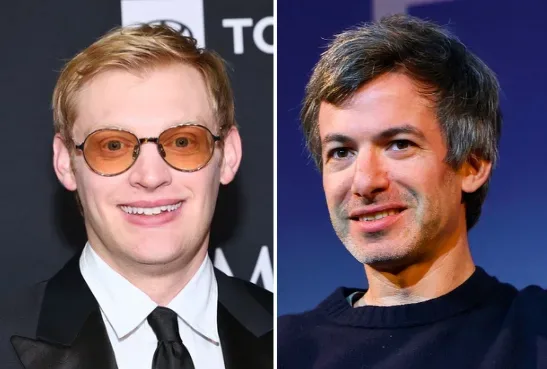
Curry Barker has put a potential collaboration with Nathan Fielder into the universe. The director of Obsession said he has already reached out to Fielder after watching You Can See Everything, a three-hour film centered on Elizabeth Holmes that Barker described as both extraordinary and difficult to neatly label.
“I told him that,” Barker said of a possible team-up. “I said, ‘Hey!’ … I just put it out in the water.” It is not a confirmation that the filmmakers are developing a project, nor is there a title, format, studio or timetable attached. For now, it is a public expression of interest from one rising filmmaker to another.
Still, Barker’s enthusiasm is revealing because it focuses on the formal qualities he sees in Fielder’s work rather than just its subject. Barker said You Can See Everything felt “new, fresh, different,” and called it a documentary that almost does not feel like one, despite being one. He also said he entered with limited knowledge of Holmes’ story and felt the three-hour running time could have been even longer.
What Barker is responding to in ‘You Can See Everything’
The key description attached to You Can See Everything is that it blurs narrative and documentary storytelling. Those terms can sound self-explanatory, but they point to two distinct traditions. A documentary conventionally presents nonfiction material, while narrative filmmaking typically uses structured scenes, character arcs and deliberately shaped dramatic momentum. A work that moves between those modes can leave audiences asking not merely what happened, but how a film is constructing their understanding of what happened.
Barker’s response suggests that this instability is part of the appeal. Calling a film “hard to call a documentary” is not the same as saying it is not nonfiction. Instead, it indicates that the film’s storytelling approach may be more immersive, stylized or structurally surprising than viewers expect from the label. That can be useful for audiences approaching a familiar public story: presentation becomes part of the experience, not simply a delivery system for information.
His comment that he may have missed small details also speaks to a practical reality of ambitious, long-form nonfiction. A three-hour work can reward close attention while making a first viewing feel necessarily incomplete. Barker did not frame that as a flaw. He framed it as an unusual sign of engagement: even at that length, he wanted more.
That reaction also helps explain why the prospect of a Barker-Fielder collaboration is intriguing on paper. The available information does not establish what either filmmaker would bring to a shared project, or whether one will ever happen. But Barker clearly admires work that resists an easy genre box, and his own Obsession has been discussed in connection with the kinds of films that resonate with younger moviegoers and persuade them to see films theatrically.
A pitch is not a project—yet
In entertainment reporting, a creator saying they have contacted another creator is often the earliest possible stage of a collaboration story. It can mean anything from a brief expression of admiration to a substantive creative conversation. The distinction matters. No agreement, production plan or even joint concept has been described here.
What is concrete is Barker’s stated admiration for Fielder and his willingness to say so directly. That is a modest but meaningful development in an awards-season environment, where filmmakers have repeated opportunities to meet peers whose work they value. Barker said both films’ ongoing recognition should create more occasions for the two to cross paths.
The broader business context remains one of creative and technological change across screen entertainment. Questions over authorship, consent and the systems shaping creative work are increasingly prominent, as explored in this report on an AI copyright dispute. That debate is separate from Barker’s comments, but it underscores why distinctive filmmaking voices and clearly intentional forms are closely watched across the industry.
Why the theatrical question is part of the conversation
The discussion around You Can See Everything and Obsession is not only about genre. It is also about what makes a theater trip feel worthwhile to younger audiences. The supplied information does not claim there is one answer, and it would be a mistake to reduce an entire generation’s viewing choices to a single style. But the apparent interest in these films points toward a useful possibility: novelty can be a draw when it is not novelty for its own sake.
A film that makes the audience reassess whether it is watching documentary, narrative, performance or some combination of those elements offers a reason to discuss it afterward. That does not guarantee a theatrical audience. Yet it can create a sense that a work is an event rather than simply another item in a vast viewing queue. Barker’s language—“new, fresh, different”—is ultimately more telling than a claim about a formula. He is responding to a movie that did not feel interchangeable.
For filmmakers, the practical implication is not that every nonfiction film should become three hours long or deliberately obscure its form. Barker’s own reaction is evidence of personal taste, not a production rule. The more defensible takeaway is that format, tone and audience expectation can be creatively linked. When a film meaningfully changes how viewers encounter its subject, it may also change how they talk about the experience.
Barker’s awards-season perspective
Barker made the comments while attending the Time100 Next Gala at Pier59 Studios, where he was honored alongside Raye, Druski, Paapa Essiedu and other rising figures. The event included a performance by Raye, who performed jazz-inflected versions of “Cry Me a River” and “Happier Times Ahead.” Himesh Patel and Alex Warren were among those who made toasts, while Saturday Night Live performer Ashley Padilla drew a strong response with a comic toast about feeling undeserving of the moment and refusing to pin all hope for the future on her niece and nephew.
For Barker, these events have also created the surreal experience of entering rooms filled with people he has known through films and social media. He singled out the Academy Gala as especially overwhelming, saying that familiar faces seemed to be everywhere.
One encounter stood apart: Emma Watson. Barker said he was a major Harry Potter fan growing up and froze when he saw her. His explanation is recognizable even beyond celebrity culture. Admiration for an artist encountered during childhood can feel different from professional respect developed later. Barker said he tried to act relaxed, but felt he failed to do so.
That candid moment provides a counterweight to the more strategic-sounding collaboration discussion. Barker may now be circulating in high-profile film spaces, but he still describes the experience as someone keenly aware of the gap between watching famous performers from afar and meeting them in person.
‘Anything But Ghosts’ is next
Barker’s next feature is Anything But Ghosts, scheduled for release on May 7, 2027. The film will be his sophomore feature following Obsession. Seth Rogen, who wrote Barker’s Time100 Next profile, said he has seen it and praised it as better than Obsession, while also praising Barker’s acting ability.
That is an enthusiastic assessment from someone who has seen the upcoming film, not a substitute for broader audience or critical response once the movie arrives. Its release is still ahead, and no additional details about the story or its production have been provided. But the timing gives Barker another significant point on the horizon as he discusses Fielder’s work and navigates a growing awards-season profile.
For now, the most accurate reading is straightforward: Barker is an openly enthusiastic fan of You Can See Everything, he has made his interest in collaborating with Fielder known, and the idea remains just that—an idea placed “out in the water.”