Criminal Minds: Evolution will end with its upcoming 20th season, bringing the long-running FBI profiling drama to a close in 2027. A specific Paramount+ premiere date has not been announced. The decision makes Season 20 the final chapter for a series that began with 15 seasons on CBS before its streaming continuation launched as Evolution.
The revival began with Season 16 in 2022. Its 19th season aired between May and July 2026, and the already-planned Season 20 will now function as a finale rather than simply the next installment. That distinction matters for viewers: the creative team knows it is writing toward an endpoint, even if no story, episode count, or plot details for the final season have been disclosed.
A two-platform run reaches its endpoint
Criminal Minds first ran on CBS for 15 seasons. Criminal Minds: Evolution continued that story on Paramount+ for five more seasons, with Season 20 completing the full 20-season run. The show’s move from broadcast television to streaming did not turn it into a separate continuity; Evolution picks up after the original series.
At the center of both versions is the FBI’s Behavioral Analysis Unit, or BAU. In the series’ framework, the team consists of profilers investigating dangerous criminals in an effort to identify and stop them before they strike again. A profiler, in this context, is an investigator who studies behavioral patterns and available evidence to develop an understanding of an offender. That premise has given the franchise a stable dramatic engine across its long lifespan: each case is filtered through a team built around analysis, collaboration, and urgency.
That consistency is one reason the final-season news carries weight. A procedural is a series organized around an investigative or case-based structure, often allowing individual episodes to deliver a distinct story while longer character arcs continue in the background. The format can sustain a long run because it provides a familiar foundation. But a final season also creates an opportunity to put more emphasis on the characters and relationships that have connected those cases over time.
Who is confirmed to be involved
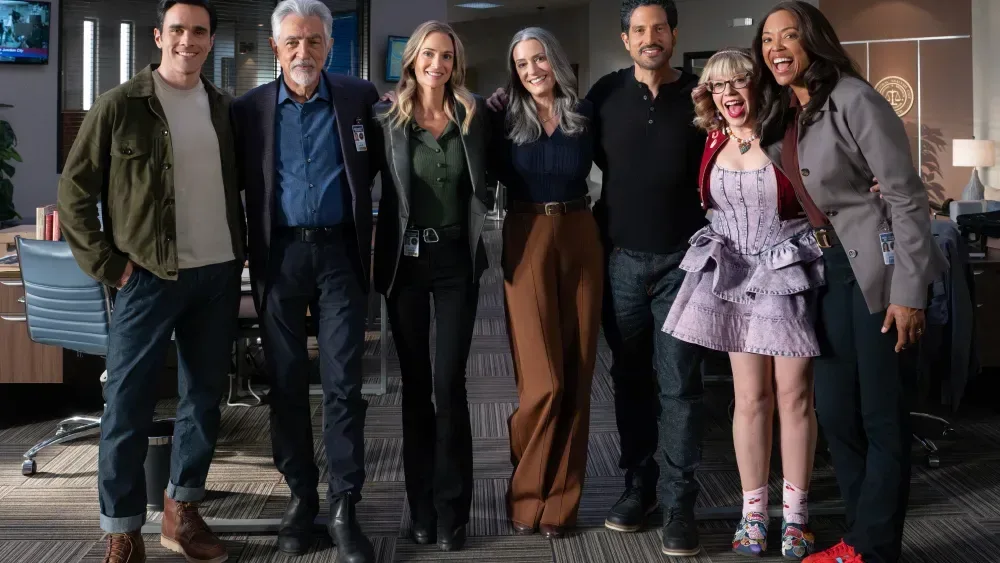
The returning cast includes franchise mainstays Joe Mantegna, A.J. Cook, Kirsten Vangsness, and Aisha Tyler. RJ Hatanaka is also part of Evolution, while Adam Rodriguez and Paget Brewster returned to the franchise as well. The announced roster underscores that the streaming era has remained closely linked to the show’s established ensemble rather than operating as a wholesale restart.
Erica Messer serves as showrunner and executive producer. A showrunner is the senior creative leader who oversees a television series’ storytelling and day-to-day creative direction, typically coordinating the writers while working with other departments and producers. Breen Frazier, Chris Barbour, Glenn Kershaw, Stacey Hardt, and Mark Gordon are also executive producers. The series is produced by 20th Television and CBS Studios.
Messer described the approaching ending as difficult while emphasizing gratitude for the cast, writers, directors, crew, and viewers who supported the program through its broadcast and streaming eras. She also said the team is looking forward to sharing Season 20 and celebrating the show’s legacy.
Related coverage includes ‘Criminal Minds: Evolution’ Will End With Season 20 in 2027.
What has—and has not—been announced
The core facts are clear: Season 20 is coming to Paramount+ in 2027, and it will be the last season of Criminal Minds: Evolution. Beyond that, much remains unannounced. There is no confirmed premiere date, no released episode schedule, no formal description of the final-season story, and no stated details about how the series will conclude.
That leaves room for anticipation, but not certainty. It would be reasonable to expect a concluding season to acknowledge the franchise’s history, given the scale of its 20-season run and Messer’s reference to celebrating that legacy. Still, viewers should treat any assumptions about returning characters, particular cases, or a specific type of ending as speculation until the production shares those details.
The lack of a premiere date is especially important in practical terms. “In 2027” establishes the release year, not a viewing window. It does not confirm whether the season will arrive early or late in the year, whether episodes will be released weekly or through another schedule, or when a trailer may appear. Those are separate announcements that have yet to be made.
Why the planned ending changes the final season
Knowing a series is ending can change the way audiences read every new episode. Viewers may look more closely at unresolved character material, ongoing professional tensions within the BAU, and callbacks to earlier eras of the franchise. In a continuing procedural, not every episode needs to carry finality. In a final season, even routine moments can take on added significance because the show has a defined destination.
That does not mean the final season has to abandon the structure that made the series recognizable. The BAU’s profiler-driven cases remain the stated foundation of Evolution. Instead, the final stretch can potentially balance two demands familiar to long-running television: delivering the investigative stories viewers expect while allowing the ensemble’s larger journey to feel complete. Whether and how it does that remains to be seen.
For fans, the most immediate implication is simple: Season 20 is not merely another renewal. It is the last confirmed opportunity to spend time with this iteration of the BAU. The cast continuity gives that closing run a clear connection to both halves of the franchise’s history—its original CBS years and its Paramount+ continuation.
The announcement also arrives after Season 19 completed its run from May through July 2026. That places the franchise in an unusual but useful position: there is an established recent season behind it and a known ending ahead, but no exact date yet for the final return. Fans can revisit the show’s earlier chapters without having to guess whether another season is planned; the remaining uncertainty is about the timing and content of the conclusion.
A legacy built around the BAU ensemble
Twenty seasons is a substantial lifespan for any scripted drama, particularly one that has crossed from a traditional broadcast network to a streaming service while retaining its central premise and key performers. The upcoming conclusion will close not only the Paramount+ revival but the broader Criminal Minds story that began on CBS.
Its continuing appeal has rested on a recognizable setup: a specialized team confronting dangerous criminal behavior through profiling and investigation. Yet the announced finale naturally puts attention on the people carrying that setup. Mantegna, Cook, Vangsness, Tyler, Rodriguez, Brewster, Hatanaka, and the wider creative team represent the continuity that has allowed the franchise to extend across two distribution models.
For another example of how pressure, institutions, and performance shape dramatic storytelling, readers can also explore this look at A Few Good Men on Broadway. The connection is not a shared story universe, but a shared interest in how systems of authority and high-stakes investigation can drive character drama.
For now, the key message is appropriately direct: Criminal Minds: Evolution has one season left. Season 20 will arrive in 2027, with its precise launch date and story still to be revealed.