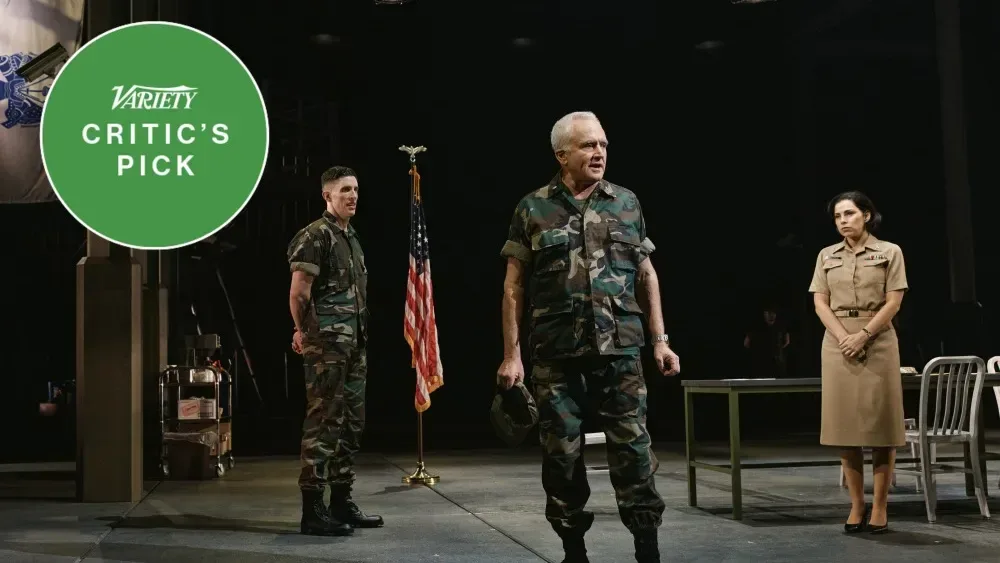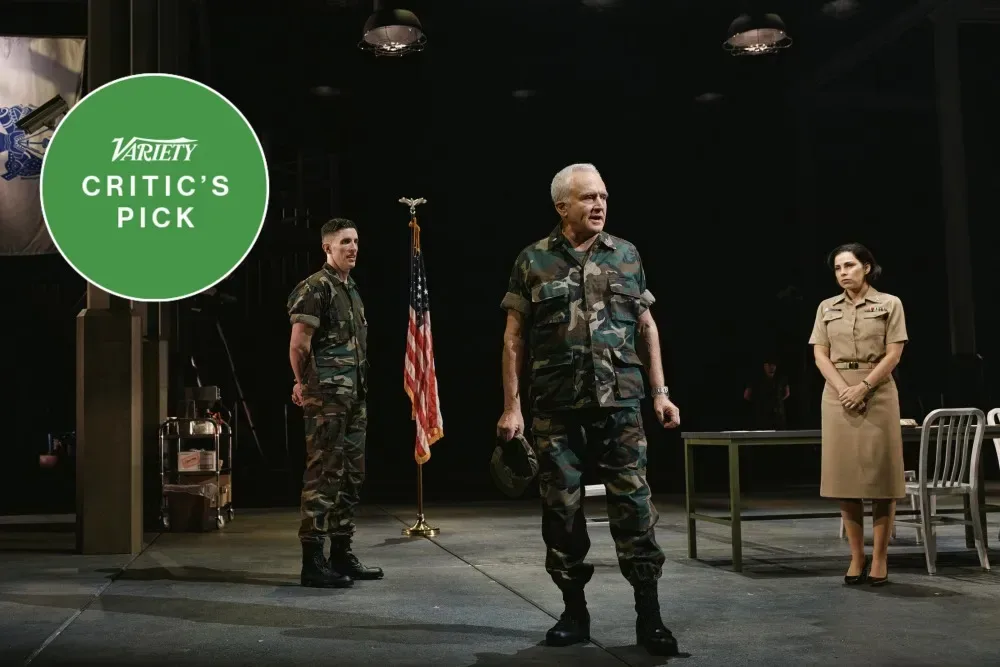
Aaron Sorkin’s A Few Good Men has returned to Broadway at the Vivian Beaumont Theater in a new production directed by Michael Arden. The 1989 courtroom drama is inseparable for many people from its 1992 film adaptation, but this staging makes a strong case for the story’s theatrical bones: bodies arranged in space, uniforms that erase individuality, and a courtroom confrontation built to land in the room rather than through a screen.
The production opened October 29, 2026, and runs two hours and 35 minutes, including one intermission. Tom Blyth plays Lt. Daniel Kaffee, Krysta Rodriguez is Lt. Cmdr. Joanne Galloway, and Bradley Whitford takes on Lt. Col. Nathan Jessep. The play follows naval lawyers defending Lance Cpl. Harold Dawson, played by Lavel Schley, and Pfc. Louden Downey, played by Collin Kelly-Sordelet, after they are accused of killing another Marine at Guantanamo Bay.
The case turns on Galloway’s belief that the death resulted from a hazing ritual that went disastrously wrong. Kaffee, initially more invested in wisecracks and avoidance than a difficult defense, is pushed by Galloway to confront what the case says about authority, accountability and the cost of falling in line.
A courtroom drama built around institutional power
The central conflict is not merely whether the two Marines committed an act of violence. It is whether an institution can demand absolute compliance while distancing itself from the results of that compliance. A Few Good Men frames the Marines as people trained to prioritize the chain of command and the needs of the Corps above their own judgment. That makes the legal question unusually thorny: how do individual rights operate when the accused have been taught that following orders is a defining duty?
That tension gives the familiar story continuing force. A courtroom drama generally promises clarity: competing arguments, evidence, rules and a final reckoning. Sorkin’s play complicates that model by asking whether official rules can truly account for an unofficial culture of coercion. The Marines’ repeated ethos of “unit, Corps, God, country” becomes more than a slogan. It is a compact that establishes belonging while also threatening to overwhelm personal responsibility.
Arden’s staging reportedly finds its sharpest visual language in that contradiction. Blocking—the planned placement and movement of performers onstage—is used to turn military cohesion into a troubling image. Marines are frequently positioned with their backs to the audience, creating an anonymous wall of uniforms rather than a collection of readily readable individuals. When they turn downstage and speak candidly, the shift registers as an act of resistance: a person emerging from the formation.
In a flashback involving Lt. Kendrick, played by John Zdrojeski, enlisted Marines stay turned away while they march and respond to commands. The image makes the machinery of obedience visible. Military drill already contains theatrical ingredients—synchronized movement, regulated posture and costume—but Arden uses those elements to emphasize how ceremony can become dehumanizing when it leaves no room for dissent.
Joanne Galloway is the production’s key outsider
Rodriguez’s Joanne “Jo” Galloway gives the revival one of its clearest points of focus. She is a naval lawyer fighting to be heard among male peers, and the production reportedly establishes her outsider status before the plot fully takes hold. In an early scene, Galloway stands apart as male colleagues gather around a table. Costume designer Alejo Vietti also uses color to clarify the divide: Galloway appears in white while Kaffee and his colleague Sam Weinberg, played by Nick Blaemire, wear khaki.
Those colors later trade places, and the group only begins to visually match when its members have committed to functioning as a team. It is a compact, legible piece of theatrical storytelling. Instead of explaining every change in professional trust, the design lets the audience see the lawyers moving from opposition and isolation toward shared purpose.
Galloway is not written as an easy character, and that remains one of the text’s complications. Her persistence is essential to the investigation, but she can be presented as excessively forceful or overly certain. The play even nods to its own verbal mannerisms through a jab at the quality of her dialogue. Rodriguez meets that heightened writing with a tightly controlled physical approach, using erect posture as an assertion of command.
The result is a character whose demand to be taken seriously is staged as labor. Galloway cannot simply possess authority; she has to visibly claim it. That makes her a counterweight to the institutional authority around her, which is treated as natural and self-justifying until the case begins pulling at its foundations.
Tom Blyth takes on a role associated with Tom Cruise
Kaffee is a difficult role in a different way. He must begin as an apparently unserious lawyer, someone who hides fear of failure and unresolved family baggage beneath sarcasm, then grow into a person willing to stake his professional identity on a moral position. Blyth, known to many viewers from The Hunger Games franchise, plays him with small, naturalistic behaviors, including the casual habit of leaning back in his chair.
There is also an audible and tonal echo of Tom Cruise’s screen performance in the part. That connection is perhaps inevitable: the film helped make Sorkin’s story a major popular-culture fixture, received four Oscar nominations, and produced one of cinema’s most quoted confrontations. Yet the stage version’s structure places added importance on how Kaffee physically looks among the Marines. As the disciplined corps moves with collective certainty, he appears comparatively unsettled—a civilian-style operator, even in uniform, trying to understand a world that has little patience for ambiguity.
His journey is not about becoming a Marine. It is about developing the courage to stand for a code that is actually his own. Dawson, one of the accused men, helps illuminate that distinction. The drama’s most painful irony is that loyalty and moral courage do not always point in the same direction, especially when a hierarchy treats obedience as the highest virtue.
The cast also includes Whitford as Jessep, the commander who embodies the play’s most dangerous certainty. Whitford previously played Kaffee onstage, adding an intriguing generational turn to his move into the older, imperious role. Jessep’s confidence is not presented as simple competence. It curdles into hubris: the conviction that his responsibilities exempt him from scrutiny and that only he understands the brutal necessities of protection.
Why the revival’s craft matters
A Few Good Men carries some of the limitations of its age. Its characterizations can edge toward broad types: the driven Galloway, the glib but wounded Kaffee and the new father Weinberg, whose Jewishness is repeatedly foregrounded. Sorkin’s style is brisk and argumentative, packed with sharp turns of phrase and ethical debate, but that speed can occasionally make characters feel like tightly designed positions in an argument rather than fully unpredictable people.
Arden’s contribution appears to be a refusal to treat that stiffness as a reason for a museum-piece revival. The staging leans into exactness. Scenic designer Dane Laffrey, lighting designer Japhy Weideman, sound designer Joshua D. Reid and movement director Ricky Ubeda are among the creative team responsible for shaping the production’s atmosphere. The stated effect is less a wholesale reinvention of Sorkin’s play than a clear-eyed realization of its most durable material: the uneasy relationship between order and justice.
That approach matters for a well-known work. Revivals are often judged by whether they can identify something newly urgent in a familiar text. Here, the answer seems to lie in form as much as message. Back-facing actors, shifts in costume color and tightly regimented movement all make the abstract pressures of hierarchy concrete. The production does not need to add a speech explaining institutional conformity when it can show an ensemble transformed into a faceless unit.
For a different recent example of how performance can turn public pressure into entertainment drama, see our review of Primetime. A Few Good Men works on a more formal, courtroom-driven register, but it similarly depends on a protagonist pushed into confrontation by an overpowering system.
A familiar line, earned late
The famous declaration about “the truth” arrives late in A Few Good Men, after the play has spent considerable time laying out the competing ideals of service, law and duty. Its endurance as a pop-culture quote can obscure the architecture required to make it work. The revival’s reported strength is that it restores the buildup: Galloway’s insistence, Kaffee’s reluctant maturation, the defendants’ constrained voices and Jessep’s escalating self-belief.
That is why the production’s triumph is less about novelty than discipline. Sorkin’s drama argues that obedience can become dangerous when it no longer permits moral judgment. Arden answers with a production whose own choreography and design are rigorously controlled—but always in service of showing the human beings who must find a way to speak out from within the formation.
Production details
- Venue: Vivian Beaumont Theater
- Opening: October 29, 2026
- Running time: 2 hours 35 minutes, including one intermission
- Director: Michael Arden
- Playwright: Aaron Sorkin
- Principal cast: Tom Blyth, Krysta Rodriguez and Bradley Whitford