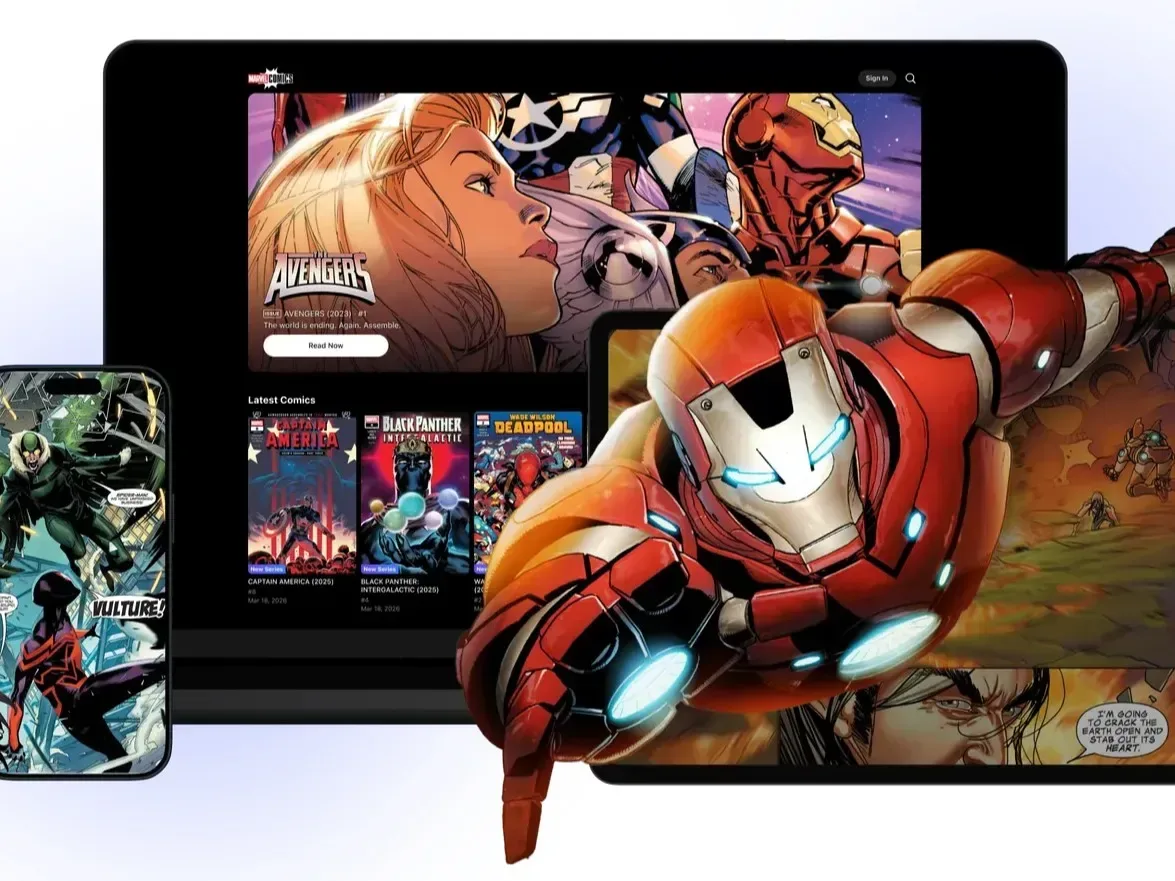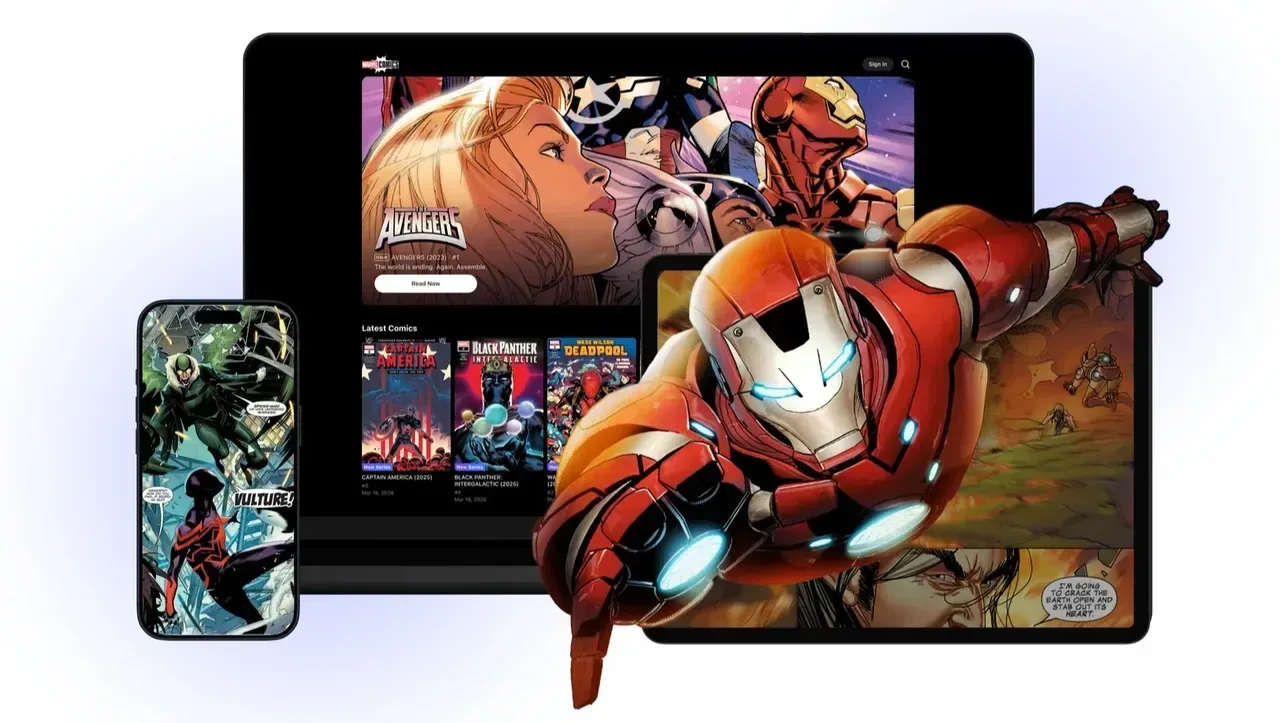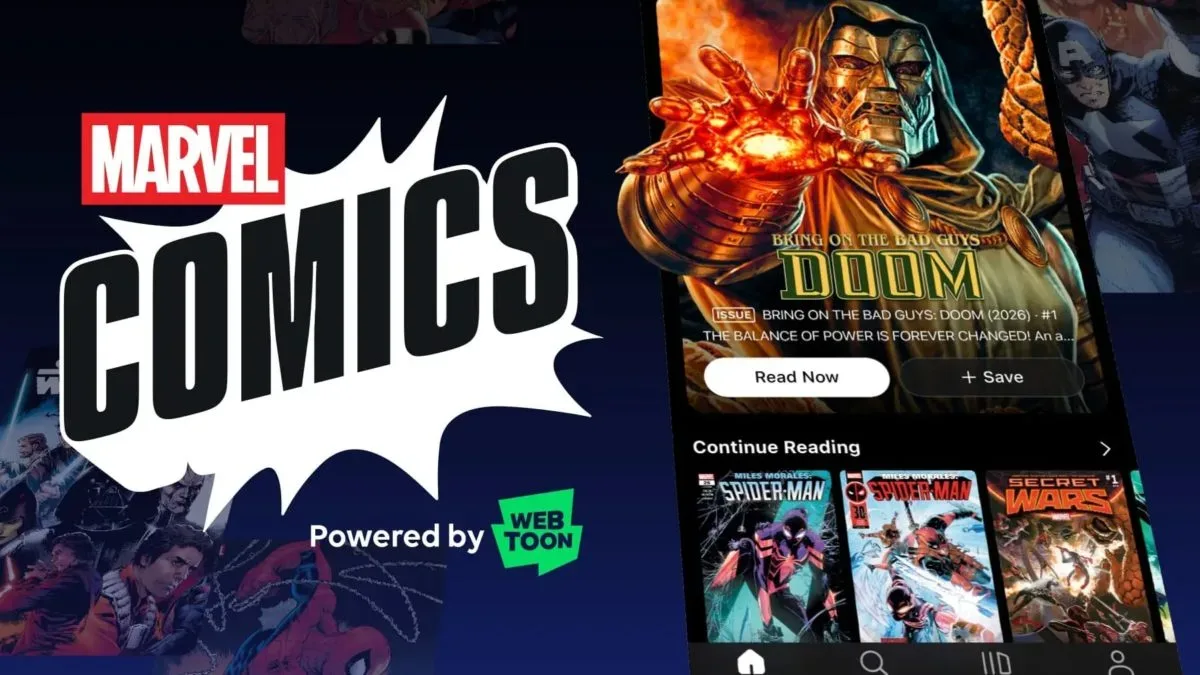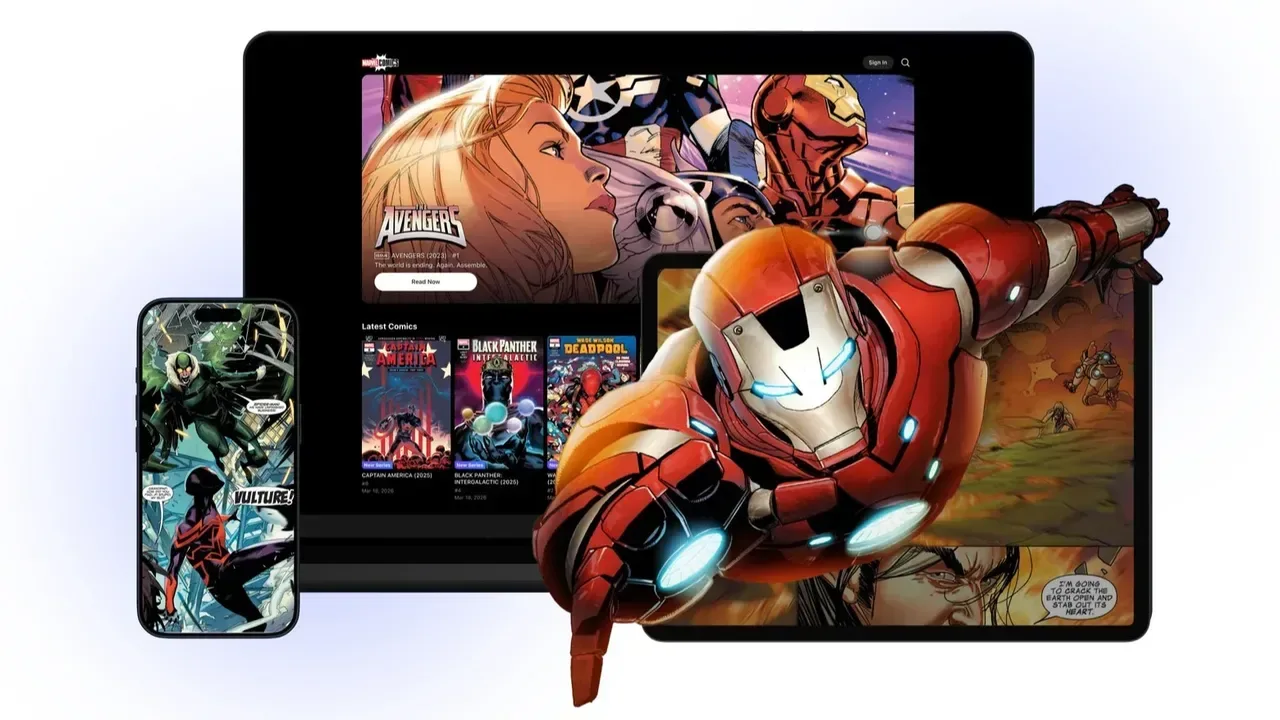
Marvel is preparing to retire the long-running Marvel Unlimited app and replace it with Marvel Comics, powered by Webtoon. The new service is set to launch on November 16 with more than 35,000 digital comics, while Marvel Unlimited is scheduled to sunset on December 7, 2026.
The headline improvement is meaningful for readers who want a closer-to-current subscription library: the higher-priced Ultimate tier is expected to receive new issues 30 days after print release. Under Marvel Unlimited, that delay was 90 days. Yet an early look at the replacement suggests a more complicated question hangs over the transition. Much of the core experience—libraries spanning Marvel and Star Wars, reading guides, full-page viewing and panel-by-panel reading—will be recognizable to existing subscribers.
That is not inherently a flaw. Familiarity can be a virtue when readers have years of saved progress and carefully assembled libraries. But it raises the pressure on Marvel and Webtoon to make the move painless and to show that the new app is more than a refreshed interface wrapped around the same essential reading tools.
The one immediate change with real reading consequences
A subscription comic service is often judged by its release window: the amount of time between a print issue’s arrival and its availability in the included digital catalog. For the Marvel Comics app’s Ultimate tier, that window is planned to be 30 days. That is two months sooner than the 90-day gap used by Marvel Unlimited.
For readers keeping up with an ongoing series, the distinction is practical rather than cosmetic. A shorter delay means less time spent avoiding spoilers, waiting for discussion to move on, or deciding whether to buy individual issues outside a subscription. It does not make the catalog day-and-date with print, but it substantially narrows the wait.
Both subscription tiers are set to include the Marvel and Star Wars comics libraries. The supplied details do not specify the difference between the tiers beyond the earlier access tied to Ultimate, so prospective subscribers should be careful not to assume additional benefits, pricing, or identical availability rules that have not been detailed.
The underlying catalog is also large enough that discovery tools matter as much as raw issue count. More than 35,000 comics is an impressive launch figure, but a huge archive only becomes approachable when readers can find a sensible starting point, follow a character or event, and resume a series without hunting through hundreds of installments.
What appears to carry over from Marvel Unlimited
Early impressions indicate that Marvel Comics preserves several of Unlimited’s strongest basics. Most importantly, readers can choose between viewing a complete comic page and moving through it panel by panel. Panel-by-panel reading presents the art in a guided sequence, helping make speech balloons and smaller details legible on a tablet-sized screen. The app can also zoom back out at the transition to a new page, allowing readers to take in the original full-page composition.
Related coverage includes Marvel Comics App Hands-On: Webtoon Migration Brings Faster New Issues, but Few Immediate Reasons to Switch.
That option matters because comic pages are designed as pages, not merely as a linear chain of images. A guided panel view can improve clarity and pacing, while the full-page reveal lets the reader see how an artist arranges action, scale, gutters and page turns. Retaining both approaches means the service does not force a single reading style onto everyone.
Reading guides also appear to be making the transition. These guides are especially useful in shared-universe publishing, where an event or storyline may run across multiple titles and involve a daunting number of issues. Rather than asking a newcomer to read an entire series run from issue one, a guide can direct them to the relevant installments in an intended order.
For many subscribers, guides are the difference between an archive that feels inviting and one that feels like homework. Marvel Unlimited’s guides were already a notable part of its appeal, so their apparent inclusion is reassuring. Still, the available hands-on time was limited, meaning there is no firm confirmation that every previously available guide, including individual favorites, will be present at launch.
A smoother issue page is a sensible improvement
The new app reportedly gives each comic issue an overview screen before reading begins. Alongside issue information, readers can slide across other installments in the same series from the top of the screen and see the reading guides that include that issue.
This is a small design choice with potentially large benefits. Digital comics readers frequently arrive at an issue from search, a saved list, a reading guide, or a recommendation rather than from a neatly ordered shelf. Showing the surrounding series and related guides at that point can reduce the number of backtracks required to answer ordinary questions: What comes next? Is this part of a bigger story? Which guide brought me here?
It is also a better fit for how large comic libraries are actually used. Readers may sample a first issue, jump to a crossover chapter, or work through a curated character list instead of reading a title uninterrupted for years. The overview page could make those routes more visible without changing the comics themselves.
Modern navigation is not the same as a faster app
Webtoon’s stated goal for the redesign is a faster, easier experience. Marvel Unlimited has existed since 2007, and its interface has increasingly looked dated. A new navigation system can therefore be welcome even if it does not redefine digital comics reading.
However, a brief test of the new app did not reveal an obvious speed advantage over Unlimited. That observation comes with important limits: the app was experienced on demonstration tablets in a crowded convention setting, where inconsistent Wi-Fi and the devices themselves could influence performance. It should not be treated as a definitive benchmark.
Even so, the distinction is worth making. User interface, commonly shortened to UI, refers to the visual controls and screens people use: navigation bars, search layouts, buttons and menus. An updated UI can make an app feel clearer and more current. Performance is different: it concerns how quickly pages load, searches return results, issues open, and reading transitions respond. An interface overhaul does not automatically establish a measurable performance leap.
Marvel Comics may ultimately be better organized or easier to learn, and that could be a substantial improvement for new readers. But the early evidence points to evolution more than reinvention. For seasoned Unlimited subscribers, the strongest reason to switch may be the 30-day new-issue window, rather than an entirely new way to read.
The roadmap is promising, but remains a roadmap
Webtoon has outlined several additions it intends to bring to the service. Those include Disney and Pixar comics, improved custom-list creation, and multiple profiles for a household, including profiles for children.
Each feature addresses a recognizable use case. Custom lists can let readers build personal queues around a character, an era, a creator or a particular event. Separate profiles can prevent one person’s reading history and recommendations from overwhelming another’s, and can give families a clearer way to organize who is using the app.
Disney and Pixar additions would broaden the service beyond its initial Marvel and Star Wars focus. But no dates were provided for these plans. That makes them useful indicators of direction, not launch commitments. Readers deciding whether to migrate should evaluate the app on what is confirmed for November 16, rather than on features that may arrive later.
The wider Marvel conversation also remains active across screens and formats; for instance, a recent Agents of SHIELD connection discussion shows how quickly fans can move between characters, adaptations and back-catalog questions. A strong comics app benefits from making that kind of curiosity easy to follow, particularly when a reader wants to trace a character beyond a TV or film appearance.
Migration is the real trust test
Marvel Comics will allow users to transfer their libraries and reading progress. That is the crucial protection in a forced app transition. Reading progress is not trivial data in an archive that spans tens of thousands of comics; it represents bookmarks, half-finished issues and a personal record of where a reader left off across many series.
Still, any migration creates friction. Some users will delay, miss instructions, distrust a new platform, or simply prefer the app they already know. Replacing an established application rather than substantially updating it makes the move more visible and introduces an additional opportunity for frustration, even when the transfer process works as intended.
Marvel and Webtoon therefore have a narrow but important window between the November 16 launch and the December 7, 2026 shutdown of Unlimited. Clear transfer guidance, dependable preservation of progress, and straightforward explanations of what changes between tiers will likely matter at least as much as the more polished navigation.
For now, Marvel Comics looks positioned as a familiar service with a meaningful accelerated-release benefit and a cleaner presentation. Whether that is enough to justify retiring Marvel Unlimited will depend less on the name above the icon than on the mundane details: how reliably readers’ histories move over, whether guides remain robust, and whether the promised roadmap becomes a real set of improvements rather than a list of future possibilities.