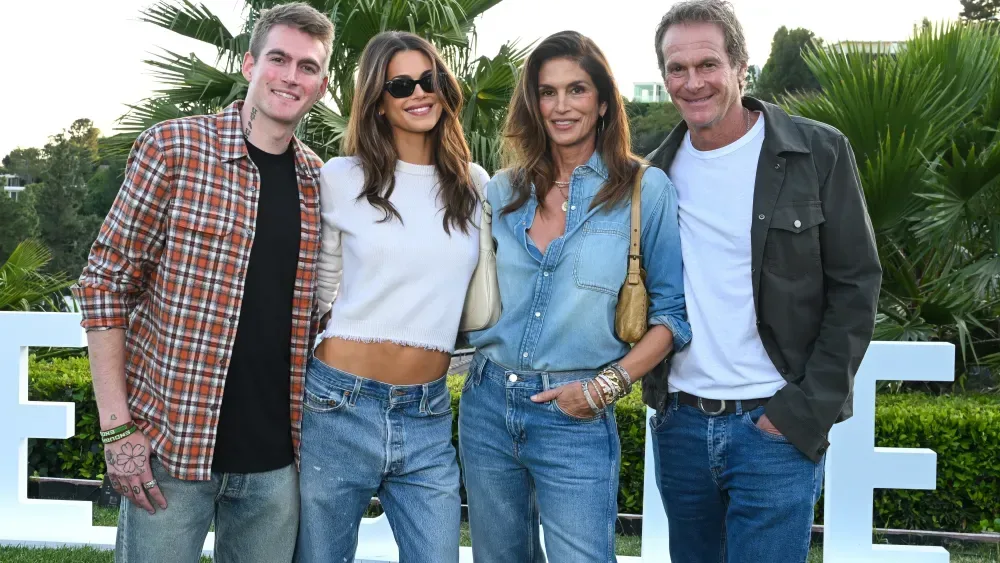
Cindy Crawford, Rande Gerber and Kaia Gerber have shared tributes to Presley Gerber, who died in September at age 27. The family’s messages center on loss, love and the qualities they say defined him: kindness, openness and a willingness to be vulnerable.
In a joint message posted to Crawford’s Instagram, the family described themselves as devastated by the death of their son and brother, while expressing gratitude for the 27 years they had with him. They remembered Presley as deeply loved and said they were proud of the way he moved through the world. The post also thanked those who have offered support, including people who know the family personally and others who have responded with sympathy.
Kaia Gerber published a separate remembrance shortly afterward. Her post wrestled with the limits of language in grief, saying that words can reduce an experience rather than fully hold it. She described being Presley’s sister as a defining part of who she is, and remembered him as a close companion and protector who brought laughter and comfort to her life.
A public remembrance shaped by a private loss
Messages of this kind are not news updates in the conventional sense; they are personal memorials. The distinction matters. Crawford, Rande Gerber and Kaia Gerber chose to tell the public how they want Presley to be remembered, but that does not make every aspect of a family’s loss public property.
The family’s statement asked for compassion through its tone, even as it thanked people for their care. A representative had separately requested privacy during what was described as a painful period. Respecting that boundary means keeping the focus on confirmed information and on the words the family elected to share, rather than treating an early tragedy as an invitation for speculation.
Presley Gerber died at a rehabilitation facility, as reflected in Los Angeles County Medical Examiner records. A cause of death was not immediately known. That uncertainty is important: the available information does not establish a cause, and it should not be filled in with assumptions based on past public disclosures, addiction treatment or anything else.
Kaia Gerber’s tribute speaks to a sibling bond
Kaia Gerber’s message is especially focused on the singular nature of siblinghood. She wrote about beginning life closely attached to her brother and about carrying an abundance of love that now has no obvious destination. Her remembrance does not try to turn grief into a neat lesson or a statement of resolution. Instead, it recognizes that loss can make language feel inadequate.
She also characterized Presley as someone who taught her while he was alive and left questions in his absence. The tribute recalls him as her best friend, a protector and the person connected to some of her biggest laughs. Those details give the message its weight: they are not a public résumé, but an account of the place he held within his family.
Related coverage includes Cindy Crawford, Rande Gerber and Kaia Gerber Pay Tribute to Presley Gerber.
That is why her post has resonated beyond a celebrity-family context. Grief is often described with broad phrases, but Kaia Gerber’s words stay with the particulars of connection: being a sister, sharing humor, finding safety in another person and trying to comprehend life after that person is gone.
Presley Gerber’s modeling work and public life
Presley Gerber began modeling at 15 and signed with IMG Models. His work included a Calvin Klein campaign, a Moschino runway appearance and a Pepsi advertisement that featured him alongside Crawford. As the son of Crawford and businessman Rande Gerber, he grew up in a highly visible family, then developed his own public profile through fashion and social media.
Yet the family’s memorial does not frame his life primarily through those professional milestones. Their emphasis is personal: a son and brother remembered for his character and for the love surrounding him. That focus provides needed perspective when a person has lived partially in the public eye. Career credits can document visibility, but they cannot convey the full scale of a family relationship.
Entertainment audiences have seen other families face similarly difficult public moments, including the recent remembrance of actor Georgina Cates. Each loss is distinct, but the basic responsibility is the same: report what is confirmed, avoid adding unsupported narrative, and leave room for the people closest to the person who died to speak for themselves.
His openness about mental health and addiction
Presley Gerber had discussed mental health and addiction publicly. In November 2024, he started an Instagram series called Mental Health Mondays, explaining that he wanted to prompt candid conversations about experiences people commonly keep hidden. He later said he had seen that message reach and help people.
The series was notable not because it offered a simple solution, but because it named the difficulty of speaking openly. Mental health is a broad term covering emotional, psychological and social well-being. Addiction is likewise a health condition, not a moral shortcut or a character label. Public discussion can reduce isolation for some people, but it does not erase the complexity of someone’s circumstances or make private medical information available for public interpretation.
Presley’s history also included a 2019 DUI arrest in Beverly Hills, followed by a sentence of three years’ probation. It is relevant as a matter of public record, but it should not be used to construct a presumed explanation for his death. The cause was not immediately known. Past events, treatment and a person’s willingness to discuss struggles are not evidence of a cause of death.
Why that distinction matters
When mental health or substance use enters a story about a death, the language used around it can shape how readers understand both the individual and the issues involved. Three principles are particularly useful:
- Do not convert disclosure into diagnosis. Someone speaking about mental health or addiction does not provide outsiders with a full clinical account.
- Do not treat treatment as proof of an outcome. Rehabilitation is health care and support; its presence does not establish why a person died.
- Do not collapse a whole life into a struggle. The family’s recollections make clear that Presley was also a son, brother, friend and creative professional whose relationships mattered deeply.
These are not merely stylistic concerns. They preserve accuracy at a moment when incomplete information can quickly harden into rumor. They also better reflect the spirit of Kaia Gerber’s earlier comments about her brother: she said his openness made him a teacher for the family and that attempts to hide difficult realities can leave a person feeling ashamed.
What the family chose to preserve
In their tribute, Crawford, Rande Gerber and Kaia Gerber remembered Presley’s kindness and vulnerability. Those words align with the part of his public presence that sought honest conversation about struggles often obscured by image management and celebrity culture.
There is a meaningful difference between openness and entitlement. Presley’s public posts created space for conversation, but neither he nor his family owed the public every detail of his life. The family’s current statements offer a picture they want held close: someone loved without condition, remembered with pride, and mourned by people whose bond with him cannot be summarized by professional headlines or online speculation.
For readers affected by a similar loss, the tributes may also underline a difficult truth: there is no required eloquence in grief. Kaia Gerber explicitly wrote that she did not have the words. The absence of an adequate explanation, speech or response is not a failure. Sometimes remembrance is simply the effort to say that a person mattered, that their place in a family remains, and that love persists alongside the pain of losing them.