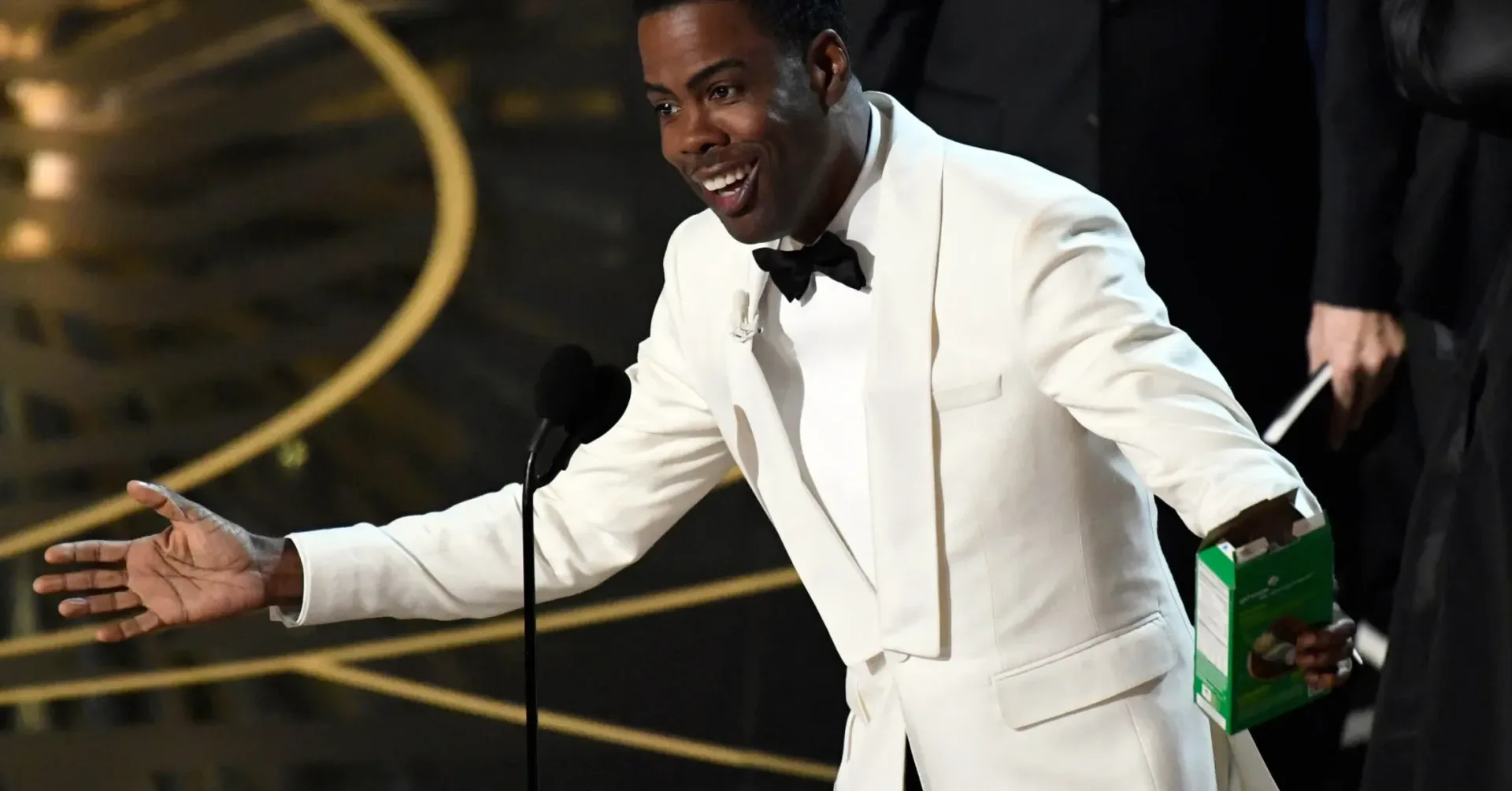
For a moment in March 2022, the Academy Awards stopped being an awards show and became an event people processed in real time from every possible angle. Chris Rock was onstage, Will Smith walked up, struck him after a joke about Jada Pinkett Smith’s shaved head, and then returned to his seat. What followed was a sequence that seemed almost impossible to separate from the ceremony itself: Smith shouting from the audience, then later taking the stage to accept the Best Actor Oscar for King Richard.
More than four years later, Rock appears determined not to let that night occupy the center of his public life. While discussing his upcoming movie Misty Green, which he wrote and directed, Rock said he wishes the confrontation had never occurred. But he also put it in a much wider human perspective, suggesting that one terrible personal day does not outweigh the hardship and instability people encounter every day beyond the Hollywood spotlight.
It is a notably restrained framing from someone whose name has been permanently tied to a single, extraordinary live-TV moment. Rock did not argue that the event was insignificant when it occurred. Nor did he erase its consequences. Instead, his comments suggest a distinction that can be difficult for audiences to make: an episode can be major in the public record without remaining the most important fact in a person’s own life.
From an awards-show flashpoint to a longer career
The 2022 ceremony gave viewers a clip that circulated at a scale few entertainment moments ever reach. It was replayed, debated and reinterpreted endlessly. People scrutinized the joke, Smith’s decision to approach the stage, Rock’s immediate reaction, the show’s handling of the moment, the acceptances that followed and the possible implications for everyone involved.
Yet the public’s appetite for a replay does not necessarily match the people at the center of it. Rock’s newer comments steer the conversation away from the perpetual postmortem and toward his work. His attention was directed to Misty Green and its star, Rosalind Eleazar, rather than toward a controversy that can easily eclipse the project he is promoting.
That shift matters because Rock is not merely appearing in the film. He wrote and directed it. The movie therefore represents a creative effort with its own collaborators, performance and identity. Treating every discussion of Rock as an opening to revisit the Oscars risks shrinking that work into an appendix to an old headline.
His remarks do not require anyone to pretend the incident was normal or forgettable. They simply reject the premise that a viral cultural rupture should receive unlimited claim on a person’s future. The internet is exceptionally good at preserving moments; people still have to decide which memories deserve to govern their present.
Rock has addressed the incident before
This is not Rock’s first public response. For nearly a year after the ceremony, he largely avoided an extended discussion of the slap. Then, in 2023, he addressed Smith at length during the closing section of Selective Outrage, his Netflix stand-up special. The live special was Netflix’s first event of that kind, and the confrontation was explicitly part of the anticipation surrounding it.
At that time, Rock’s approach was far more expansive and confrontational. He used stand-up to work through the anger, ridicule the circumstances and push back against the idea that he saw himself as a victim. That response belonged to a performer reclaiming control of a narrative that had been forced upon him in front of a global audience.
The difference between that material and his recent brief comments is meaningful. One was a comic’s sustained rebuttal after a long public silence. The other is a refusal to allow the same subject to displace a new film and the people who made it. Neither posture cancels the other. Time changes the emotional and professional value of returning to a subject.
Netflix remains a major part of the entertainment conversation well beyond stand-up specials, as shown by its plans for a new adaptation of Lonesome Dove. Rock’s 2023 special, however, has a particular place in the platform’s history because it was presented live, at a point when the public interest in hearing his response had reached enormous levels.
An Oscars host who is not chasing another turn
Rock’s reluctance to revisit the slap extends to returning as Oscars host. He has held that job twice before, hosting the Academy Awards in 2005 and again in 2016. Both assignments came long before the 2022 confrontation, and both reflected the specific skills required of a host: joke writing, timing, poise under pressure and the ability to guide a huge broadcast through comedy, tributes and unpredictable acceptance speeches.
But Rock does not sound eager for a third assignment. He praised Conan O’Brien and Golden Globes host Nikki Glaser, while indicating that his own season as an awards-show host may be over. It is not hard to see why that may be a sensible boundary. Hosting an awards show is prestigious, but it is also a peculiar job: the host becomes responsible for maintaining a room’s mood while delivering jokes about powerful people who are sitting only a few feet away.
After 2022, any hypothetical Rock return would arrive with an unbearable amount of baggage. Viewers would analyze every opening monologue line for references. A clean evening of television could be overshadowed by whether the broadcast acknowledged the past, avoided it or made it part of the entertainment. Rock’s lack of enthusiasm avoids turning an already difficult gig into a spectacle about spectacle.
He did leave a narrow, joking exception for attending the Oscars. Rock said he would go back if Misty Green somehow earned him a nomination, though he immediately discounted that possibility and said he was fine with it. The comment is self-deprecating, but it also places the ceremony in its proper professional context: he would return for recognition of new work, not for a ceremonial revisiting of an old wound.
The consequences of March 2022 still remain part of the record
Moving forward does not mean the consequences vanished. After the incident, the Academy barred Smith from its events for 10 years. Smith later apologized publicly, calling his conduct unacceptable and saying that he had tried to contact Rock. Those facts remain central to the history of the night, along with the unusual reality that Smith won his first Best Actor Oscar shortly after the altercation.
The Academy’s action also showed that the moment could not be treated as merely another provocative awards-show bit. A live ceremony depends on a basic understanding that participants, presenters and hosts can perform without being physically confronted onstage. The incident crossed that line. Whatever different viewers thought of the joke, the reaction or the ensuing discourse, the professional stakes were always larger than a trending clip.
Rock’s present-day stance does not minimize that. Saying an event no longer feels especially important in the total scale of one’s life is different from saying it never mattered. It is a statement about proportion. Rock explicitly contrasted his experience with far more serious problems in the world, including homelessness, and framed his own bad day as something that should not outrank those realities.
That perspective may disappoint anyone looking for a new round of celebrity conflict, but it offers a clearer view of what Rock seems to want now: a career discussed as a career. He is a comedian, actor, writer and director with a new film to put before audiences. Misty Green, Rosalind Eleazar’s performance and Rock’s filmmaking are the current subjects he would rather foreground.
Why the story has lasted, and why it does not have to last forever
Some entertainment stories endure because they symbolize larger arguments. The 2022 Oscars confrontation touched on comedy, public humiliation, celebrity image, marriage, race, institutional accountability and the strange pressure of live television. It was not simply a disagreement between two famous people. The event became a shared cultural reference point because it raised questions that did not produce easy consensus.
Still, culture has a habit of turning one documented moment into a permanent identity label. Rock’s comments push against that habit without demanding amnesia. He has already said what he wanted to say in a major comedy special. Smith has issued a public apology. The Academy imposed its sanction. The public can retain the history while accepting that Rock may not wish to keep narrating it.
For now, the most useful update is also the least sensational one. Rock wishes the 2022 incident had not happened. He is not angling to host the Oscars again. And he appears far more interested in directing attention toward Misty Green than in re-entering an argument that has already consumed years of discussion. In an attention economy built to make old conflict feel permanent, that is a meaningful choice.