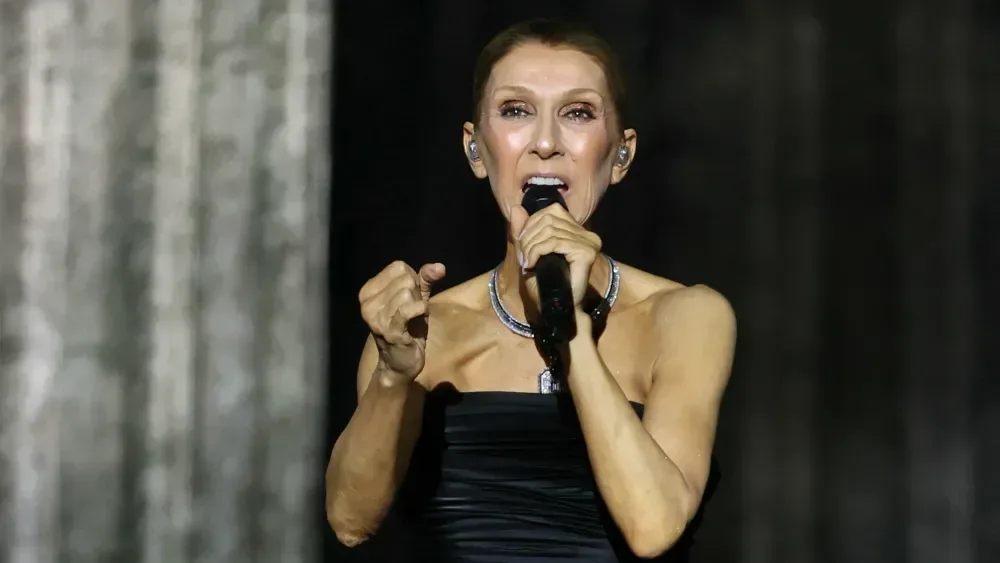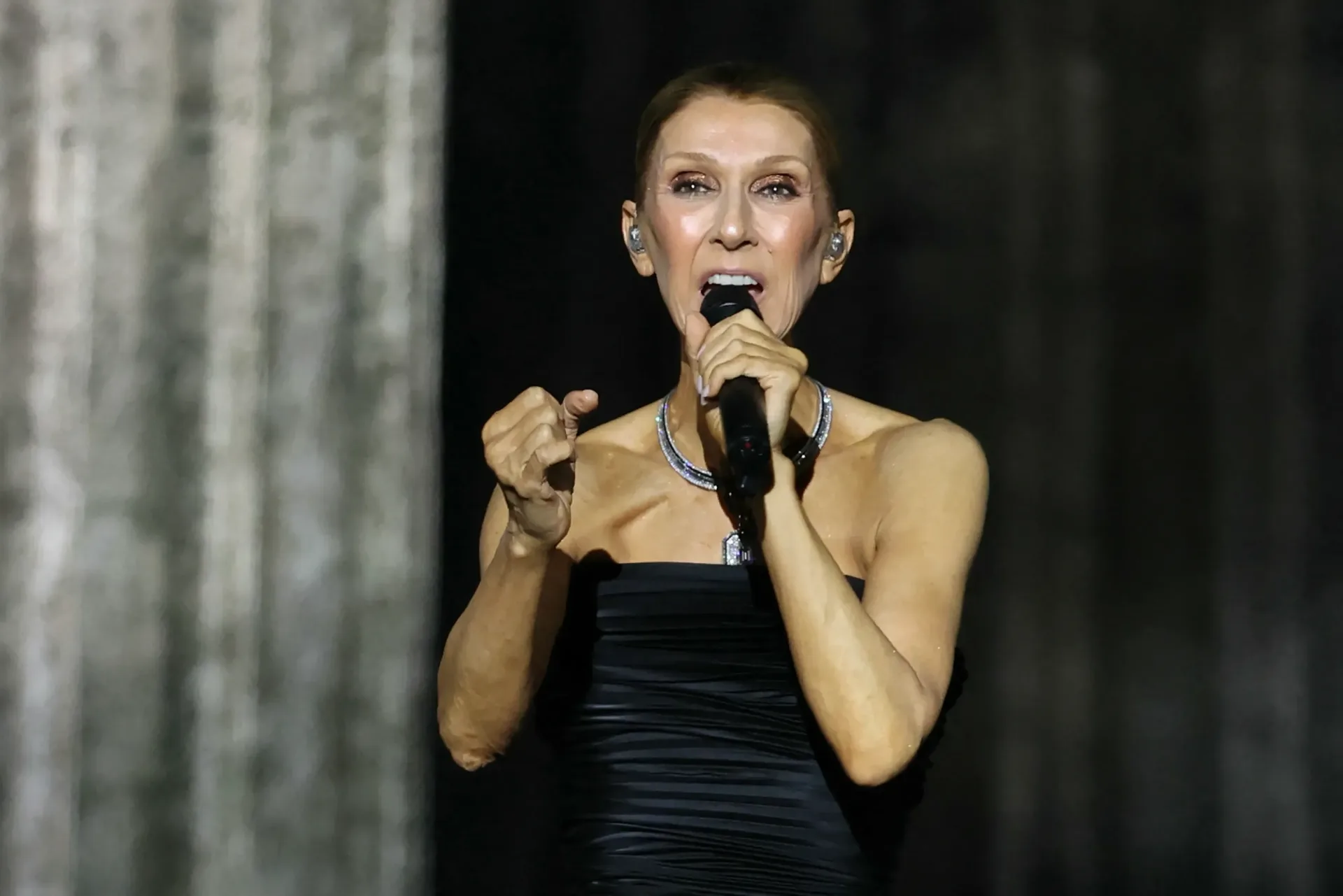
Celine Dion has opened her 16-date residency at Plenitude Arena outside Paris with an emotional return that placed the point of the evening in plain view: she is back onstage, singing live, after a long and deeply public absence from major concert performances.
The singer became tearful while greeting the crowd at the opening show. She had hoped to stay composed, she said, but the sight of the audience and the significance of the occasion overtook that plan. Her message was one of gratitude—to people who waited, supported her and continued to believe she would perform again—and of shared celebration rather than a victory lap staged at a distance.
It was Dion’s first major live series since stepping away from the spotlight in 2022. That timing gives every detail of the Paris engagement extra weight. A 16-show run is not simply one guest appearance or a televised song; it is a sustained commitment to an arena-sized audience, with more than 33,000 people expected at Plenitude Arena.
A comeback shaped by endurance
Dion was diagnosed in 2022 with Stiff Person Syndrome, or SPS, a rare neurological and autoimmune disorder associated with muscular stiffness and symptoms that can interfere with walking and singing. The condition forced an extraordinary pause in a career that had long been defined by vocal power, precision and an unusually punishing level of international touring.
Her return has never been framed as if those years disappeared. On opening night, Dion addressed the ongoing reality of living with her health condition, describing how confronting it day after day led her to make it part of her reason to keep moving forward. She also expanded the sentiment beyond herself, asking the room to recognize that strangers can be carrying grief, hardship or joy that is invisible from the next seat over.
That is a remarkably direct theme for a pop concert, but it fits the occasion. The audience was not merely there to hear a catalog of enormous songs. It was participating in a milestone that many fans feared might never arrive after the cancellations and delays of recent years.
Dion’s earlier Paris dates had originally been planned for 2020 at Paris La Défense Arena as part of the Courage World Tour. The pandemic postponed those plans, and her health subsequently led to further disruption. Her struggle was also seen in the 2024 documentary I Am: Celine Dion, directed by Irene Taylor. For viewers who watched that film, a full Paris residency carries a different kind of drama from the usual “return” headline: the scale itself is the statement.
Paris has turned the residency into an event beyond the arena
The build-up has spread well beyond the concert venue. Dion’s arrival in the French capital two weeks before the opening night sparked intensive attention online and in the city itself. The metro stop near Plenitude Arena has been renamed Celine and decorated with lyrics associated with her career, while fans from numerous countries have gathered outside the Royal Monceau hotel behind security barriers.
Related coverage includes Celine Dion Opens Paris Residency With Emotional Return to the Stage.
Videos of Dion interacting with those fans—sometimes joining them in song without accompaniment and sometimes dancing in front of the hotel—have circulated widely. Those images matter because they show a performer meeting a fan culture that has stayed active through her absence. They also underline how completely Paris has embraced the residency as a civic spectacle rather than treating it as just another sequence of dates on an arena calendar.
Interest was apparent months before the first performance. Dion announced her concert comeback on March 30, her birthday, through an Eiffel Tower event featuring an illuminated tribute and a choreographed light presentation set to her greatest hits. Dion did not attend that celebration in person, but she sent a video message. Around nine million people were estimated to have registered for advance tickets.
That appetite also creates risks for concertgoers. More than 200 fraudulent websites and social-media accounts reportedly emerged around the April presale period, targeting people seeking tickets. The number is a sharp reminder that a major return can generate a secondary marketplace of scams just as quickly as it generates legitimate excitement. Fans considering resale offers have a clear reason to proceed carefully and verify every purchase through official channels.
A French-language centerpiece, with a long night promised
The residency is expected to lean significantly into Dion’s French repertoire. As much as 60% of the set list is anticipated to come from those songs, including material written and composed by Jean-Jacques Goldman such as Pour que tu m’aimes encore and J’irai où tu iras. That balance makes sense in Paris, where Dion’s French-language work is central to her identity as an artist rather than a side road from her English-language global hits.
She has also indicated in an informal conversation with fans that the opening show would run for more than two hours, even advising attendees to choose comfortable shoes. The implication is a celebratory, large-format evening, one with room for both the career-defining songs and the emotional context surrounding their performance.
There has been speculation about a possible surprise duet with Beyoncé, who is in Paris with Jay-Z following his Paris concert two days before Dion’s opening night. At present, that remains only a rumor, not a confirmed part of the residency. The excitement around the possibility says something useful, though: Dion’s return is being treated as a major pop-cultural occasion with the gravity to draw even bigger headlines than the standard residency launch.
Her most visible step back toward performance came at the 2024 Paris Olympics opening ceremony, where she sang Edith Piaf’s Hymne à l’amour by the Eiffel Tower. That appearance was moving precisely because it was concise and high stakes. The residency changes the scale of the question from whether Dion could reclaim a stage for a moment to how she will inhabit it across 16 nights.
Why the economic claims have attracted attention
The residency has also been discussed in unusually grand economic terms. One French broadcaster has estimated that the Paris concerts could produce €1 billion in economic impact for France. That figure has been compared with the estimated impact of Beyoncé’s June 2025 Paris dates—four times larger—and with the 2024 Paris Olympics, at roughly one-fifth of that event’s overall impact.
Such projections should be read as estimates, not guarantees. They are nevertheless an indication of how a residency on this scale can ripple outward: hotels, restaurants, local transport, tourism and a worldwide audience all become part of the story. A French newspaper even placed Dion on its weekend cover alongside a provocative question about whether she might help rescue the country’s 2027 budget. No performer can literally solve a national budget, of course, but the headline captures the extraordinary expectations being placed on this run.
For pop culture, the more lasting point may be simpler. Dion’s Paris residency demonstrates how a live comeback can become a shared narrative across music, health, travel, fandom and city identity. It is not only the audience inside Plenitude Arena that is watching. People are following the hotel gatherings, the metro tribute, the ticket scramble and the possibility of surprises—as well as the personal stakes Dion has spoken about openly.
Live performance has always offered a particular kind of proof: not that an artist’s difficulties are gone, but that art can still meet an audience in the present tense. Dion told the crowd that night she had fulfilled a dream. For the fans who held onto the hope of hearing her sing again, the residency’s opening makes that dream a real event, unfolding one Paris show at a time.
For another look at a performer discussing the intersection of acting, identity and major stage work, read Andrew Scott on Elsinore, Hamlet, and why gay actors belong in straight roles.