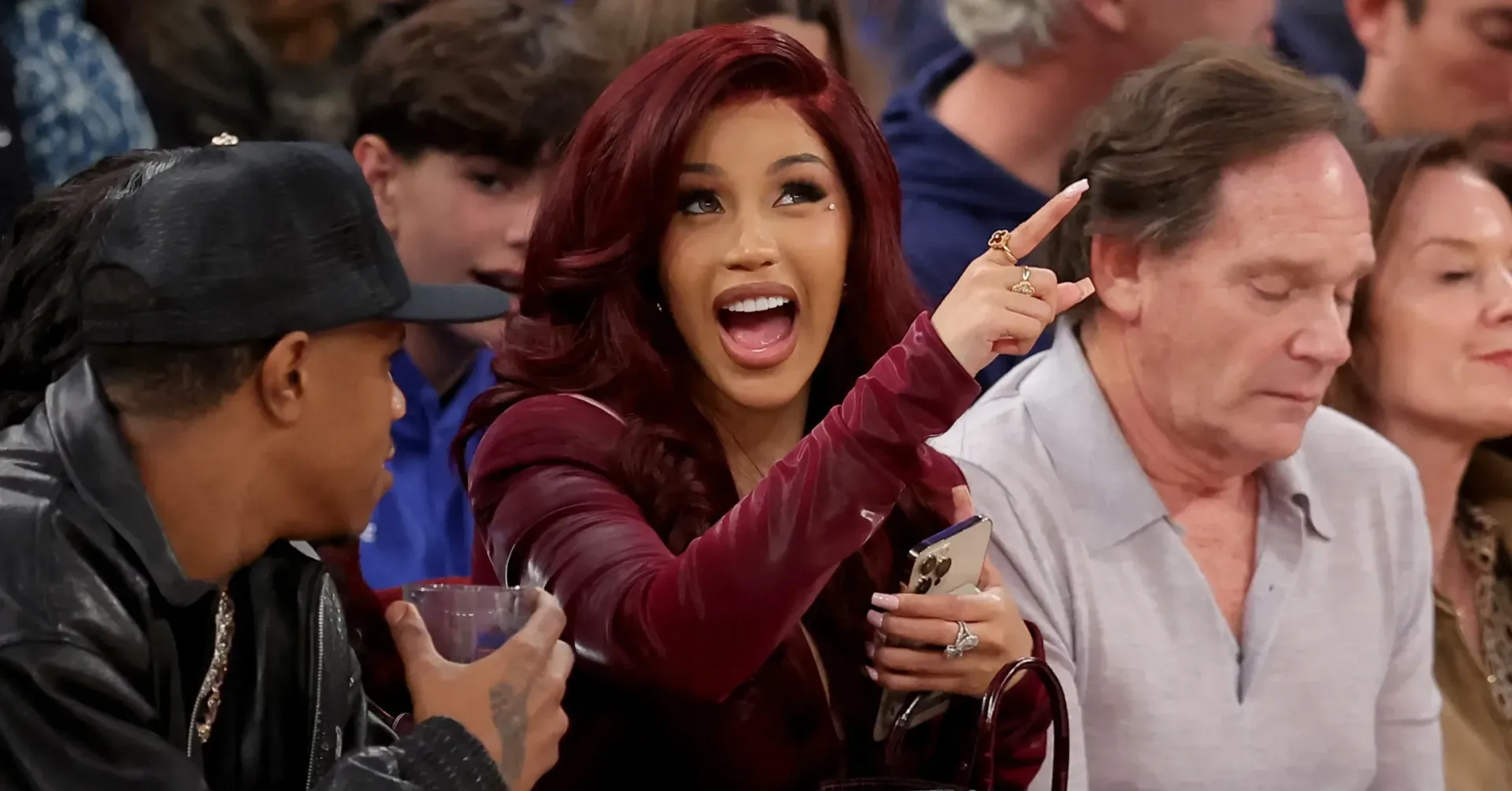
Cardi B drew a firm, immediate boundary during a Las Vegas nightclub appearance when a person in the crowd reached out and touched her while she was dancing with her back to the audience.
Video of the moment circulated online following the appearance, which took place around her iHeartRadio Music Festival commitments in Las Vegas. As Cardi danced near the front of the crowd, a hand reached toward her from below. She quickly waved it away with a slap of her own hand, visibly signaling that the contact was not welcome.
The clip is brief, and it does not turn into a larger onstage confrontation. Cardi continued dancing after the exchange, and the rest of the appearance appeared to proceed without another reported incident. But the moment has understandably generated discussion because it captures a basic live-event principle in real time: being close to a performer is not permission to touch them.
A version of the circulating clip can be viewed in this report on the Las Vegas appearance.
For more context, explore Hidetaka Miyazaki Says Other Company Presidents Have Inspired FromSoftware Enemies.
A quick response to an unwanted touch
The context matters. Cardi was not stepping down to greet attendees or inviting a physical interaction from the audience. She was dancing, facing away from the crowd, when the person reached toward her. Her reaction was swift and direct: hand away, boundary restored, performance continuing.
That kind of reaction can look minor when reduced to a few seconds of viral footage. It is still significant. A performer may be in a club, on a stage, or at the edge of a crowd, but the distinction between public visibility and personal access remains clear. Fans can enjoy the show without treating the performer’s body as part of the experience.
Online reactions split in the familiar way. Many people criticized the person who reached out, while others treated the clip as a joke or a meme. The latter response misses what happened: unwanted contact was met with a clear refusal. The fact that Cardi resumed dancing does not recast the contact as acceptable; it shows she chose not to let one person take over the event.
Consent does not disappear at a live show
Consent is the agreement to participate in a particular interaction. In a live-music setting, buying admission, standing near a stage, filming a performer, or cheering during a set does not create agreement for physical contact. That stays true even in nightlife environments designed around energy, dancing, and close quarters.
There is an important practical difference between an accidental bump in a packed room and a deliberate reach toward someone’s body. The video discussed here appears to show the latter, and Cardi’s response was correspondingly unmistakable. She did not need to pause the music, make a speech, or negotiate the point with the crowd for the signal to be understood.
For venue operators, artists, promoters, and attendees, the incident is a small but useful reminder that crowd proximity needs boundaries. A raised stage, barrier, security lane, or a little extra distance can serve a straightforward purpose: letting audiences feel connected to the performer while reducing opportunities for someone to cross a line.
Not every club appearance has the infrastructure of a major arena show. That does not change the expectation of basic respect. In intimate rooms especially, the responsibility moves in both directions. Teams should consider how close guests can get to an artist, and guests should recognize that closeness is a privilege, not an invitation.
The performance carried on
The DJ was playing Sexyy Red’s Get It Sexyy during the incident. Cardi later performed her newer track AH HA for the club audience. The available account indicates that the appearance otherwise went smoothly.
That continuation is worth noting because viral clips often flatten an event into one isolated flashpoint. The touch-and-response exchange became the online headline, but it was one moment during a broader nightclub stop built around Cardi dancing and performing. Continuing does not lessen the boundary she set; it simply means she retained control over whether that person’s action would derail her evening.
There is also no need to turn the video into a larger narrative than the evidence supports. The clip shows a specific incident and a specific response. It does not establish the identity or intent of the person who reached out beyond the visible action, nor does it require speculation about consequences that have not been described. The clearest reading is also the simplest one: an attendee touched Cardi without invitation, and Cardi physically rejected the contact.
Why the clip resonated
Cardi B’s public persona is often highly conversational and responsive, particularly online. That can make fans feel unusually close to an artist, but public accessibility is not the same thing as personal availability. Parasocial behavior is a useful term here: it describes the sense of connection an audience member can develop with a public figure who does not actually know them personally. That feeling can be harmless when it stays within respectful limits. It becomes a problem when someone mistakes familiarity with access.
Live entertainment intensifies that feeling. Fans are physically present, performers may be only a few feet away, and video clips can make the setting appear even more casual than it is. Yet the social rule remains uncomplicated: admire the performer, enjoy the music, take the offered photo or interaction if one is offered, but do not initiate contact.
The same principle applies well beyond celebrity settings. Whether the person is an artist, athlete, streamer, convention guest, club dancer, or another attendee, their visibility does not reduce their right to decide who can touch them. Cardi’s quick hand motion conveyed that without interrupting the night for anyone else.
What is next for Cardi B
Beyond the viral club video, Cardi has indicated that she is looking toward another album in 2027. She said she plans to spend time recording after her birthday in November and described feeling confident and motivated to work in the studio.
That proposed timeline would follow a much shorter wait than the gap between Invasion of Privacy and Am I the Drama?, described as seven years. Fans have also expressed hope that a future album cycle could bring more live dates, though no tour details are established here.
For now, the Las Vegas clip is less a music-news development than a plainly visible reminder of audience etiquette. Cardi B was there to dance and perform. When one person confused being near the action with being entitled to touch her, she answered immediately—and then carried on with the show.