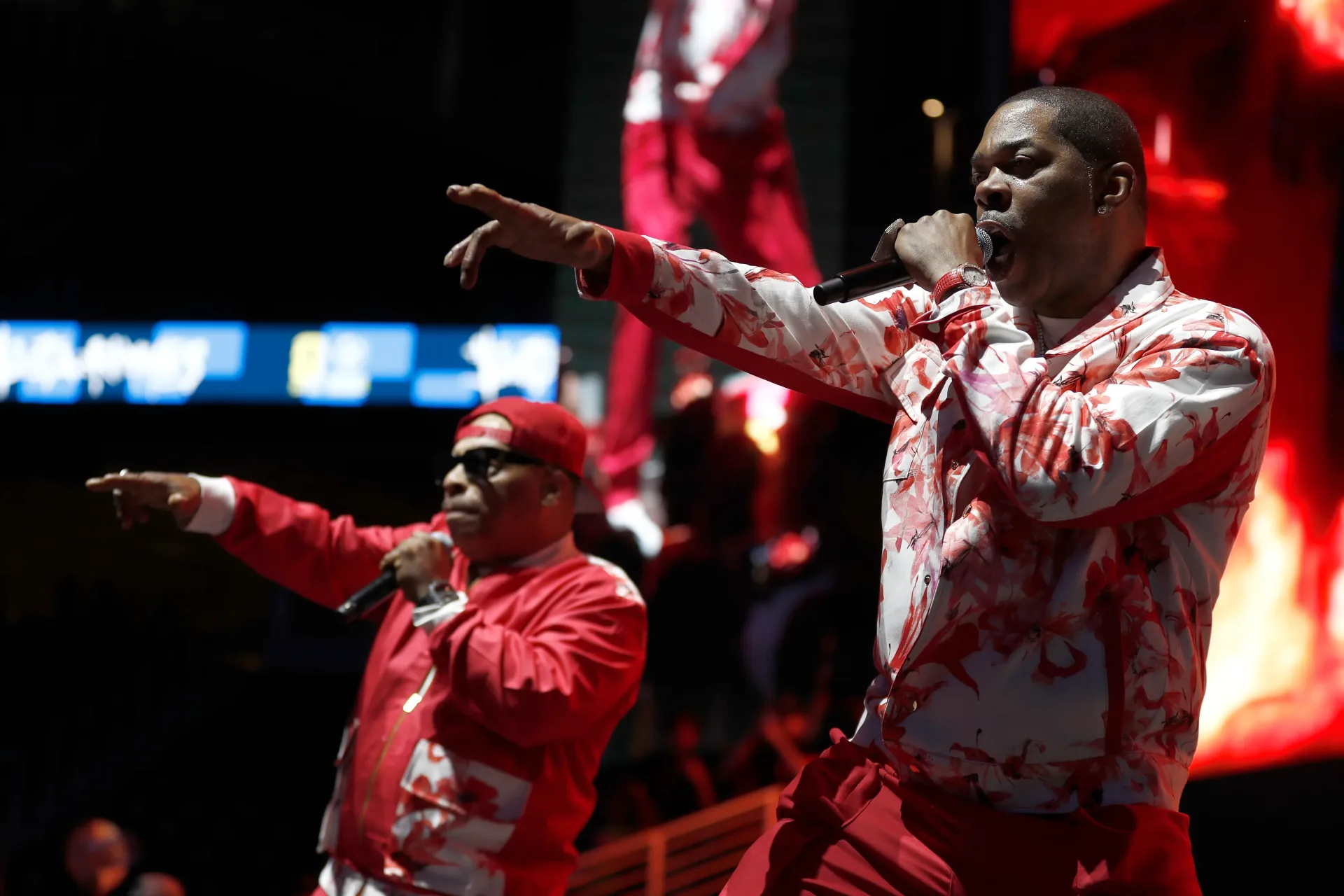
Busta Rhymes has named A Tribe Called Quest’s The Low End Theory as his essential album pick in a music-library feature built around a simple but revealing premise: choose one record that matters, then leave a handwritten note for the next person to encounter it.
The choice is personal in ways that go well beyond admiration. Busta appeared alongside Leaders of the New School on “Scenario,” the closing track of the 1991 album. That appearance helped bring him to a wider audience before his solo career, making The Low End Theory part of his own professional origin story as well as a landmark he returns to as a listener.
His selection also arrived in the year the record turned 35. The Library of Congress added The Low End Theory to the National Recording Registry in 2022, formal recognition of an album whose influence has continued to be felt across hip-hop listening, performance and production conversations.
More than a favorite record
A celebrity choosing a beloved album can be a tidy exercise in canon-building: a familiar classic gets another salute, everybody agrees it is important, and the shelf remains very impressed with itself. Busta’s relationship with this particular album carries a more specific weight. He credited Q-Tip, Ali Shaheed Muhammad, Jarobi and the late Phife Dawg with seeing his potential before he did.
He also recalled being at Battery Studios while the album was coming together, when the artists involved were still living with their parents. That detail gives the record a human scale beneath its later reputation. Before it became a work preserved in a national registry and widely treated as a foundational hip-hop release, it was being assembled by young artists in the midst of figuring out what came next.
“Scenario” is central to that history. The track placed Leaders of the New School alongside A Tribe Called Quest and offered Busta an early high-profile opening. It is tempting to treat a famous career as though it was always inevitable; moments like this show the importance of a creative community making room for another voice. The album’s legacy and Busta’s emergence are connected, but neither story needs to be reduced to the other.
What changed on The Low End Theory
The Low End Theory followed A Tribe Called Quest’s 1990 debut and contains 14 tracks. It marked a shift within the group, including a larger role for Phife Dawg alongside Q-Tip. For listeners, that matters because a group’s identity is not only a matter of who is credited on the cover. It is also shaped by how prominently its members are heard, how their perspectives move through the songs and how a record distributes its musical space.
The album also featured jazz bassist Ron Carter on “Verses From The Abstract.” The appearance is a concrete example of the record’s musical scope. “Jazz-inflected” can become a catch-all phrase when people discuss hip-hop, but Carter’s presence points to an actual musician and an actual collaboration rather than a vague label pasted onto the project after the fact.
Related coverage includes Busta Rhymes Names The Low End Theory Essential Listening.
Its title puts the bass register in the foreground. In musical terms, the low end refers to the lower-frequency area that gives a track weight and rhythmic foundation. It is not merely a technical detail for listeners who own large speakers and enjoy alarming their neighbors. In hip-hop, the relationship among drums, bass and vocal cadence can define a song’s physical momentum. The title therefore signals an attention to sound as much as it does a statement of attitude.
That focus sits alongside songs concerned with the business around young artists. “Rap Promoter” and “Show Business” address problems they faced in the industry. Their inclusion is important context for the album’s standing: the record is not presented solely as a celebration of musical craft or a showcase for memorable performances. It also engages with the pressures and structures surrounding people attempting to build careers.
A record of connections, not a sealed time capsule
Busta’s broader browsing during the feature adds another layer to why The Low End Theory remains meaningful. He pulled music by James Brown and Sly and the Family Stone, identifying their importance to hip-hop’s musical roots and to the drum material producers sampled. Sampling, in this context, means incorporating a portion of an existing recording into a new work. It can turn a drum passage, musical phrase or other recorded element into part of a new composition and performance.
Those selections do not make the history of hip-hop a straight line with a single beginning and a single destination. They do show one of its essential modes of connection: artists listen across genres and eras, identify sounds that speak to them, and build new records in conversation with what they hear. James Brown and Sly and the Family Stone are not background decorations in that account; their drums point toward the practical musical materials that producers have worked with.
Busta’s choices extended to reggae and dancehall artists Shabba Ranks, Super Cat and The Skatalites, plus Fela Kuti. Taken together, the shelf pulls suggest a wide frame for listening rather than a narrow exercise in naming only rap albums. That is useful for anyone approaching The Low End Theory for the first time. The record can be appreciated as a self-contained album, but Busta’s selections encourage attention to the broader web of rhythm, performance and recorded music that informs hip-hop culture.
For a related look at another rapper moving between music and screen work, see MC Jin’s role in the English-language release of Kung Fu Soccer.
From Dilla collaboration to a lasting recommendation
The library appearance followed Busta’s conversation with host Novena Carmel about Dillagence II, a project built around beats by the late J Dilla. Busta announced the project in August. It continues a recording partnership that reaches back to his solo albums and the 2007 Dillagence mixtape.
That surrounding context makes the The Low End Theory pick feel less like a detached anniversary nod and more like an artist mapping the relationships that have shaped his work. There is the formative opportunity of “Scenario,” the trust he says Tribe’s members showed him early on, the sampled musical foundations represented by his other library choices, and the ongoing connection to J Dilla’s beats. The different names belong to different points in his story, but all are tied to the question of how artists learn from, collaborate with and preserve the work of others.
The handwritten-note format is fitting for that kind of selection. A note left with an album does not dictate what a future listener must hear. It offers a prompt: pick this up, spend time with it and consider why someone regarded it as necessary. In Busta Rhymes’ case, the recommendation comes with unusually direct stakes. He was not simply influenced by The Low End Theory; he was on it, in a moment that helped introduce him before his solo career.
Why the pick still lands
There is a difference between calling an album historically important and describing why an artist might consider it essential. The former can become a checklist of accolades, anniversaries and reputation. The latter is more personal. Busta’s choice brings those categories together without confusing them. The album has institutional recognition through its 2022 addition to the National Recording Registry. It also holds a place in his memory of studios, early encouragement and an appearance that expanded his audience.
That dual status may be the clearest takeaway from the feature. The Low End Theory can be discussed through its 14-track structure, Phife Dawg’s expanded role, Ron Carter’s contribution, its industry-facing songs and the lasting force of “Scenario.” Yet the record’s value is also found in the relationships around it: people recognizing ability in a young performer, collaborators sharing a track, and later artists continuing to trace where the sounds they love came from.
A great album is often described as timeless, a compliment that can accidentally strip away the circumstances that made it. Busta Rhymes’ selection does the opposite. It returns The Low End Theory to a specific setting—Battery Studios, early careers, a collaborative scene—while also demonstrating why listeners keep carrying it forward. Thirty-five years after its release, the album remains both an enduring work and a living point of reference for one of the artists whose path it helped change.