Spoilers for the Ted Lasso Season 4 finale, “The Departing Lass,” follow.
The opening of a television show is usually designed to make repetition feel comforting. Viewers hear the same musical phrase, see the same images, and settle into a familiar emotional contract before the episode begins. Ted Lasso has spent much of its run doing exactly that with its title song, co-written and performed by Marcus Mumford alongside composer Tom Howe. The Season 4 finale breaks that ritual—but not by abandoning the song.
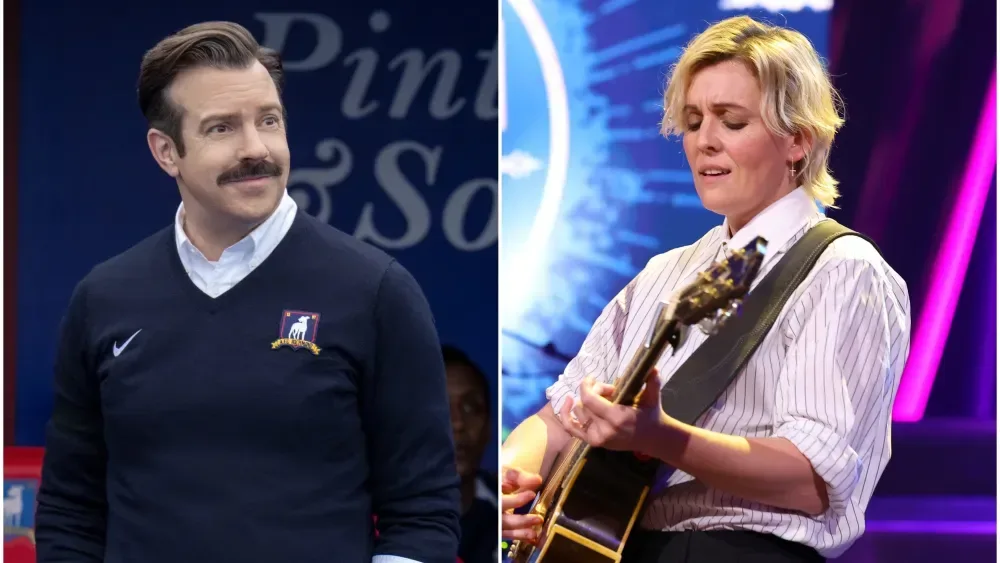
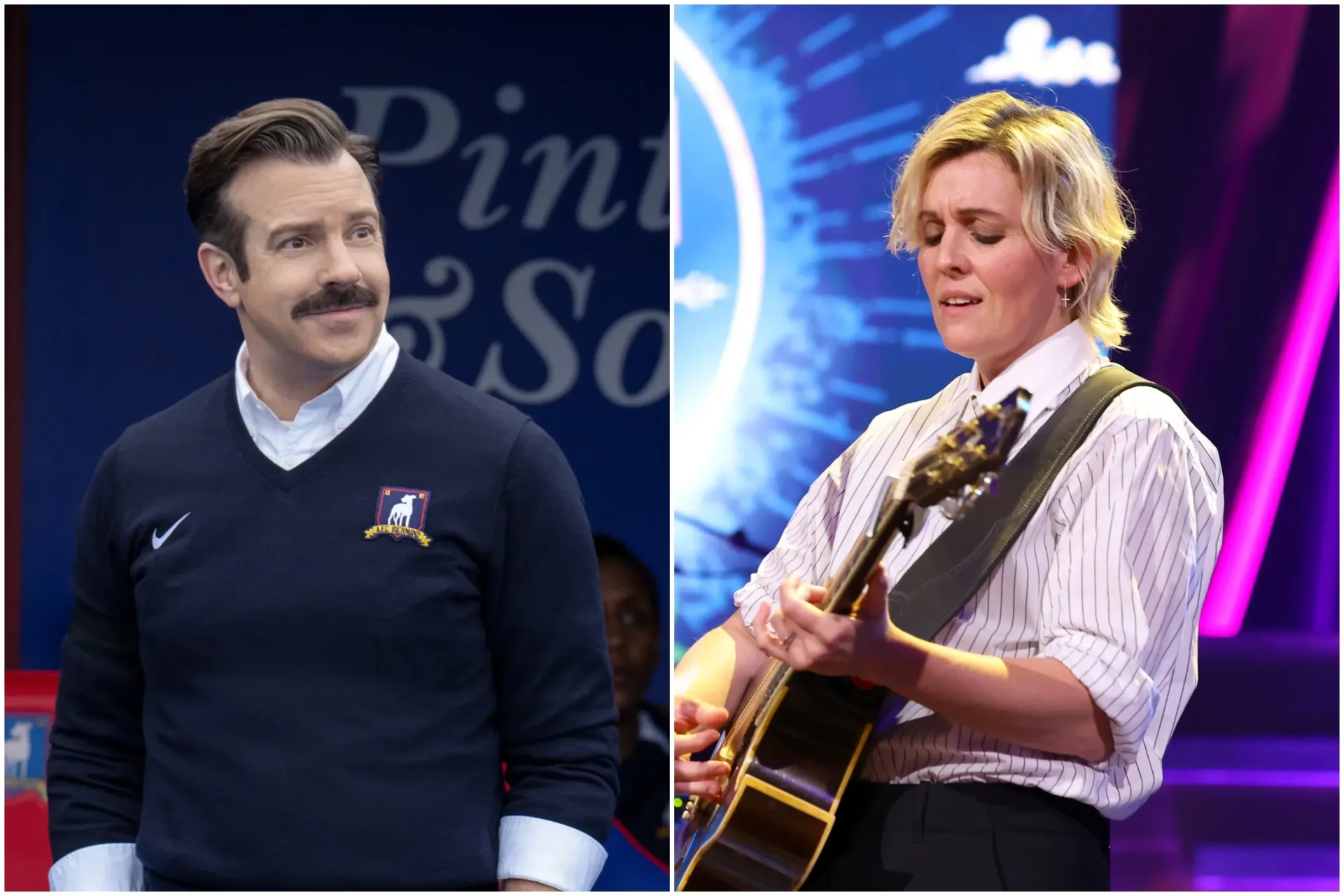
Instead, “The Departing Lass” opens with singer-songwriter Brandi Carlile performing a new cover of the familiar Ted Lasso theme. It is a small change in screen time and a large change in meaning. The tune remains recognizable, preserving the musical identity audiences associate with the show, while the voice delivering it is different. That combination makes the finale’s opening feel less like a replacement and more like a handoff.
For a series now framed around a transition from its men’s team to its women’s team, the decision is purposeful. Executive producer and star Jason Sudeikis had reportedly considered using a woman’s voice for the theme as the show changed direction, while also wanting the move to arrive naturally rather than suddenly. The finale provided that moment, and Carlile was the performer he approached.
A familiar theme, deliberately reframed
A theme song is more than a piece of music that fills the credits. In television, it acts as an audio identifier: a short musical cue repeatedly tied to the program’s characters, tone, and world. Changing one can signal an entirely new show. Covering one is subtler. The melody, structure, and recognition remain, but a different performer can bring a different emotional emphasis.
That is what makes Carlile’s role especially notable. Ted Lasso did not simply select an unrelated song for a finale montage or use a guest performer as a one-off novelty. It reinterpreted the series’ central musical calling card at precisely the point when the story’s focus is evolving. The new recording keeps a line to the show’s past while acknowledging that the future may be told from another perspective.
The production’s reasoning also avoids treating the change as a blunt symbolic swap. The reported goal was a graceful transition. In practice, that means the original Mumford/Howe composition is not discarded; it is carried forward through Carlile’s version. The arrangement and interpretation may alter the experience, but the song’s role as the Ted Lasso theme remains intact.
That distinction matters for longtime viewers. A show can grow without asking its audience to pretend its earlier identity never existed. The finale’s approach suggests continuity: the series is moving somewhere new, and its music is making that movement audible.
Why Brandi Carlile fits the moment
Carlile was not a stranger to the series before the finale. Her cover of “Home” from The Wiz appeared in a Season 3 episode, establishing a prior musical connection between her work and the show. The finale, however, gives her a much more prominent assignment. Rather than appearing within an episode, she takes over the audio audiences hear at the very beginning.
Her selection also grew out of an existing relationship. Sudeikis and Carlile’s connection dates at least to a 2021 episode of Saturday Night Live, when he hosted and she appeared as musical guest. Sudeikis has also been described as a longtime admirer of her work, and he and fellow executive producer Brendan Hunt have attended several of her performances.
Those connections explain the collaboration without reducing it to familiarity. The creative question was how to reshape a signature piece of Ted Lasso music for a finale and for a potentially changed series. Carlile had both an existing relationship to the show’s musical world and the ability to deliver a distinct interpretation of its best-known tune.
Hunt, who plays Coach Beard, has described hearing the complete recording as intensely emotional. He said the version played for him included Carlile and her full band, and he characterized the unreleased full-length performance as powerful enough to move him to tears. The finale itself uses only a roughly 30-second piece during the credits, meaning viewers have heard a brief excerpt rather than necessarily the complete recording.
That difference is worth keeping clear. A full version was played privately for Hunt, but there is no confirmed public release described here. His hope that Apple might release it is just that: hope, not confirmation that listeners can stream or purchase the complete track.
Not the first Ted Lasso opening detour
Although Carlile’s recording is notable for what it may represent, Ted Lasso has altered its opening music before. Season 2’s standalone “Beard After Hours,” centered on Coach Beard’s eventful night, opened with a song by Wilco’s Jeff Tweedy instead of the standard Mumford and Howe theme.
That earlier switch established that the series could bend its opening convention when an episode demanded a different mood or point of view. But the Season 4 finale has a broader implication. “Beard After Hours” was a character-specific detour. Carlile’s cover arrives as the series is explicitly considering a shift toward the women’s team, making the revised theme feel connected to the program’s prospective next chapter rather than only to an unusual episode format.
There is still an important uncertainty at the center of that interpretation. A Season 5 has not been confirmed in the information available here. Carlile’s version could become the show’s ongoing theme if Ted Lasso returns, but it has not been established as a permanent replacement. For now, it is the finale’s opening theme—and a strong indication of how the production may want to frame a continuation.
What the change says about the show’s women’s-team focus
Using a woman’s vocal performance for the title music does not, on its own, define every aspect of Ted Lasso’s future. It does, however, make the intended directional change immediately legible. Before any dialogue, plot point, or character entrance, the opening tells audiences that they are hearing a familiar world through a newly emphasized voice.
That is an effective storytelling tool because opening credits operate at the boundary between expectation and episode. The title sequence tells viewers what kind of experience is beginning. Reworking the established theme lets Ted Lasso preserve the upbeat, communal association of its original sound while putting its women’s-team transition at the center of the show’s presentation.
It is also a reminder that musical choices can do narrative work without becoming exposition. No character needs to explain that the series is changing. The song itself makes the point through performance and placement. Carlile’s cover operates like a bridge: it joins a recognizable composition to a different voice and to a potentially different era.
That sort of bridge is particularly useful for a returning series. Continuation invites two opposing risks: changing too little can make a show feel stalled, while changing too abruptly can make it feel disconnected from what viewers valued. The finale’s title sequence aims for a middle path. It makes a transition visible and audible while retaining the theme’s core identity.
What viewers can and cannot expect next
The immediate takeaway is straightforward: the Season 4 finale uses Brandi Carlile’s cover in place of the usual opening theme. The larger takeaway is more tentative. The creative team sees the recording as fitting a changing Ted Lasso, especially its movement from a men’s-team story toward a women’s-team story. Carlile has previously contributed music to the show, and the full version of her new recording appears to extend beyond the short credits excerpt heard in the finale.
What remains unknown is whether that full recording will be officially released and whether a future season will adopt the Carlile version as its permanent opening. Neither outcome should be assumed. The finale offers a compelling possible template, not a confirmed long-term production plan.
For viewers interested in the wider Apple TV ecosystem around sport and sound presentation, the platform has also been building out its sports offerings; its Formula 1 coverage, for example, has added Dolby Atmos for a U.S. Grand Prix weekend, as covered in this Apple TV Formula 1 audio update. That is separate from Ted Lasso and does not indicate anything about a release for Carlile’s full theme recording, but it underscores why music and audio choices remain a visible part of the platform’s programming identity.
For Ted Lasso, the most resonant part of the finale change may be its restraint. The series did not need a wholly new anthem to suggest a new phase. It used the same song, entrusted it to a different performer, and let the altered voice carry the weight of the transition.