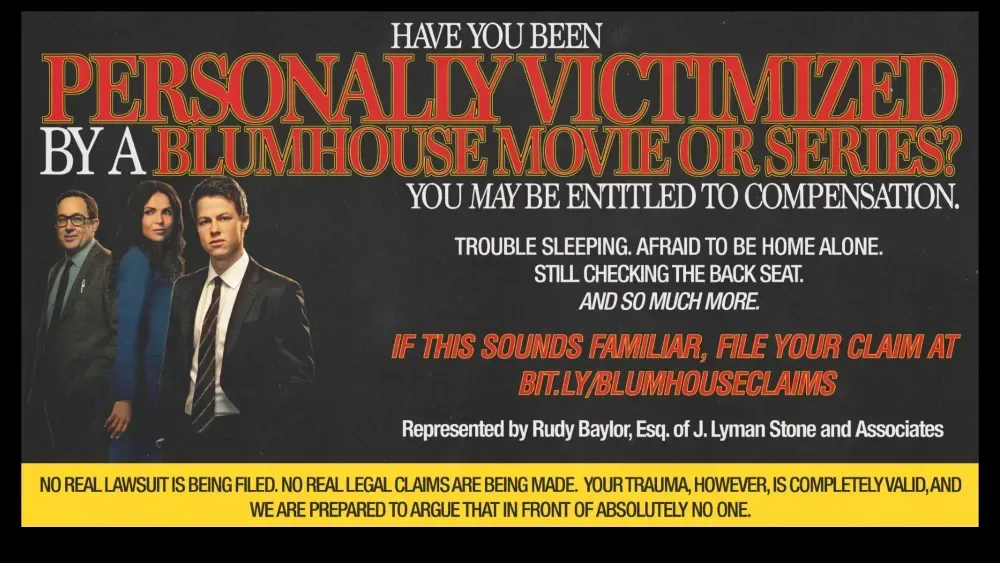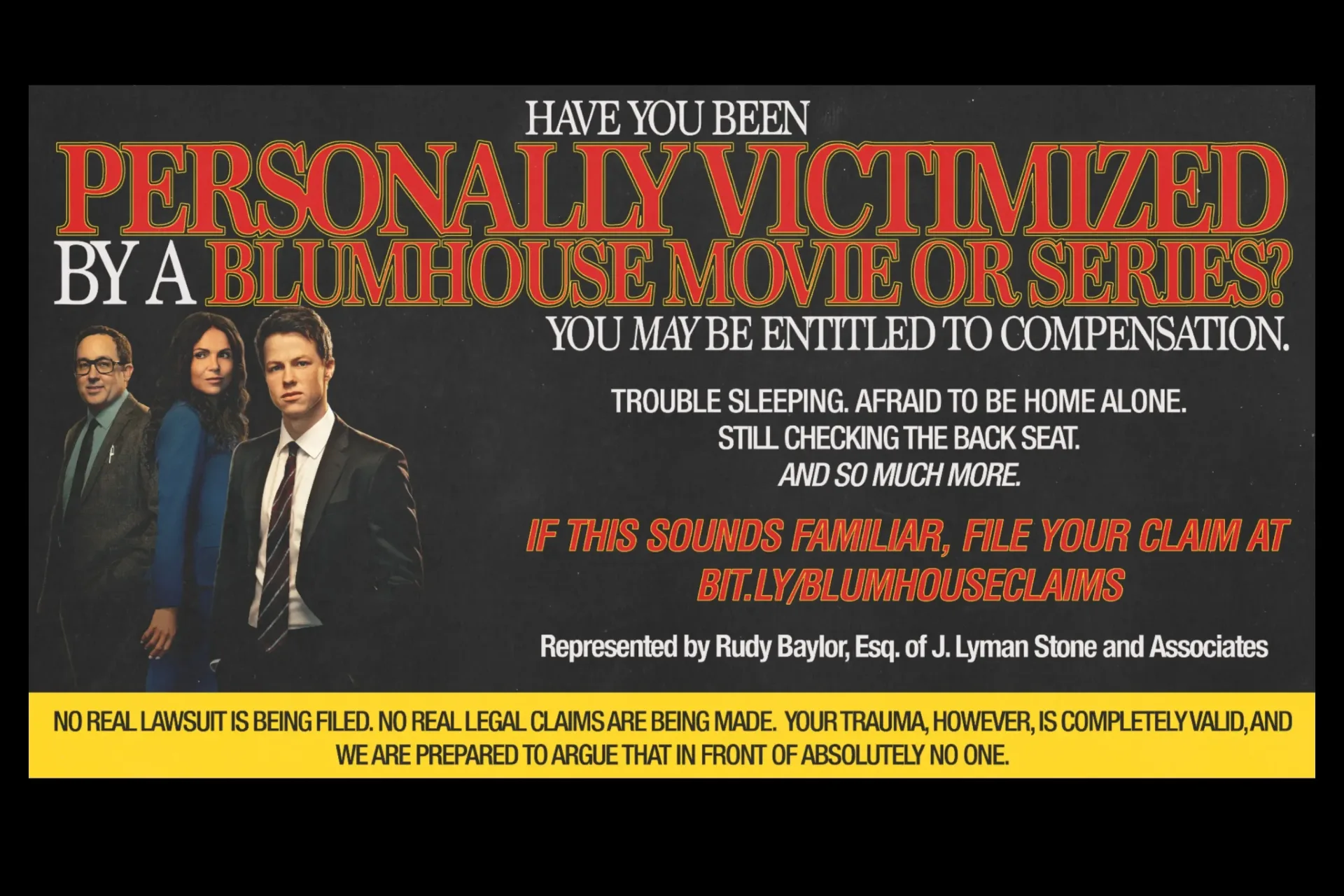
Blumhouse Atomic Monster is leaning all the way into the idea that a good scare leaves a mark. To help promote Season 2 of The Rainmaker, the company has launched a tongue-in-cheek campaign asking people who feel “personally victimized” by a Blumhouse movie or series to lodge a complaint.
The premise deliberately resembles legal advertising: viewers are told they may be entitled to compensation after being wrongfully terrified. But the campaign’s fine print draws the line plainly. No lawsuit has been filed, no actual legal claims are being made, and the compensation language is part of the joke. The invitation is instead a fan-engagement stunt built around the collision of horror fandom and a television drama about attorneys.
People who choose to take part can submit a complaint through the campaign’s designated link. Blumhouse says it will collect and share submissions through its social accounts. The spoof launched on the company’s social channels and through The Van, the Blumhouse Atomic Monster newsletter.
A legal-ad parody built for a legal thriller
The campaign arrives as the second season of The Rainmaker gets underway on USA Network, where Episode 2 airs Friday. The series is also available on Prime Video. On Friday, it ranked No. 9 among all content in the United States on that service.
At its center, the promotion makes a simple genre connection. Blumhouse is broadly identified with horror, while The Rainmaker is a legal thriller. The mock claim notice turns the exaggerated aftermath of watching a scary movie into the language of a potential case: fans are the supposedly aggrieved party, the studio is the imagined defendant, and the viewer’s fright becomes the alleged injury.
That setup gives the campaign a deliberately absurd edge without presenting itself as a real dispute. It is important that the disclaimer is not buried in the concept: the promotional copy directly says there are no genuine claims and no real case. In plain terms, this is participatory marketing, not a route to damages, a class action, or legal advice.
Karen Barragan, chief marketing officer at Blumhouse Atomic Monster, characterized the effort as a way to make the show feel connected to the company’s broader identity, reaching existing fans while widening the audience for The Rainmaker. She also noted that the concept required extensive conversations with lawyers—an especially fitting detail for an ad campaign that borrows the form of legal solicitation.
What “spoof” means here
A spoof is a comedic imitation of a recognizable format. Here, the recognizable format is the kind of advertisement that asks consumers or viewers to contact a law firm about a possible claim. The humor depends on taking the emotional experience of horror seriously enough to mimic formal legal language, then immediately deflating it with the admission that nobody is actually going to court.
It is a useful distinction for anyone seeing the promotion in a social feed. The submission page is intended for playful fan responses that may be featured by the company, not a confidential channel for personal legal matters. Participants should therefore treat a submission as public-facing promotional material rather than as a formal complaint or a request for legal representation.
The Rainmaker Season 2’s expanding courtroom stakes
The campaign’s legal framing is not merely a surface-level gag. Season 2 places its characters in multiple high-pressure disputes. Milo Callaghan returns as Rudy Baylor, an underdog lawyer working with Jocelyn “Bruiser” Stone, played by Lana Parrilla, and paralegal Deck Shifflet, played by P.J. Byrne.
The principal story sees J. Lyman Stone and Associates facing both familiar and new opponents in a case involving the lives of hundreds of children. The season’s logline suggests that a courtroom victory could carry its own danger, a premise that positions the legal fight as more than a clean contest between winning and losing.
Rudy also faces Sarah Plankmore, his former law-school flame, played by Madison Iseman. She enters the courtroom at the instruction of her new boss, Amanda Vonn, portrayed by Merle Dandridge. Vonn is described as a powerful attorney whose agenda may conceal an international conspiracy.
A separate plot brings Bruiser’s former husband, Tom Cassady, played by Austin Nichols, back to her for help. His legal troubles put both him and the minor-league baseball team’s star pitcher, played by Liam O’Halloran, at risk. Together, those strands give the season a broad field of conflict: public-interest stakes, personal history, suspicious professional motives, and danger surrounding a sports figure.
For viewers, that means the fake-claims concept is not selling a horror series masquerading as a legal drama. It is promoting a legal thriller through a horror brand’s sensibility. The joke recognizes that Blumhouse’s audience arrives with memories of being startled, unnerved, or otherwise rattled by its films and series, then repurposes that shared vocabulary for a show about lawyers.
A campaign designed to make fandom visible
The practical goal is participation. Rather than simply placing a conventional trailer or poster in front of potential viewers, the campaign asks fans to invent and submit their own account of being “wrongfully spooked.” That can turn a passive audience into part of the promotion, while giving the company material to share on its social channels.
There is a clear brand logic to that approach. Horror has a built-in social language: viewers recount the scene that made them jump, the character they could not stop thinking about, or the film they were not prepared to watch alone. A mock grievance gives those reactions a structured, comic frame. The legal premise also keeps the message tied to The Rainmaker rather than functioning as a generic celebration of scary movies.
It is also an example of cross-genre marketing, meaning a campaign that uses the tone or associations of one kind of entertainment to introduce another. Blumhouse’s horror reputation supplies the punchline; a courtroom drama supplies the format. Neither side of the equation needs to be mistaken for the other for the joke to work.
Fans of screen horror looking for another recent genre conversation can also read our look at Other Mommy. In the case of the Blumhouse promotion, though, the point is less about judging a film’s scares than playfully treating those scares as evidence.
Strong early context for the show’s return
Season 2 begins with meaningful momentum for the series. Season 1 was USA Network’s most-watched freshman series in seven years and the most-watched new scripted series across cable in 2025. Those figures explain why the promotional effort is focused on broadening the show’s reach without abandoning the personality of one of its production partners.
The Rainmaker is produced by Lionsgate Television and Blumhouse Atomic Monster. Michael Seitzman serves as showrunner and executive producer. John Grisham, Patrick Moran, Jason Richman, David Gernert and Jason Blum are also executive producers.
Seitzman extended the campaign’s joke by imagining Rudy, Deck and Bruiser looking at the box office for Obsession and identifying it as their big target. It is another reminder that the campaign is speaking in the dramatic idiom of litigation, not announcing a real case against anyone.
What viewers should take from the promotion
- It is not a real legal action. The campaign explicitly says that no lawsuit or genuine claim is being filed.
- The “compensation” language is comedic. It is part of an imitation of legal advertising, not an offer of a payout.
- Submissions may become social content. Blumhouse has said it will collect and share entries on its social channels.
- Its purpose is to promote Season 2 of The Rainmaker. The concept connects the company’s horror audience to a legal-thriller series.
In short, the campaign asks a knowingly silly question: if a horror movie genuinely got under your skin, can you put the studio on trial for it? The answer, legally, is no. As a way of getting people to talk about a courtroom drama while revisiting their favorite fright-induced grievances, it is exactly the point.