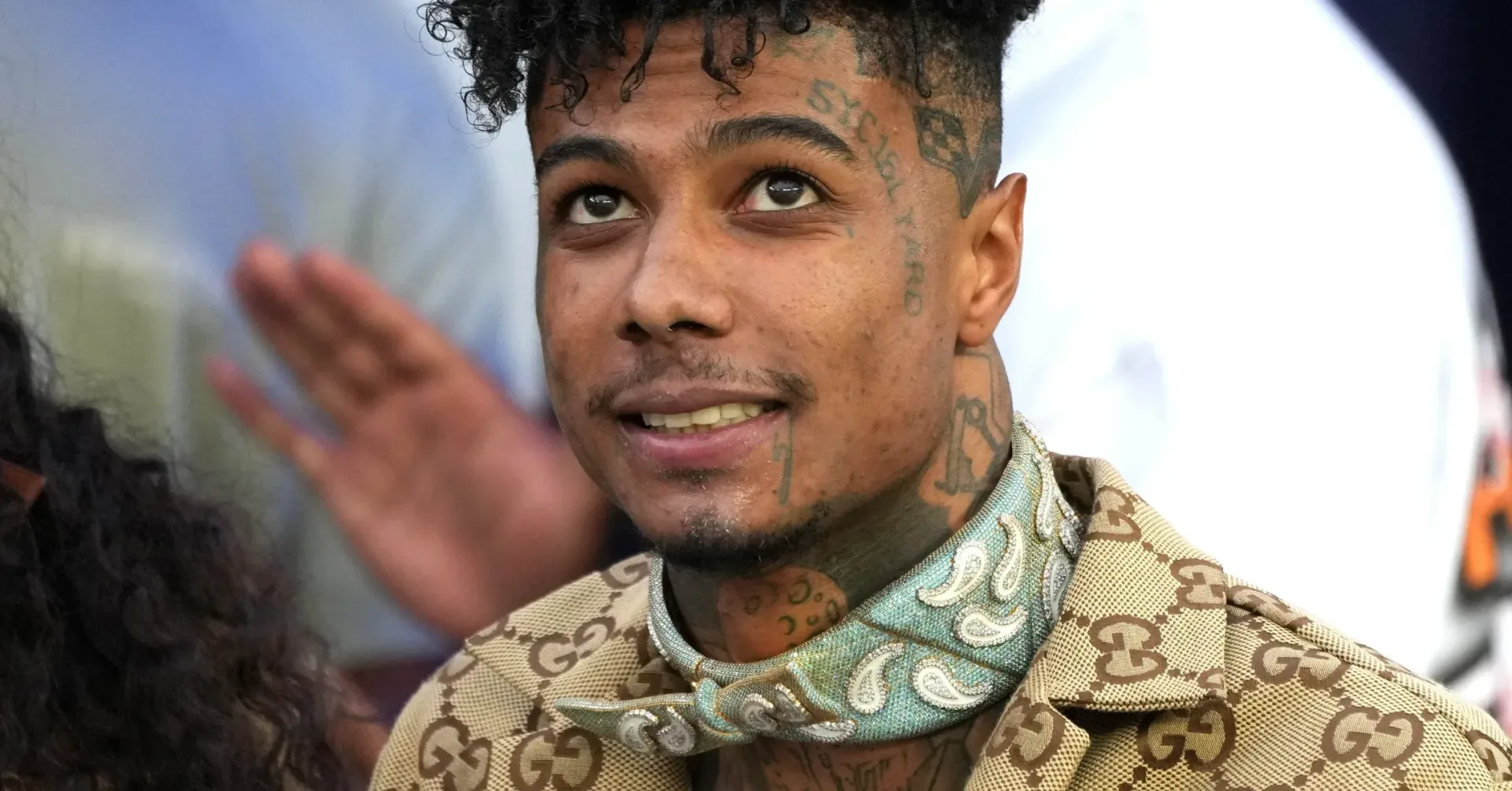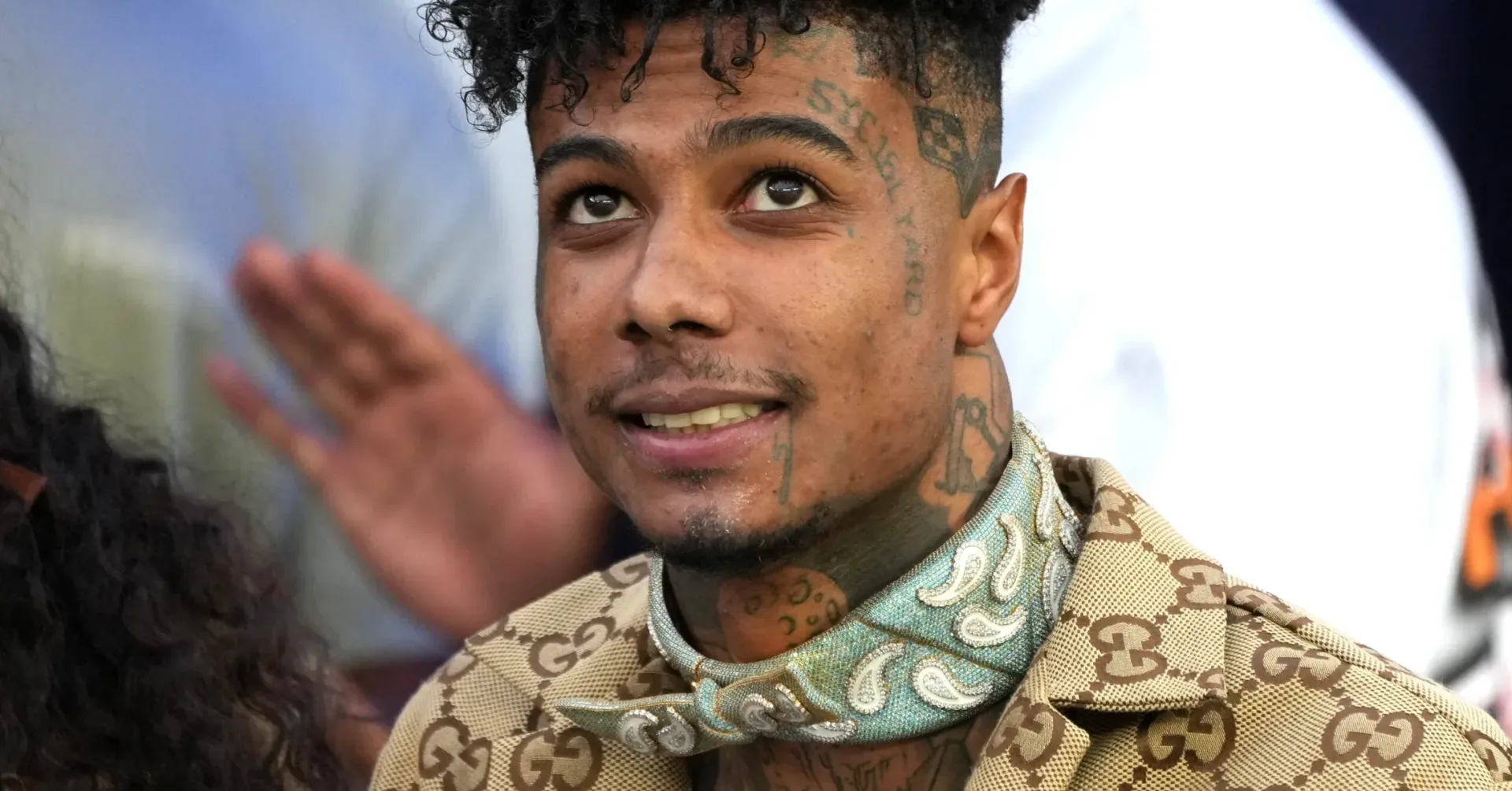
Blueface’s facial tattoo collection has grown again, with four newly visible designs adding even more visual density to an already unmistakable look. The latest ink centers on money imagery, gambling symbolism and luxury-car branding: a Benjamin Franklin portrait paired with “100,” a set of gambling chips, a Mercedes-Benz Maybach logo on the chin, and a Bentley-style emblem whose central “B” appears to have been replaced by a “C.”
They are notable not simply because they are new tattoos, but because of where they sit. Face tattoos are immediately legible in photos and videos, turning each addition into a prominent component of a public image rather than a detail viewers might only notice in a posed shot or onstage. The new designs appear darker than Blueface’s older facial tattoos, a difference consistent with them being fresh rather than fully healed.
The response online has been forceful and divided in tone, though much of the reaction has been plainly critical. Comments circulating around the images included concern rather than curiosity, with some people framing the decision as upsetting and others saying they could only hope for the best. That kind of reaction is now part of the story whenever a celebrity makes a highly visible and permanent change: the tattoo becomes both a personal choice and a social-media prompt.
What the four designs appear to show
The clearest element in the reported set is Benjamin Franklin with the number “100” below it, invoking the imagery of a U.S. $100 bill. Alongside it are gambling chips, another direct visual shorthand for money, stakes and risk. Taken together, those two motifs make the new group feel coordinated, even without an explanation from Blueface about a specific meaning.
The automobile imagery is more literal. One new chin tattoo is identified as the Mercedes-Benz Maybach logo. Maybach is a luxury marque associated with Mercedes-Benz, so the mark carries the cachet of high-end automotive branding. Another tattoo resembles a Bentley logo, except its central letter is a “C” rather than Bentley’s familiar “B.” That altered initial makes the design more than a straightforward reproduction of the badge; visually, it reads as a personalized variation.
There is no supplied explanation of who created the tattoos, what each one means to Blueface, or whether the altered Bentley-style design is meant to stand for a particular word or person. The images support identifying the motifs, but not assigning a deeper story to them. In celebrity coverage, that distinction matters: symbolism can be obvious while intent remains private.
Fresh ink and why the contrast is so noticeable
A fresh tattoo can look especially bold next to older, healed work. Here, the darker appearance of the four additions has made them easy to separate from the tattoos already on Blueface’s face. As tattooed skin heals, the visible ink can change in appearance over the following weeks or months as the outer skin layers shed and settle. That does not mean a new tattoo will necessarily end up looking identical to an older one, but it explains why immediate images often present a sharper, darker contrast.
It is also worth separating “fresh” from “final.” Public photos capture a moment in the process, not a permanent color reference. The supplied account describes all four tattoos as having been completed in one session, which makes their matching darkness and similarly immediate prominence unsurprising. It also makes the session itself a large commitment, particularly given the placement.
Related coverage includes Blueface Adds Four New Face Tattoos, Prompting Online Debate.
Why face placement changes the conversation
Facial tattoos are frequently discussed in terms of pain because tattooing near bone can be especially uncomfortable. But placement is also why the audience response tends to be stronger. A design on the face is difficult to miss, is nearly always present in public-facing images, and becomes intertwined with recognition. For a musician whose visual identity is already built around prominent body art, adding four pieces at once amplifies that effect.
The practical implication is not that every face tattoo needs a public defense. It is that the visibility makes them unusually open to projection. Viewers may read a logo as status, a currency image as bravado, gambling chips as a lifestyle signal, or the altered letter in the Bentley-style design as a coded personal reference. Those readings are interpretations, not confirmed explanations. What can be established is that the designs use symbols that already carry powerful associations before they are even placed on a person’s face.
The broader look is built around recognizable marks
These four additions continue an existing pattern. Blueface already has a large number of tattoos across his body and has added extensive facial ink. Among the brand-related designs previously visible on his face are references to Walgreens and Chase Bank. The newer Maybach and Bentley-style marks therefore do not arrive as a complete departure from his visual language. They extend a recurring interest in familiar corporate imagery and instantly recognizable symbols.
That familiarity is a key part of why such tattoos travel so quickly online. A portrait of Franklin, casino chips and vehicle badges can be understood at a glance, even by people who do not closely follow Blueface. The symbols do a lot of communicative work in a small physical area. On a face, where individual tattoos may occupy limited space and compete with one another, that clarity is likely part of their impact.
At the same time, recognizability does not eliminate ambiguity. A brand logo in this context can signal aspiration, irony, personal taste, a name-based alteration or simply an aesthetic preference. The visible evidence establishes the imagery, but not a commercial relationship with any company, a message being endorsed by the brands, or an official tie between the tattoos and those businesses. Those claims should not be inferred from the presence of a logo alone.
Why the online debate has been so immediate
The reaction is less about deciphering whether a tattoo exists than about what permanent, prominent artwork means to different viewers. Some commenters have taken a plainly worried view. Others have focused on the escalation of an already tattoo-heavy face. The intensity is amplified by the fact that the reported designs were done together, creating a noticeable before-and-after change rather than a single new mark that might be absorbed into the existing collection.
There is also a family-and-relationship dimension in the wider conversation around Blueface’s tattoo choices. Recent developments included Chrisean Rock touching up her Blueface face tattoo, while Blueface got Chrisean’s name tattooed on his back. Those details place the new facial work within an ongoing, very public pattern of tattoos being used for identity, connection and personal statement.
That does not make the four new designs relationship tattoos; the reported motifs are financial, gambling and automotive. But it helps explain why viewers examine his body art as a running public narrative rather than isolated decoration. Each fresh piece is compared with what was there before, what it resembles, and what followers think it may say about the person wearing it.
For readers following adjacent music and celebrity conversations, Yung Miami’s recent comments on a possible City Girls reunion offer another example of how brief public developments can quickly become larger fan discussions. In Blueface’s case, the conversation is visual first: four symbols, one session, and a face that has become an increasingly detailed canvas.
What is known, and what remains speculation
- Known: Four new face tattoos have been identified as Benjamin Franklin with “100,” gambling chips, a Maybach logo, and a Bentley-style logo modified with a “C.”
- Known: The tattoos were reportedly done in one session and look darker than surrounding healed tattoos because they are fresh.
- Known: Blueface has existing facial tattoos, including brand-related imagery associated with Walgreens and Chase Bank.
- Known: Online commenters have responded with substantial criticism and concern.
- Unconfirmed: The personal meaning behind any of the four new designs, the significance of the “C,” and whether the tattoos have any connection to the companies whose marks they resemble.
For now, the image is the message. The Franklin-and-“100” tattoo, chips and luxury automotive symbols create a compact set of motifs that is easy to recognize and hard to ignore. Whether the ink fades into the visual background once healed or remains a focal point of debate, the new additions have already accomplished one thing: they have made Blueface’s ever-evolving tattoo collection the subject of another immediate internet argument.