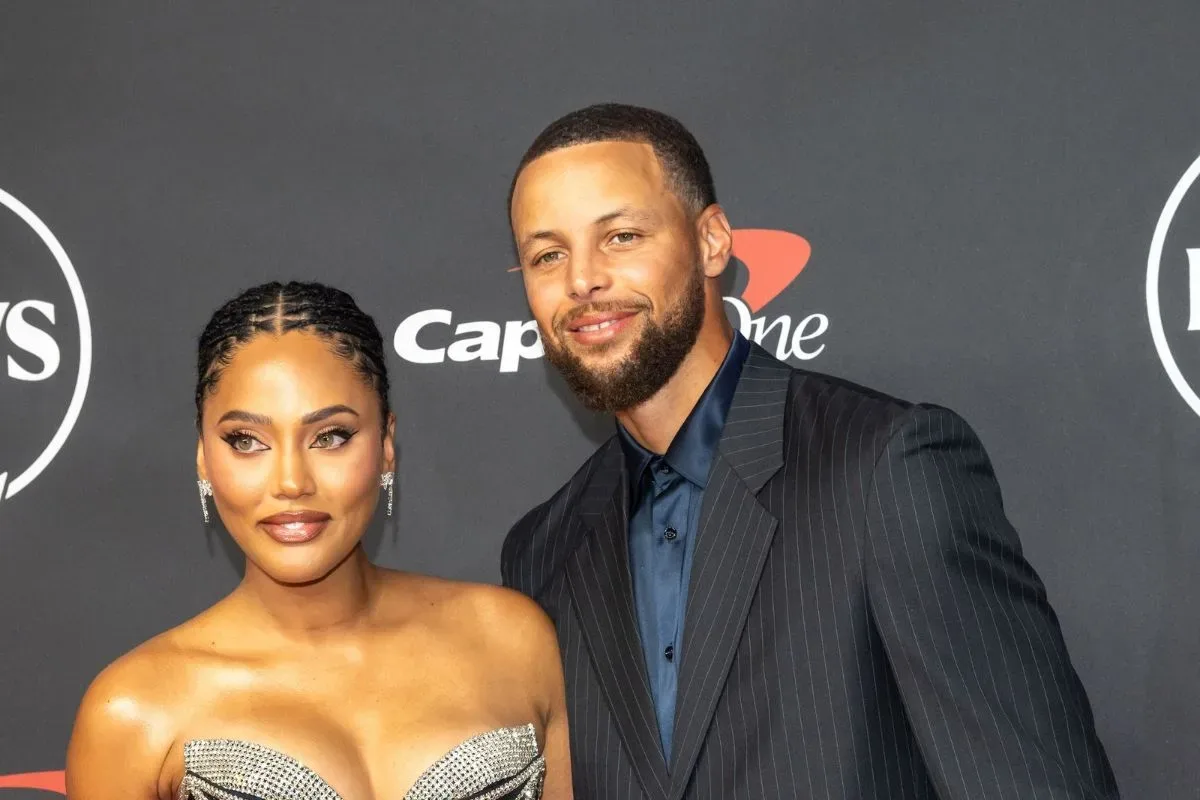
Ayesha Curry’s move into a feature-film lead has arrived with a very modern piece of premiere-day noise: a short clip, a scripted kiss and a wave of online commentary attempting to turn a fictional scene into a statement about her real marriage.
Second Chance Holiday, now streaming on The Roku Channel, casts Curry as Chelsey, a dating expert whose holiday season has become a cycle of breakups. Her character agrees to pose as one half of a couple with a former high-school flame, played by Matthew Daddario. In a romantic comedy, that setup is not merely background detail; it establishes the central device that places the two characters in close proximity and creates the possibility of an on-screen romance.
The kiss that circulated online is part of that fictional premise. Yet some social-media reactions focused less on Chelsey and the movie’s story than on Curry’s marriage to NBA player Steph Curry. That leap misses a basic distinction: an on-screen kiss is a performance in a scripted production, while the relationship viewers see between the characters belongs to the film.
A leading role, rather than a celebrity cameo
What makes the release notable is not simply that Curry is in a holiday movie. Second Chance Holiday represents her first leading role in a feature film. She has appeared on screen before, including in the 2024 Netflix film Irish Wish and the series About Last Night, and has hosted food and competition programming. Those experiences differ from carrying the narrative of a scripted romantic feature, where the protagonist’s choices, chemistry and emotional arc are expected to hold the story together.
That distinction matters in the language of film credits. A lead role is generally the character positioned at the center of the story’s main conflict and resolution. It is not the same as appearing briefly, playing a supporting character, or appearing as a recognizable version of oneself. Curry’s Chelsey is the character through whom this holiday relationship premise unfolds.
The project therefore gives Curry a different kind of public-facing challenge. Hosting calls for spontaneity, presence and the ability to guide an audience through a format. Acting in a romantic comedy requires playing a defined character inside a story with pre-established situations, scene partners and dramatic beats. A staged kiss, in that context, is not an unscripted personal disclosure. It is one part of portraying a character’s developing connection.
The movie’s premise makes the romance central
The title Second Chance Holiday signals the territory clearly: a seasonal romantic comedy built around reunion and renewed possibility. Chelsey’s agreement to fake a relationship with her old flame provides the mechanism. A fake-dating premise is a storytelling setup in which characters publicly perform a relationship for an in-story reason. The tension comes from the gap between the arrangement they claim is temporary and the feelings that may emerge as they maintain it.
In other words, a romantic moment between Curry and Daddario’s characters would be in keeping with the movie’s stated narrative, rather than an unexpected departure from it. The clip’s virality may have made that individual moment more visible than the rest of the film’s context, but an isolated scene does not change its function within a scripted romantic comedy.
Related coverage includes Ayesha Curry’s First Lead Role Arrives With Viral Kiss Debate.
Curry had already explained the genre’s appeal when the project was announced in July, saying that holiday rom-coms create charming, cozy worlds in which anything can feel possible. That description also captures the form’s appeal: holiday settings tend to heighten atmosphere, encourage reunions and frame romance through a sense of seasonal optimism. Chelsey’s run of holiday disappointments gives the film a contrasting starting point, while the reunion with a high-school flame supplies its potential change in direction.
For viewers interested in how film stories and online conversation overlap, the larger point is straightforward. A viral clip is selected for speed and impact. A movie scene is written to serve characters and a plot. Those two contexts are rarely identical.
Steph Curry’s earlier support provides the relevant public context
The commentary also overlooked the support Steph Curry offered before the film reached audiences. When the movie was announced, he celebrated Ayesha Curry in an Instagram Story, calling her “My Leading Lady.” The message was public, direct and tied specifically to her new starring role.
The timing is important. His support came months before a scene from the movie began circulating on its release day. Rather than treating the film’s romantic element as a surprise or a controversy, he acknowledged the significance of his wife stepping into a lead role.
The Currys married in 2011, marked 15 years of marriage in July and share four children. Their anniversary observance was described as low-key. Those personal details do not turn a fictional scene into a measure of a relationship; they instead underline why online attempts to read private meaning into a few seconds of performance can be misplaced.
There is also a practical media-literacy lesson in the episode. Social posts frequently circulate without the setup that makes a scene intelligible: character names, story stakes, the genre, the full sequence, or even confirmation that the moment is from a movie. In this case, the available premise establishes all of those basics. Curry and Daddario are not appearing as themselves; they are playing Chelsey and her former high-school flame in a holiday romantic comedy.
The creative team behind Second Chance Holiday
Second Chance Holiday was directed by Maxwell McGuire and written by Erin Muroski. Jasmine Vega, Arcade Riley, Sergio Di Zio and Melissa De Sousa are among the supporting cast. Roku released the film on Thursday, November 5, alongside another original holiday title, The Holiday Spark.
Knowing the director and writer is useful beyond credit-spotting. In a scripted production, the director shapes how the written material is performed and presented, while the screenwriter provides the screenplay: the blueprint for characters, scenes and dialogue. Performers bring those elements to life, but the narrative situations themselves are part of a wider collaborative process. That is especially relevant when one scene is being judged separately from the movie around it.
The moment is also a reminder that a performer’s public identity and a role can invite different expectations, particularly when that performer is already widely known through family, sports-adjacent public life, hosting or other work. But expanding into scripted acting means taking on characters whose circumstances are not necessarily the performer’s own. That separation is a normal part of the job, even when audiences are inclined to blur it.
For Curry, the immediate significance is that her first feature lead has a clear, genre-appropriate hook: a dating expert, a series of holiday breakups, a fake relationship and a familiar face from the past. The attention around one kiss may have become the day’s social-media flashpoint, but it is only a fragment of the role and not an especially useful substitute for the film’s full premise.
Where the release fits in the wider movie conversation
Holiday releases can generate conversation quickly because their stories are built around recognizable emotional cues: reunion, family, tradition, disappointment and the possibility of a reset before the calendar turns. Second Chance Holiday combines several of those cues through Chelsey’s professional expertise in dating, her repeated personal setbacks and the return of someone from her past.
That does not mean every viewer has to respond to the movie in the same way. It does mean reactions are more useful when they address the work on its actual terms: the performance, the characters, the romantic-comedy setup and the finished story. For another example of how new screen projects can quickly become part of a broader pop-culture discussion, see the latest on Chris Pratt’s return as James Reece.
As for Curry’s release-day clip, its clearest context remains the simplest one. It is a scene from a fictional romance starring an actor in her first feature-film lead, not a public referendum on the marriage behind the performer. Second Chance Holiday is streaming on The Roku Channel.