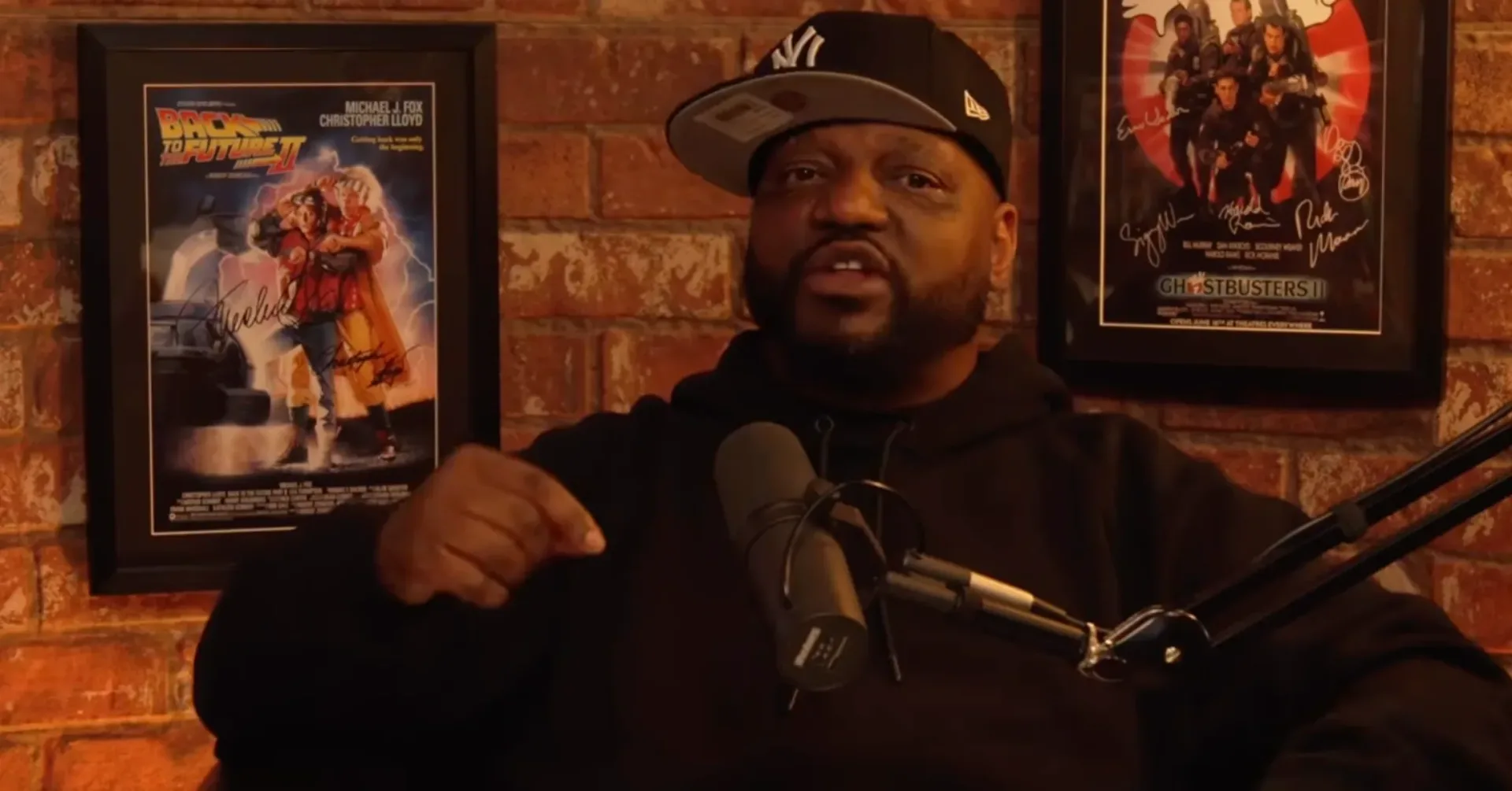
A face-to-face attempt to work through the public split between Aries Spears and DJ Vlad instead showed just how many separate disputes had been stacked on top of one another. During DJ Vlad’s appearance on Spears & Steinberg, Spears ultimately told his former collaborator to leave the studio roughly 40 minutes into the conversation. DJ Vlad later returned, and the pair completed an episode that ran for nearly two hours, but the break in the discussion underscored that the underlying conflict had not been settled.
The exchange was not solely about the payment issue that initially put the relationship under strain. Spears pressed DJ Vlad about whether their connection had ever been a friendship, challenged how he had spoken about Spears publicly, and raised the wider criticism DJ Vlad has received over his place in Hip Hop media. DJ Vlad pushed back, framing their relationship as friendly but fundamentally professional and arguing that Spears had made a private business disagreement public first.
A pay dispute became an argument over the relationship itself
The original disagreement centered on Spears seeking a higher fee for appearances on VladTV. In their new sit-down, the two went back over that negotiation early in the episode. DJ Vlad compared Spears’s interview figures with those of Boosie Badazz, while the pair also disputed who was responsible for moving their disagreement from private messages to public discussion. DJ Vlad brought up text messages dated April 18 during that portion of the debate.
That context matters because a fee negotiation is usually narrow: one party seeks more compensation, the other evaluates whether the business return supports it, and both sides either agree or part ways. This conversation did not stay narrow. Spears’s objections included what happened after the negotiation became known publicly. He argued that mentioning the money matter did not warrant what he described as a campaign to damage his name. DJ Vlad’s position was that Spears had opened the matter to public response by airing the dispute.
Those are incompatible interpretations of the same escalation. One side treats the later criticism as disproportionate and personally damaging; the other treats it as a response to a public accusation. A conversation can become extremely difficult to resolve once participants are no longer debating only the original terms of a deal, but also the legitimacy of their own reactions to it.
Friendship and professionalism proved to be different standards
Spears asked DJ Vlad whether he had ever regarded him as a friend. DJ Vlad said the relationship was friendly, though primarily professional. Spears countered that DJ Vlad had used the word “friend” for their connection in the past.
The distinction may look semantic, but it changes the emotional logic of the disagreement. A professional relationship can involve mutual benefit, cordiality and recurring work without a promise of personal loyalty. Friendship carries a different expectation: that conflict will be addressed with discretion, consideration and a greater degree of protection from public embarrassment. Neither interpretation automatically resolves the factual disagreement, but they explain why the two men appeared to attach different weight to the same interactions.
For viewers, it is also a reminder that a long-running media partnership can mean different things to each person involved. One party may see a repeat guest arrangement and a stable business connection. Another may understand the same history as evidence of a personal bond. When pay is renegotiated, the mismatch becomes much harder to ignore.
The dispute widened to public image and Hip Hop criticism
Spears also asked DJ Vlad if he considered himself a “culture vulture,” a term often used to criticize someone perceived as gaining access, profit or authority from a culture without showing sufficient accountability to the people who created it or live within it. In this case, Spears connected the question to criticism DJ Vlad has faced for building an interview business around Black artists and entertainers in Hip Hop.
DJ Vlad rejected that characterization. The argument grew more combative, with both men speaking over each other and revisiting prior insults. The discussion therefore moved beyond a disagreement over rates or messaging and into an argument about credibility, cultural participation and the responsibilities of a platform that profits from interviews.
Those broader questions are not resolved simply because two people sit across a table. They concern perception as much as a discrete transaction: who has benefited, who has been treated fairly, and who has the power to define the public story after a relationship deteriorates. The on-camera setting gives each person a chance to state a case directly, but it also means every clarification can become another point of contest.
The remark that pushed the conversation over the edge
A “Kung Fu Panda” joke DJ Vlad made during the broader feud became another major flashpoint. Spears confronted him about it and became increasingly angry as the conversation shifted from business terms to personal disrespect. Andy Steinberg, Spears’s co-host, attempted to mediate, but Spears eventually ordered DJ Vlad out of the studio.
The temporary ejection did not end the recording. DJ Vlad eventually returned and the conversation resumed, even though the same central disagreements remained in place. Completing the episode after that interruption is notable not because it indicates a resolution, but because it shows both participants still wanted their respective arguments heard in the same room.
There is an important difference between finishing a conversation and repairing a relationship. The available account indicates the pair completed the nearly two-hour episode, not that they reached an agreement over compensation, friendship, public criticism or the remarks that angered Spears. The most accurate reading is that they managed to continue the discussion after a rupture, while leaving the dispute unresolved.
Why public conflict is harder to contain
Once a private dispute becomes a public feud, the disagreement acquires a second layer: reputation. Instead of asking only what the fair fee should have been, the parties may begin arguing over who exposed whom, who escalated, and how audiences should interpret the other person’s conduct. That broader fight can be harder to resolve than the original business question because there is no obvious single remedy for hurt feelings or perceived damage to one’s image.
This is especially true in interview-driven media, where conversations themselves are the product. A dispute over an appearance fee can become content; the response to that content can then create more content. The result is a feedback loop in which commercial disagreement, personal grievance and audience-facing commentary start influencing one another. Spears’s assertion that he was being smeared and DJ Vlad’s claim that Spears had made the issue public illustrate the competing narratives at the center of that loop.
The conflict also arrives during a period of heightened scrutiny around AI-generated material and creative control. A separate discussion of the issue can be found in Entertainment’s AI Debate Is Shifting From Big Prompts to Specific Creative Guardrails. Here, the supplied background notes that an AI-generated Spears diss track followed legal threats, adding another digital dimension to a dispute already being fought through appearances and public statements.
What the nearly two-hour exchange establishes
The episode establishes that the rift between Spears and DJ Vlad is much larger than the initial rate discussion. Spears sought answers about the nature of their relationship and about comments he found disrespectful. DJ Vlad defended his handling of the public dispute and rejected the cultural criticism raised against him. Neither position was erased by the studio walkout or by DJ Vlad’s return.
For an audience watching a confrontation like this, the useful distinction is between an explanation and a settlement. The participants explained, at length, why each believed the other had crossed a line. But explaining a grievance does not require the other side to accept it, and no reconciliation is indicated by the fact that the recording continued. The episode instead captures a collision of business expectations, personal history and public reputational stakes—one intense enough that a planned conversation briefly became a demand to leave the room.