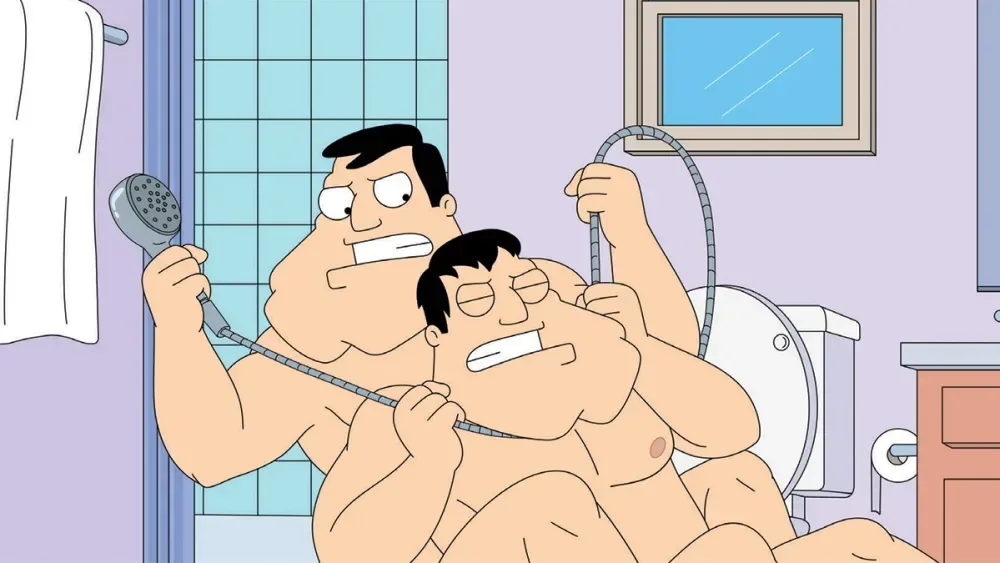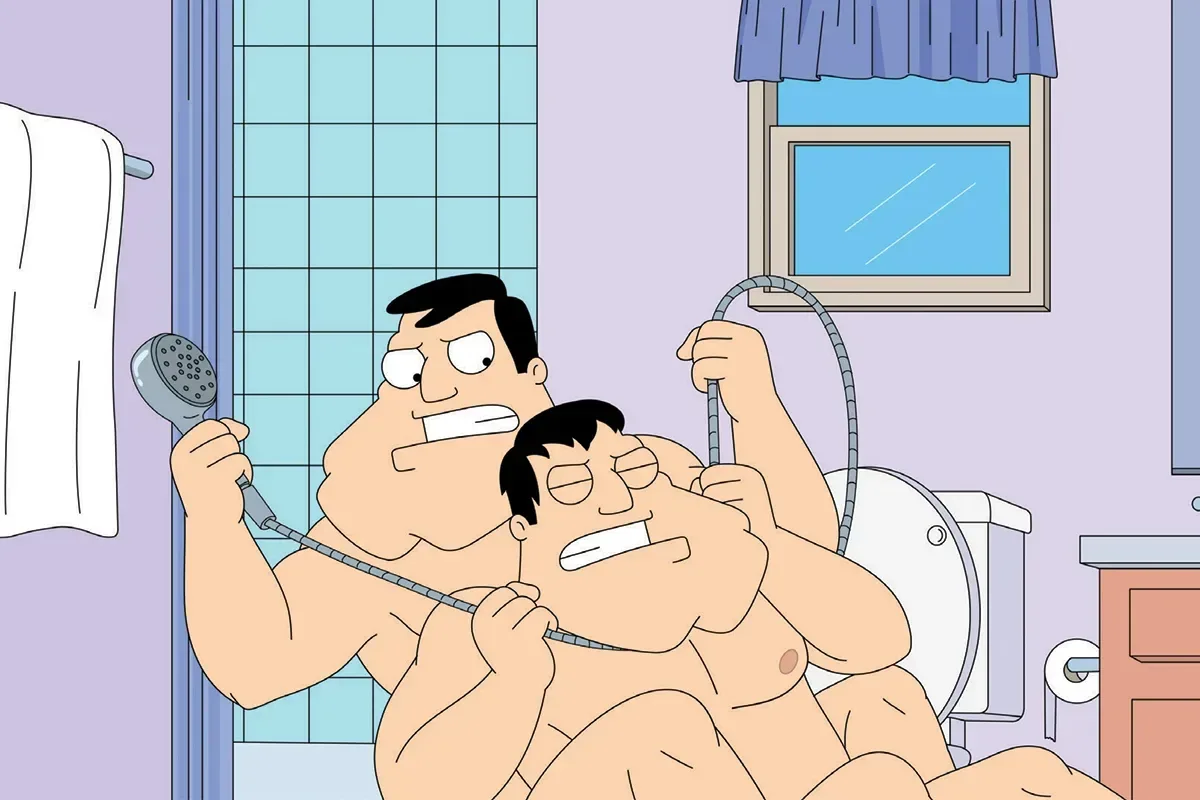
American Dad is preparing to hit a number that would make even Roger stop changing wigs for a moment: Episode 400. The animated comedy’s milestone installment airs Sunday, Sept. 13, at 9 p.m. ET on Fox, and it is built around an appropriately supersized premise. Stan Smith takes on his 400th CIA mission, only to discover that the job comes with an alarming revelation: he has been cloned more than once.
For a show whose household already includes a CIA agent, an alien with a bottomless wardrobe, a talking goldfish carrying the mind of a Cold War-era East German athlete, and an endless supply of questionable family decisions, clones may qualify as a relatively normal Tuesday. But the premise also fits a series that has made numerical milestones into invitations for its writers to get strange on purpose.
Episode 100 involved the deaths of 100 characters. Episode 200 put the Smiths up against 200 versions of Roger. For Episode 300, Roger was broken into 300 pieces. Now, Episode 400 uses Stan’s CIA career as the counting device—and turns it into a cloning story. It is exactly the kind of escalation American Dad can make feel both wildly excessive and weirdly domestic.
A long-running animated survivor with a flexible rulebook
The 400th episode is notable not only because of the size of the number, but because of the route American Dad took to reach it. The series began on Fox, was canceled there in 2013, then continued at TBS for another 10 seasons. When TBS had largely stepped back from original scripted programming by 2025, the show’s future again became uncertain. Fox then brought the comedy back, giving it a four-season order.
That is an unusually durable itinerary for any TV series, never mind an animated one that has lasted long enough to make its own episode count a recurring gag structure. It has gone from broadcast to cable and back to broadcast, while retaining the core creative engine that allows Langley Falls to become almost any kind of fictional arena the story requires.
Executive producer and co-creator Matt Weitzman has described the return to Fox as a genuine surprise. The move meant a reunion with the network where the series began, even if the road home took more than a decade and a long cable-era detour. Executive producer Brian Boyle, meanwhile, has expressed far more confidence that the series would find a way to keep going, pointing to the enduring strength of the show itself.
That resilience is perhaps the most fitting theme for Episode 400. Stan can learn that he has duplicates. American Dad itself has already proved it can survive multiple lives.
From political setup to the Smith family’s permanent chaos
American Dad was originally conceived with a stronger political-satire component. Stan is, after all, a CIA agent in fictional Langley Falls, Virginia, a setup with obvious material baked into it. Over time, however, the show moved away from relying on the constantly shifting news cycle and leaned harder into stories about the deeply dysfunctional Smith household.
That pivot gave the series a more evergreen foundation. Political references can expire at the speed of a scrolling headline, while family arguments, secret schemes, identity crises, bad parenting choices, bizarre friendships and accidentally catastrophic errands have considerably longer shelf lives. American Dad did not abandon the capacity for satire; it broadened the kind of absurdity it could pursue.
The central family remains the reliable launchpad. Seth MacFarlane voices Stan and also plays Roger, the alien discovered at Area 51 whose disguise habit has become one of the show’s most elastic storytelling devices. Wendy Schaal voices Francine, Stan’s wife. Scott Grimes plays their son Steve, while Rachael MacFarlane voices their daughter Hayley. Jeff Fischer plays Hayley’s husband, Jeff. Dee Bradley Baker voices Klaus, the goldfish with a human mind and a reliably complicated personal history.
Those ingredients allow the series to ground even its least grounded ideas in a recognizable group dynamic. A tale can start with an argument at home, take a hard left into a genre experiment, and still return to the Smiths dealing with the emotional debris. Or no one learns anything at all, which is also an honored sitcom tradition.
The mix makes American Dad especially adaptable. An episode may operate as a straightforward comedy one week, then turn toward an unusually esoteric concept the next. Space-opera and Western-style detours have been part of that range. The audience is not promised one fixed flavor; it is promised that the family will somehow be on hand when the flavor becomes impossible to identify.
The TBS years widened the show’s range
The move to TBS after the 2013 cancellation did more than keep American Dad alive. It gave the series greater latitude in tone and content. Cable did not carry the same FCC restrictions as broadcast television, opening space for the show to become more provocative when a story called for it.
That does not mean the Fox era was creatively powerless. The point is more that American Dad found another gear on cable. The format and voice remained recognizable, but its boundaries could stretch. For a comedy already comfortable with aliens, government conspiracies, golden-fish resentments and Roger’s many identities, a roomier set of limits was hardly going to result in less mischief.
When Fox reclaimed the show, it brought a cable-seasoned version of American Dad back to a broadcast home. The current four-season order creates substantial room for the team to keep exploring the show’s broad format, rather than treating Episode 400 as a farewell lap. In the strange mathematics of Langley Falls, 400 is not necessarily an ending. It is simply the number at which Stan discovers he may not be the only Stan.
Continuity behind the scenes matters, too
Long-running animated series are often discussed through their characters, voice casts and famous bits. But American Dad’s longevity also reflects continuity in its writers’ room. Boyle has noted that many writers have been associated with the show since near the beginning, including four people who started as production assistants roughly 17 years ago.
That kind of internal history can matter enormously for a comedy with such a specific rhythm. The series needs people who understand that a Stan mission can become a family plot, a Roger persona can become an entire episode’s universe, and Klaus can enter a scene with the confidence of someone who has never once considered whether he should be quiet. Familiarity with the characters helps preserve their voices while leaving enough freedom for writers to keep putting them into new kinds of stories.
It also explains how a program can shift networks and expand its content range without losing its identity. The business circumstances surrounding the series changed considerably: cancellation, a cable revival, a decade of additional seasons, then a return to Fox. Yet the people making it retained a shared sense of what American Dad can be.
That creative stability is especially important because the show does not depend on a single repeatable plot machine. Stan cannot merely go on the same CIA mission 400 times, at least not without learning about clones. The series instead has room for family comedy, genre parody, surreal side trips and stories that make Roger’s capacity for reinvention feel less like a gimmick than an operating principle.
Why the 400th episode’s premise fits
Milestone episodes can sometimes become overly ceremonial, as though the main character has been handed a cake and told to look grateful for the cameras. American Dad’s numbered installments take a more on-brand approach: treat the number as a dare. The 100th, 200th and 300th episodes each made their count central to the story in a deliberately outsized way.
Episode 400 continues that pattern through Stan’s CIA record. A 400th mission is a natural milestone for him, but cloning turns the celebration into a threat to his precious belief that he is a singularly competent government operative. Stan’s need to be important is one of the show’s most dependable pressure points. Finding out there are several versions of him is therefore not just a science-fiction wrinkle; it is a direct hit on his self-image.
The setup also leaves plenty of space for the rest of the household to react in their own distinct ways. The confirmed premise is Stan’s mission and multiple clones; how the episode resolves that discovery remains for viewers to see. But the concept lands squarely in the show’s established territory, where a huge fantastical idea is most useful when it makes family life even more inconvenient.
American Dad Episode 400 airs on Fox on Sept. 13 at 9 p.m. ET. For more on the evolving craft of enduring TV comedy, see our look at Greg Daniels’ comedy playbook across animation and live-action television.