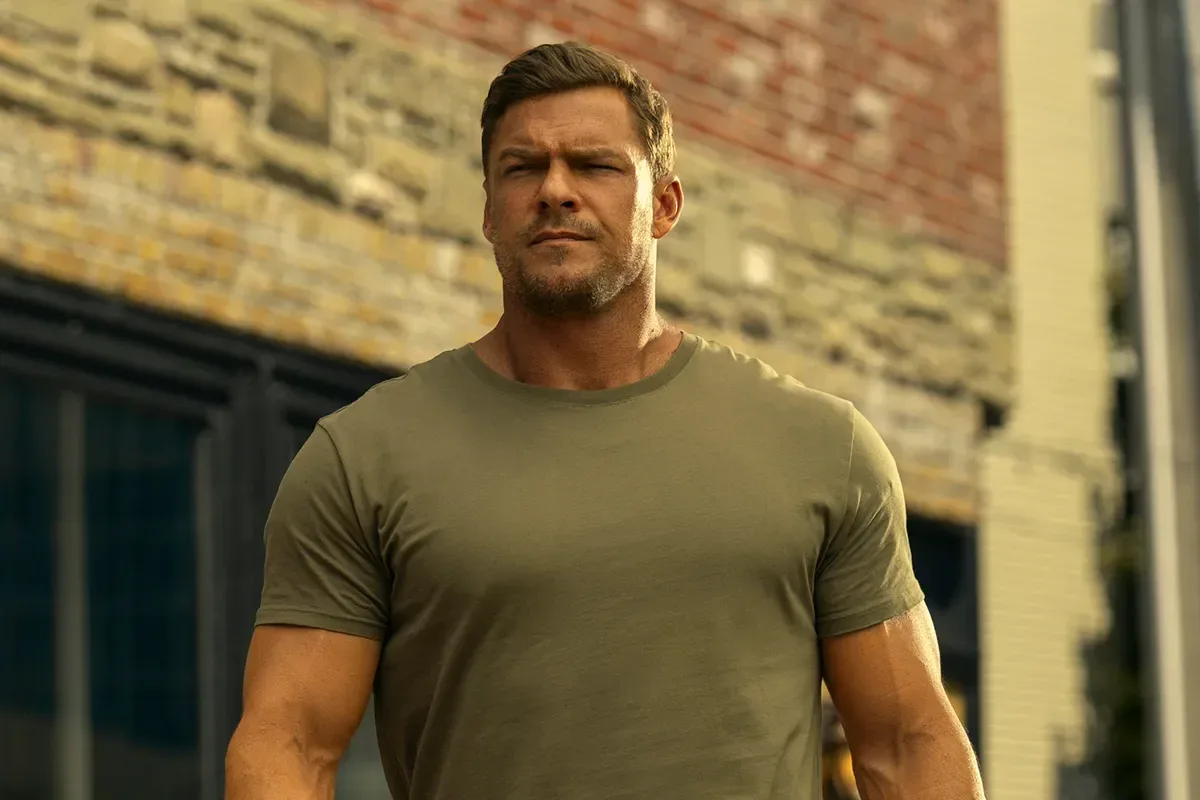
Alan Ritchson has indicated that Die Trying, Lee Child’s second Jack Reacher novel, was once on the path to becoming a season of Reacher. In a Threads reply, Ritchson called the book his favorite in the series and said he had it approved before “someone got re-elected.” He did not name a person or explain what approval entailed, when it was granted, or why the apparent plan changed.
The comment arrived in response to a fan lamenting that the series had not yet reached the story in which Reacher fights through a white-supremacist militia compound. That description points to Die Trying, a 1998 thriller in which Reacher and the daughter of a politician are abducted by a radical militia that intends to use them as leverage in political negotiations.
It is a striking prospect because it would put the Prime Video action series in direct conversation with one of the more politically charged premises in Child’s long-running body of Reacher fiction. But the important qualifier is equally clear: Ritchson’s social-media comment is not a production announcement. It does not confirm that Die Trying will be adapted, establish that it has been permanently ruled out, or identify the decision-makers behind the reported change.
What Ritchson actually indicated
Ritchson’s post gives fans a meaningful but narrow piece of information: he says he had approval for Die Trying at some earlier point, and he links the loss of that plan to an unnamed re-election. That is different from a confirmed season order, a publicly announced adaptation slate, or a statement from the show’s studio or streaming platform.
“Approved” can mean several things in entertainment development, from creative agreement around a preferred direction to a more formal internal go-ahead. The available comment does not define the term. It also does not say whether scripts were commissioned, whether the book was assigned to a particular season, or whether the decision involved editorial concerns, scheduling, rights, budget, or anything else.
As a result, the fairest reading is that Ritchson has shared his own account of a thwarted plan—not that audiences have received a definitive roadmap for the show’s future. Fans can reasonably see the post as evidence of his enthusiasm for the novel, while treating any larger conclusion about the series’ decision-making as unconfirmed.
Why Die Trying stands apart
Die Trying was originally released in 1998. Its central premise is built around an abduction rather than the more familiar image of Reacher arriving in a town and uncovering its hidden rot. Reacher and a politician’s daughter become prisoners of a radical militia, with their captors seeking political leverage.
That setup naturally creates a different kind of pressure from a purely local conspiracy. Reacher is still positioned against violent antagonists, but the story’s stakes extend into political coercion and ideological extremism. A militia is generally an armed civilian group organized outside the formal military; in this case, the supplied description identifies the group as radical and white supremacist. Those elements make the novel’s conflict unusually sensitive material for a high-profile contemporary adaptation.
Related coverage includes Alan Ritchson Says ‘Die Trying’ Was Approved for ‘Reacher’ Before Re-Election.
It also helps explain why viewers keep raising the book. The premise offers an enclosed, high-pressure conflict: captives, armed adversaries, a politically connected hostage and a remote hostile force. Those are ingredients that can suit the blunt, physical problem-solving associated with Reacher, even as the underlying subject matter demands more care than a standard fight-of-the-week scenario.
The politics around the remark
Ritchson did not identify the person referenced in his Threads comment. However, he has publicly criticized President Donald Trump in the past. During an appearance on the Happy Sad Confused With Josh Horowitz podcast, Ritchson made inflammatory remarks concerning Trump and the Epstein files.
White House spokeswoman Abigail Jackson responded in a public statement that Trump had been “totally exonerated on anything relating to Epstein,” attributing that position to the president. The exchange provides context for why readers have connected Ritchson’s vague reference to a re-election with Trump, but it does not turn that inference into a direct statement from Ritchson. His Threads post itself left the person unnamed.
That distinction matters. The comment is politically pointed, but its wording is still deliberately indirect. It communicates Ritchson’s frustration without supplying a detailed explanation of what changed for Die Trying. There is no confirmation in the available information that any elected official personally intervened in the show, or that politics was the sole reason an adaptation did not move forward.
Where the series is now
Reacher remains an active franchise. Season 4 premiered on Prime Video in August, and the series has already received a fifth-season renewal ahead of that premiere. The show’s third season was the platform’s most-watched season since the first season of Fallout, a performance marker that underscores the scale of the audience still following Ritchson’s take on Child’s character.
That continuing renewal is the practical takeaway for viewers hoping the show could eventually revisit Die Trying. A season is not confirmed simply because the series has another renewal, and the supplied information gives no reason to assume the novel is next in line. Still, an ongoing show has more opportunities to choose among the extensive Reacher library than one approaching a final season.
Adaptations also do not need to proceed in publication order. The fact that Die Trying is the second novel does not, by itself, establish where it would fit on television. The series’ priorities can be shaped by the kind of season its creators want to make, the setting and supporting cast a novel requires, and the changing context around its themes. None of those choices have been publicly detailed here.
What fans should—and should not—take from the post
- It supports Ritchson’s interest in the book. He explicitly described Die Trying as his favorite Reacher novel.
- It suggests an earlier internal plan existed. Ritchson says he had approval, though the scope and form of that approval are unknown.
- It does not confirm an upcoming adaptation. No season number, release window, casting, production timetable or official project announcement was provided.
- It does not explain the decision in detail. The re-election reference is vague, and no independent production rationale is included in the available information.
- It highlights the book’s enduring appeal. Its hostage-and-militia premise clearly remains a point of interest for both Ritchson and viewers.
For now, Die Trying occupies an unusual place in the conversation around Reacher: not an announced season, but not merely a fan-casting fantasy either. Ritchson’s account suggests it was seriously considered and approved in some fashion before being derailed. Until there is a formal update, though, that is the limit of what can be stated with confidence.
The larger story is less about a guaranteed next chapter than about adaptation choices colliding with present-day context. A novel published in 1998 can acquire a different resonance decades later, particularly when its antagonists are a radical white-supremacist militia and its plot uses a political hostage crisis as leverage. Whether Reacher ever returns to that material remains unresolved. What is clear is that its star still sees substantial value in it.
For more television coverage beyond the Reacher beat, see our look at Sharon Horgan’s Youth and its rom-com crossroads.