Major spoilers for Clayface follow, including its Club Vesuvius climax.
Aaron Paul is in Clayface—but viewers should not expect a conventional supporting turn, a named introduction, or even a scene that lets him speak for himself. His appearance lasts roughly a second, arriving amid the film’s hectic Club Vesuvius sequence as Matt Hagen uses his new shapeshifting abilities to evade danger. The best reading of the clues left in the finished movie is that Paul is playing Jimmy Hagen, Matt’s father.
That identification is not delivered through an on-screen caption or a direct piece of dialogue saying “this is Jimmy Hagen.” It is instead embedded in the mechanics of the scene and in a prior reference to Matt’s family. That makes the cameo easy to miss and also explains why it has prompted such confusion: Paul’s face is unmistakable, yet the film has not established him as a present-day character before the moment he flashes across the screen.
The practical answer, then, is simple but qualified. Paul appears to portray Matt Hagen’s father, Jimmy, in what remains of a much smaller role than audiences may have expected. The movie supplies strong narrative evidence for that conclusion, while stopping short of an explicit confirmation.
Where Aaron Paul appears in Clayface
Paul is visible during Matt Hagen’s climactic assault on Club Vesuvius. Matt, a movie star whose story becomes the origin of Gotham’s shapeshifting Batman villain Clayface, is confronting Markos Szabo’s armed men and trying to carry out his revenge. His response is not merely to run. He continually alters his appearance while moving through the dancefloor, using unfamiliar faces as cover amid the crowded nightclub.
That ability works as a kind of social camouflage. Rather than becoming invisible, Matt becomes difficult to track because observers cannot be confident that the person they are pursuing is still the same person. Several of the faces he assumes belong to people already around Club Vesuvius, including Szabo’s henchman Sal and a nightclub attendee named Rosie. Those transformations make immediate tactical sense: in a packed, volatile setting, a pursuer can lose precious seconds after seeing a familiar person where Matt should be.
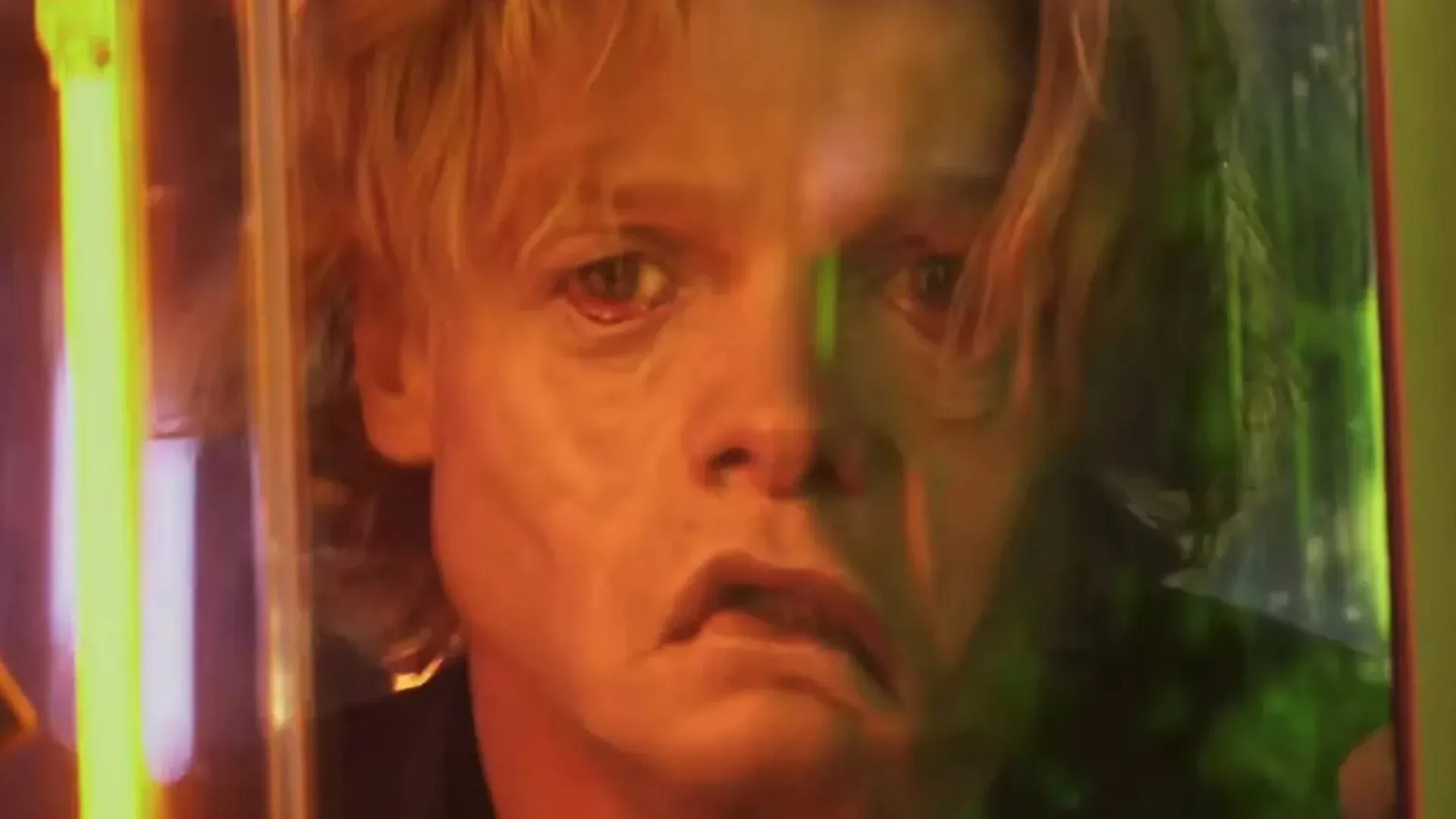
Then comes the striking exception. For a split second, Matt changes into Paul. Since Paul has not otherwise appeared as an established character in the film, the transformation initially plays as an oddly disconnected celebrity cameo. It becomes more meaningful once the movie’s earlier family reference and one character’s reaction are placed alongside it.
Why the cameo points to Jimmy Hagen
Earlier in the film, one of Szabo’s henchmen refers to knowing Matt’s father, Jimmy. The Hagens are associated with the Narrows, a rougher Gotham district. At Club Vesuvius, Patches is abruptly thrown off balance when Matt assumes Paul’s appearance because Patches knew Jimmy. That reaction is the key piece of storytelling evidence: the face has personal recognition value for Patches, and the film has already given the audience a man fitting that description in Matt’s father.
Paul’s look in the brief image reinforces the inference. He appears unkempt and shaggy-haired, not styled as one of the other fan-speculated Gotham figures. The completed film does not introduce Victor Zsasz or Black Mask, despite speculation that either might have been connected to the actor. Nor does the image suggest those possibilities: there are no visible tattoos or mask that would support either interpretation.
Put together, the clues form a coherent chain:
- Matt’s father is identified earlier as Jimmy.
- Patches has a history with Jimmy.
- Patches reacts when Matt adopts Paul’s face.
- Paul’s appearance does not resemble an introduced version of other popular speculative candidates.
That is why “Jimmy Hagen” is the most defensible answer. Still, it is important to preserve the distinction between what the film strongly implies and what it formally states. There is no explicit verbal confirmation of Paul’s character name in the finished picture. Calling the part a confirmed credited performance would go beyond the evidence presently on screen.
A likely remnant of a reduced storyline
The unusual brevity of the appearance naturally raises a second question: why is a recognizable actor present for only a blink-and-miss-it transformation? The film itself offers an answer by implication rather than documentation. Jimmy Hagen appears to have had more narrative material at some stage, with the released version retaining only the connective tissue needed for Patches’ reaction and Matt’s disguise.
That does not establish exactly what was removed, when it was removed, or whether Paul filmed scenes that could surface later. Those details are unknown. But the structure of the movie leaves a visible footprint of a larger father-related thread. Jimmy is mentioned; Patches recognizes him; Matt returns to a rundown apartment after his money is stolen, an apartment that may be his father’s; and Paul’s face is deployed at a moment where that recognition matters. The pieces do not function like a random celebrity insertion. They function like fragments of a character connection that the final cut does not fully dramatize.
The term vestigial cameo fits this situation. A vestigial element is something that remains after its original larger function has diminished or disappeared. In film editing, that can mean a surviving image, line, prop, or reaction shot that still hints at a cut subplot. Paul’s moment is not useless—Patches’ confusion depends on the audience understanding that Matt has become someone from his past—but it is unusually compressed. The result is a cameo that plays less like a star entrance and more like a narrative fossil.
Why the scene works differently from a typical cameo
A conventional cameo normally asks viewers to enjoy recognition for its own sake: a famous face appears briefly, perhaps as a joke, a nod, or an unexpected bit of casting. Clayface uses Paul’s presence in a more complicated manner. The face is meant to be unfamiliar to viewers but familiar to a character inside the story. That reversal creates momentary disorientation.
For the audience, Paul is recognizable as Aaron Paul, an actor not previously established in the film. For Patches, however, the person on the dancefloor is apparently Jimmy Hagen, a man he once knew. Matt’s shapeshifting makes both responses true at once. The viewer sees the performer; Patches sees the father; Matt is neither of them at that instant, but uses the resemblance as a weapon of escape and confusion.
This is also a useful example of why a shapeshifter’s power can be dramatically different from simple disguise. A mask or costume requires preparation and typically offers only visual resemblance. Matt’s transformations are immediate and personal enough to activate memories, loyalties, and hesitation in the people around him. At Club Vesuvius, that psychological disruption is as important as changing his silhouette. A pursuer who suddenly believes he has seen a dead or absent acquaintance is more vulnerable than one who has merely lost sight of a target.
What viewers should and should not take from the scene
The cameo clarifies a small piece of Matt Hagen’s background, but it should not be treated as evidence that Paul is playing a newly introduced major DC villain. The movie does not present him as Victor Zsasz, Black Mask, or another named Gotham criminal. It also does not establish a broader present-day storyline for Jimmy Hagen.
Instead, the scene mainly deepens the sense that Matt’s life is rooted in Gotham’s Narrows and in a difficult family history. The association with Jimmy makes the rundown apartment Matt retreats to feel potentially familial, though the film does not specifically label it as Jimmy’s apartment. That reading remains reasonable, not definitive.
For viewers revisiting the climax, the important details are Patches’ moment of disorientation and the fact that Paul’s face appears amid transformations that otherwise include people in the club. Watching the sequence with Jimmy in mind turns the image from a puzzling bit of stunt casting into a compact plot beat: Matt has found a face capable of making at least one enemy pause.
Clayface’s Gotham context
Clayface is a supervillain origin story within James Gunn’s DCU Chapter One. Tom Rhys Harries plays Matt Hagen, while James Watkins directs. The film follows Hagen’s path toward becoming the shapeshifting Batman adversary Clayface, even though Batman himself does not appear in the movie. That absence helps keep the focus on Matt’s own transformation and the Gotham underworld orbiting Club Vesuvius, Szabo, and the Narrows.
The setting nevertheless matters. Gotham’s criminal networks and neighborhood histories give the father clue its weight. Patches’ recognition is not simply a convenient reaction from a stranger; it suggests a past connection between people who emerged from the same harder-edged corner of the city. For more on the references threaded through that setting, see our guide to Clayface’s Gotham, Batman, and DC references.
Paul’s appearance therefore lands at the intersection of two ideas central to the film: identity as performance, and the way old Gotham ties can resurface at precisely the wrong moment. Matt is already an actor before he becomes Clayface. Once he gains the ability to literally inhabit another person’s appearance, his past becomes a collection of faces he can potentially weaponize. Jimmy’s face is not deployed for sentimentality. It is deployed because Matt understands whom it will unsettle.
Could more of Aaron Paul’s role appear later?
It is possible that deleted material could eventually provide more context, but there is no basis to promise that it will. The finished film contains only the fleeting transformation and the surrounding clues. Until any additional material is made available, the responsible interpretation is limited to what audiences can see: Paul is present, his face is used during the Club Vesuvius chase, and the scene strongly indicates that he represents Jimmy Hagen.
That modest answer is more interesting than it first appears. A one-second image does not make Paul a surprise co-lead or secretly set up a major villain. It does, however, reveal how much information Clayface can compress into a transformation. In a single glimpse, the movie connects Matt’s power, his father, Patches’ history, and the possibility of a fuller family storyline that no longer survives in the released cut.
So if the question is whether Aaron Paul is actually in Clayface, the answer is yes. If the question is who he plays, the evidence points firmly to Jimmy Hagen—Matt’s father—even if the movie leaves that answer just outside the frame.