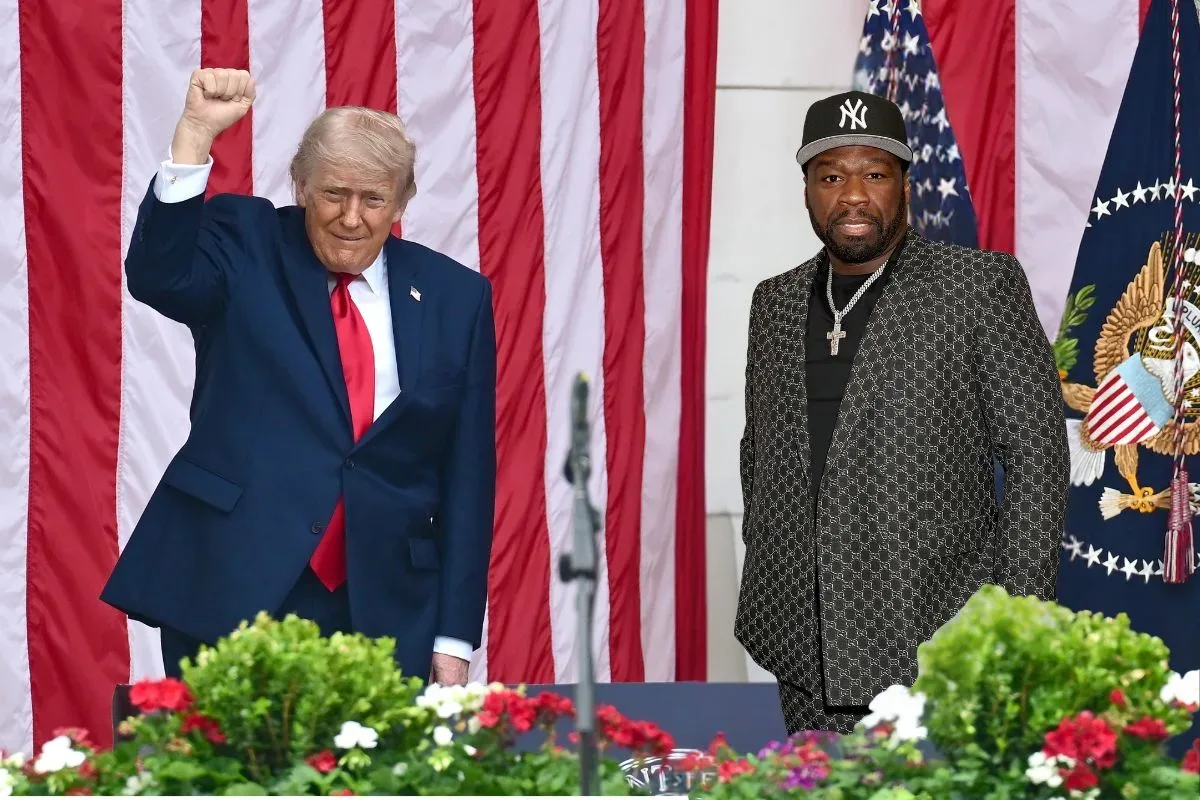
50 Cent has responded with disbelief and gallows humor after Donald Trump mentioned Nicki Minaj’s appearance during a Michigan campaign stop. The rapper posted footage of Trump at a podium alongside an image of Minaj, then wrote that he felt as though he had missed part of the story.
“👀man I got feeling we fvcked, you know what’s going on because I don’t know what’s going on ! 😆.”
He followed with another post urging followers to laugh, tagging Branson Cognac and Le Chemin du Roi. The posts did not attempt to unpack the speech in detail, which may be the point: the footage sits at the intersection of politics, celebrity, sports recollections and a remark that quickly became larger than the anecdote it was meant to support.
Minaj had traveled aboard Air Force One with Trump on Sunday, October 25, ahead of the Port Huron appearance. In an interview with White House communications director Steven Cheung, she discussed negotiations, business and the economy, explaining her confidence in Trump by saying that he works harder than people half his age.
How Nicki Minaj entered a story about college football
Trump’s Minaj remark arrived while he was discussing Ohio Senator Jon Husted and Husted’s background as a defensive back at the University of Dayton. Trump said Jon Gruden, now known as an NFL coach, had been Husted’s college teammate and had described Husted’s tackling during their time on the team.
That football story had already featured in prior appearances. Trump discussed Husted’s physique in Youngstown on October 12, then returned to the subject in Greenville on October 20. In Michigan, he again described looking at Husted’s build in the context of the Gruden story, before turning unexpectedly to Minaj.
“By the way, I looked at one hell of a beautiful ass before…Nicki Minaj,” Trump said. “That’s hard to miss.”
He then continued the Husted anecdote, framing his focus on the senator as a surprising exception to his usual interest in women’s appearance. Later in the remarks, Trump said he hoped Minaj was not offended and called her a longtime supporter.
The abrupt pivot matters because the two references are doing different jobs in the speech. Husted was being discussed as a former football player whose physicality was meant to reinforce a story of hard tackles. Minaj, meanwhile, was referenced as a celebrity in a personal comment about her body. Putting them together gave the clip its viral, difficult-to-explain quality—and gave 50 Cent a ready-made reason to post that he did not know what was happening.
A reaction built on confusion rather than a political argument
50 Cent’s response is notable for what it does not do. He does not offer a direct defense of Trump, a direct criticism of Minaj, or a detailed political reading of the appearance. Instead, the caption treats the moment as a bewildering public collision involving people whose names are more commonly associated with music, entertainment and business than a campaign-stage football anecdote.
That kind of reaction is especially legible online. A short caption can acknowledge a strange clip without claiming to settle its meaning. His “laugh so you don’t cry” follow-up turns the reaction into a familiar comic coping mechanism: when a public moment is too disjointed to summarize cleanly, the response is to point at the disarray rather than force a polished explanation.
There is also a practical social-media dynamic at work. Posts featuring a recognizable political figure, a superstar musician and a blunt onstage comment can travel faster than the surrounding speech. The clip is compact; the full chain of references is not. A viewer who sees only the Minaj line may miss that Trump had been telling a story about Husted, Gruden and college football. Conversely, a viewer who follows the football context may still find that the celebrity reference changes the tone of the anecdote entirely.
What “context” can and cannot clarify
Context explains the path of a statement: here, Trump was recounting what he said was a story related to Husted’s football build and Gruden’s recollections. It does not erase the wording of the detour, nor does it tell audiences how Minaj should feel about it. Trump himself acknowledged that possibility when he said he hoped she was not insulted.
This distinction is useful in a media environment where “out of context” is often used as a catch-all rebuttal. Sometimes a clipped excerpt genuinely omits a key detail that changes what happened. In this case, the wider remarks add the sports discussion and Trump’s explanation of why he was talking about Husted’s physique. But the wider remarks also contain the Minaj reference; it was not created by editing. Context provides sequence, not a universal verdict.
That is likely why 50 Cent’s post lands as a reaction to the whole spectacle instead of a conventional commentary post. He is responding to the very fact that a speech involving a senator’s defensive-back history could suddenly include a highly personal appraisal of Minaj.
Minaj’s support and the separate question raised by the clip
Minaj’s October 25 travel and interview make the timing more conspicuous. She had publicly praised Trump’s work ethic and discussed trusting him with the economy. Those comments establish a favorable political and business-oriented exchange between Minaj and Trump before the Port Huron appearance.
But favorable comments about a political figure’s work ethic or economic approach are not automatically an invitation for remarks about someone’s body. The two issues are separate, even when they appear in the same news cycle. Trump’s later reference to Minaj drew attention because it changed the framing from her stated views on business and the economy to her physical appearance.
That shift also explains why the moment has entertainment-news traction beyond a standard political event. Celebrity political engagement often produces discussion of endorsements, access, policy priorities or public alliances. Here, the visual clip and wording pulled attention toward an unscripted-seeming tangent. 50 Cent’s response became part of the story because he captured the audience’s most immediate question: how did the conversation get here?
For readers encountering the footage through reposts, it is worth keeping the pieces distinct:
- Minaj traveled with Trump and praised his work ethic in a White House interview.
- Trump’s Michigan comments were tied initially to a story about Husted’s University of Dayton football years and Gruden’s recollections.
- Trump brought Minaj into that discussion with a comment about her appearance.
- 50 Cent shared the clip and responded with comic confusion rather than a detailed position.
Why celebrity reactions become the next chapter
Viral political clips frequently develop in stages. First comes the original statement. Next comes the stripped-down repost, where the most startling sentence is separated from its setup. Then comes the celebrity reaction, which can give viewers an emotional shorthand for the moment. In this case, 50 Cent’s post does not provide a policy analysis, but it does communicate that the clip is odd enough to resist an easy, ordinary reading.
His use of humor is also consistent with a broader entertainment-world habit: an artist can acknowledge a headline-grabbing moment while keeping the focus on its absurdity. By adding the tags for his cognac and champagne brands, he paired the reaction with his business presence rather than presenting it as a formal political statement.
For more music-world friction expressed through a direct response, see Papoose’s “Food For Thought” freestyle reply to Eazy The Block Captain.
No response from Minaj is included here regarding the Michigan remark. What is clear is the chronology: she made favorable comments about Trump’s work ethic and economic leadership, Trump later mentioned her while recounting a football-related story about Husted, and 50 Cent turned the resulting clip into a public display of disbelief.
Ultimately, the exchange illustrates how quickly a live political appearance can become pop-culture material. A senator’s college football history was supposed to be the subject. A celebrity reference redirected the attention. Then another rapper’s confused caption gave the internet its simplest summary: nobody seems fully sure how the speech arrived at that point.