Some of the most intriguing Halo ideas are now firmly in the realm of “what might have been.” Concept art and accompanying story material tied to an unrealized Halo 7 outline a version of Zeta Halo built around a containment facility, a lockdown, and a prisoner described in notably ominous terms: an “ancient, terrible creature” that once ruled the ring.
The material arrived in what is thought to be the final edition of Canon Fodder, published by Halo Studios franchise writer Alex Wakeford. It offers glimpses rather than a complete plot breakdown, but those glimpses are unusually specific. They point to an intended seventh mainline game that would have returned players to Zeta Halo while widening its environments and digging deeper into Forerunner technology, Flood-related danger, and the ring’s older identity as Gyre 11.
That vision is especially interesting because development of the next Halo game is now being handled by Activision, while Halo Studios has moved into a support role for existing releases. The art should not be read as a promise of content for the next game. It is instead a record of ideas associated with a different Halo 7 direction—one with a lot of unanswered questions packed into a very short collection of captions.
A prison at the center of the mystery
The clearest story hook is the Containment Facility, described as being overseen by the submonitor Adjutant Repose. In Halo terminology, a submonitor is a subordinate artificial intelligence connected to the operation of a larger installation. In this case, Adjutant Repose appears to be responsible for the facility’s response when Reclaimers arrive and the Flood begin to cause trouble.
That setup immediately gives the location a strong dramatic purpose. It is not merely another ancient hallway or battlefield backdrop: the facility is framed as a place built to hold something, with an overseer capable of triggering a lockdown. Lockdown is a familiar science-fiction device, of course, but it is particularly effective in a Halo setting. It turns architecture into a threat. Doors, access routes, containment systems and automated defenses can all become obstacles—or tools—when a facility decides that the people inside it may be part of the emergency.
The concept description says that many Zeta Halo facilities used timelock technology. Within the supplied material, that technology is linked to Forerunner knowledge of advanced higher-dimensional engineering and to what the Forerunners learned from the Ancestor-San’Shyuum alliance’s “time bolt” feature. The same principles were applied to the cage holding the unnamed creature.
There is an important limit to what that tells us. “Timelock” is evocative, but the material does not explain its exact operation in gameplay or narrative terms. It does not establish whether it literally stops time, shifts an object through time, locks it outside ordinary space, or does something else entirely. What can be said is narrower and more compelling: the planned prison required unusually advanced Forerunner-derived technology, and its captive was evidently considered dangerous enough to warrant it.
The proposed Containment Facility was connected to a timelock cage for a being said to have held dominion over the ring when it was known as Gyre 11.
Related coverage includes Halo 7 Concept Art Reveals Zeta Halo's Unused Timelock Prison and 'Ancient, Terrible Creature'.
That reference to Gyre 11 gives the creature’s threat a historical dimension. It was not simply lurking in an abandoned laboratory; it was associated with a prior era of the installation itself. Yet the concept material keeps its identity concealed. There is no supplied name, species, visual confirmation or explanation of its relationship to the Flood, the Forerunners or the other powers on Zeta Halo. The mystery is likely why the premise lands so well. Halo is full of large-scale military conflict, but a sealed entity with an old claim over the ring promises a more focused question: what did the builders fear badly enough to put behind a timelock?
Flood trouble and a redirected fireteam
The Flood are mentioned in connection with the Containment Facility, where their activity helps prompt the lockdown response. Their presence matters because it would place a familiar Halo danger next to an entirely unfamiliar one. The details do not say the creature is Flood-related, and it would be a mistake to treat the two as confirmed parts of the same mystery. Still, their proximity in the material suggests a location under pressure from more than one source.
Another fragment refers to Fireteam Crimson being redirected and then having to hand over the slipcase artifact. Again, the available information does not define the artifact, explain why the team is rerouted, or identify who receives the object. But it suggests that the unrealized story may have balanced huge ring-wide stakes with mission-level complications: a squad sent one direction, an object that changes hands, and a facility whose containment status is deteriorating.
That kind of structure would have suited Zeta Halo as described here. A ringworld is inherently enormous, so a campaign needs reasons to move between its distinct spaces. An artifact transfer, a crisis in the containment network and a spreading battle can each provide motivation without making every mission feel like the same march toward a single endpoint. This is analysis rather than a confirmed feature list, but it explains why the fragments feel like pieces of a potentially connected campaign rather than isolated lore notes.
The ring surface was meant to be a war zone
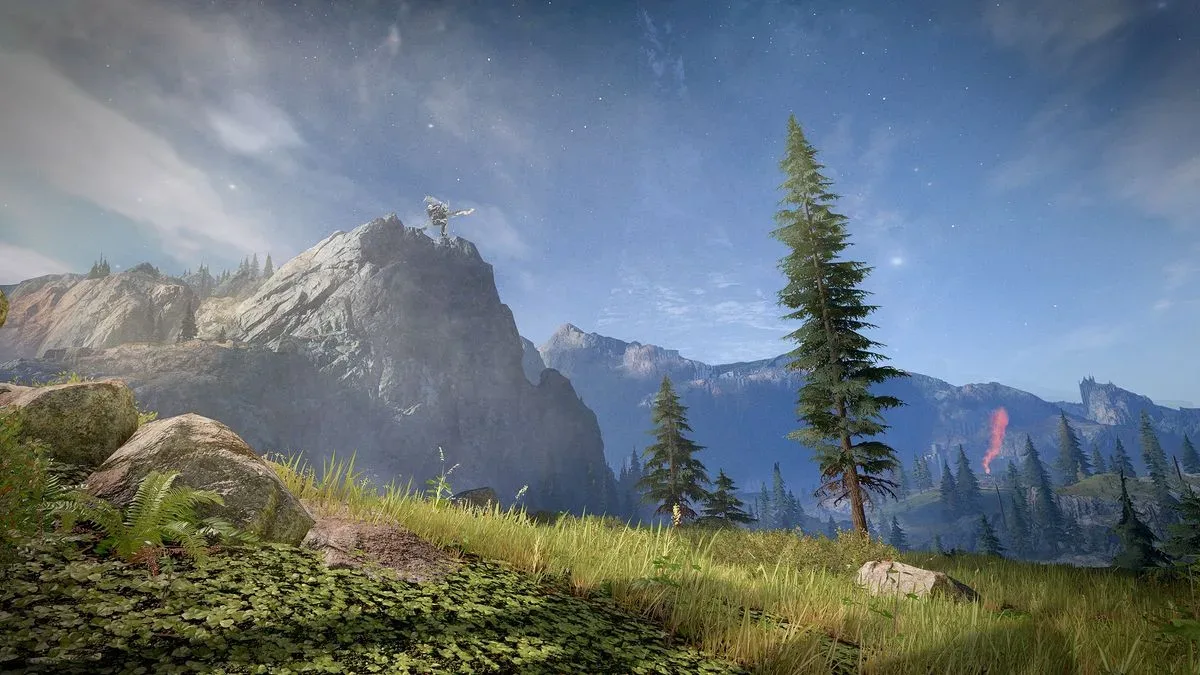
The concept material is not all underground facilities and locked-away horrors. One image shows a Promethean Knight above ground on Zeta Halo after escaping laboratories beneath the surface. The Knight stands on a cliff, while the broader landscape appears ready for combat. The material does not reveal what the character is looking toward, so any explanation of that image would be speculation. Its value is mood and scale: a figure emerging from hidden spaces into an open battlefield.
Another description makes the geographic ambition more explicit. The battle for Zeta Halo was intended to cover much of the ring’s surface, crossing snowy and icy fields, jungles whose mighty trees have been penetrated by Banished steel, wetlands, and sand-blasted ruins once inhabited by the Tudejsa.
Those are useful details because they suggest environmental variety with visible signs of conflict rather than a simple tour through disconnected biomes. The Banished steel embedded in jungle trees, for instance, is a compact piece of environmental storytelling. It implies that military infrastructure has been forced into a living landscape. The ruined Tudejsa settlements point in another direction: traces of people and places with their own past, weathered into the broader history of the ring.
- Snow and ice: broad, cold landscapes intended to form part of the ring-wide battle.
- Jungles and wetlands: natural areas marked by Banished construction and massive trees.
- Sand-blasted ruins: remnants tied to the Tudejsa.
- Subsurface labs: spaces beneath the surface from which a Promethean Knight is shown emerging.
- The Containment Facility: an enclosed, monitored site connected to the timelock prison.
For players, the practical implication is not that any of these places will eventually be playable. There is no basis here to promise that. Instead, the images offer a useful look at the design priorities behind this version of Halo 7: contrast between colossal open terrain and buried installations; familiar factions and threats beside obscure lore; and an attempt to make Zeta Halo feel like a place with multiple layers of occupation, conflict and memory.
Concept art is evidence of direction, not a finished game
It is tempting to approach unreleased-game art as a checklist of cut missions, bosses and maps. That approach often goes too far. Concept art captures possibilities, visual targets and narrative pitches during development; it does not guarantee that every depicted element had reached production, had a finalized role, or would have survived later revisions. The descriptions here are valuable precisely because they add context, but they still leave major gaps.
There is no confirmed campaign structure, no confirmed platform list, no release window, no confirmed protagonist focus, and no detailed explanation of the creature or timelock mechanics in the provided material. There is also no reason to assume Activision’s next Halo project will inherit these ideas. A change in development leadership can preserve concepts, reshape them, or leave them entirely behind.
That uncertainty is familiar across major game series. As another example of a franchise future that remains unconfirmed, an Uncharted follow-up remains an open question despite interest from a key performer. The point is not to equate the two series, but to underline a basic rule for fans: interesting creative material and confirmed future releases are different things.
Still, these Halo 7 glimpses accomplish something rare. They make an abandoned direction feel legible. A fortress designed around a strange temporal cage; Adjutant Repose forced into lockdown; Flood activity complicating a visit by Reclaimers; Fireteam Crimson and an unexplained artifact; and a ring-spanning conflict through ice, jungle, wetlands and ancient ruins—those pieces create a coherent tone even without a finished game around them.
The “ancient, terrible creature” remains the sharpest hook because the material refuses to explain it. That restraint leaves room for fans to imagine the answer, while the surrounding details establish that the idea was not merely a spooky sentence in isolation. It belonged to a larger Zeta Halo vision with a prison, an overseer, competing crises and a battlefield stretching across the ring. Whatever comes next for Halo, this particular version now stands as a tantalizing fragment of the one that did not.