
World of Warcraft Forever began its launch with a very large chunk of server infrastructure behind it. Blizzard publicly listed 3,924 virtual machines, 251,136GB of memory and 70,480 CPU cores as the resources running the new experience—numbers that help explain why the opening hours were widely described as unusually stable for a major online game launch.
The figure that immediately stands out is the memory allocation: 251,136GB, or roughly 251TB when expressed in decimal storage-style terms. The raw total alone does not tell us exactly how the game’s systems are divided, how much capacity was actively used, or how long the launch configuration will remain in place. But it does establish the scale of preparation Blizzard put behind a release expected to bring a great many players online at once.
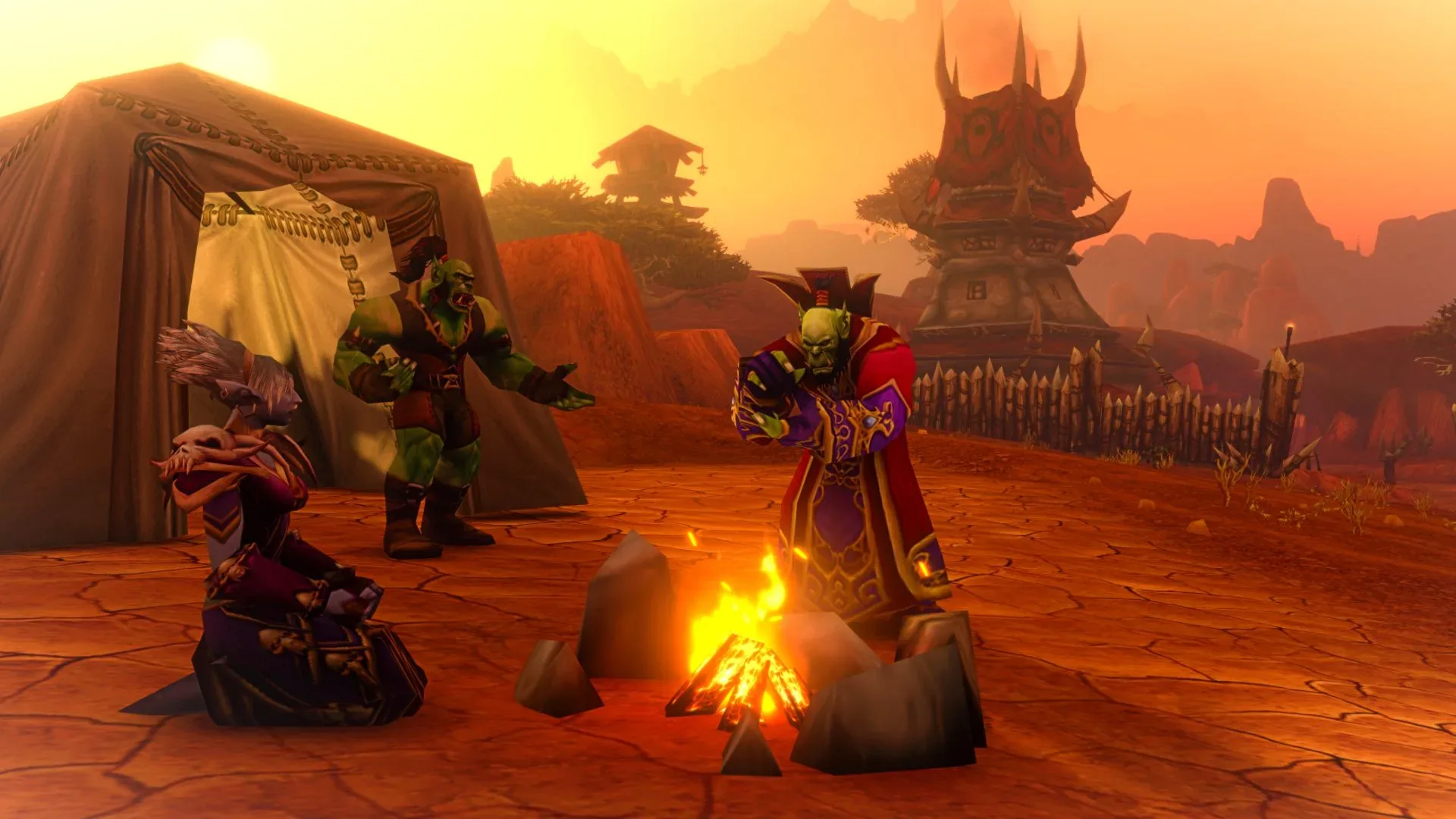
Early reports from players focused on the outcomes that matter most at an MMO opening: little apparent queueing, few disconnects and no widespread reports of crippling lag. Hundreds of characters were visible in the starting zone at the 6 p.m. ET launch point, yet the game remained playable. That is a meaningful result because the earliest minutes of an online role-playing game are usually when demand is most concentrated rather than naturally spread across zones, levels and play sessions.
What Blizzard says was running the launch
Blizzard shared the server totals in a playful World of Warcraft post, but the ingredients are serious infrastructure:
- 3,924 virtual machines
- 251,136GB of memory
- 70,480 CPU cores
A virtual machine, often shortened to VM, is a software-defined computer running on larger physical hardware. It can be assigned computing resources and operated separately from other VMs. For a service with many moving parts, virtual machines can help distribute workloads and make capacity planning more flexible than treating the entire game as one giant server process.
Memory, or RAM, is fast working space used while software is operating. In the context of a persistent online game, it can support the active work needed to keep game services responsive. CPU cores are processing units that can handle work in parallel. Neither headline number is a direct player count, and Blizzard has not disclosed how many people logged in at launch. Still, the combination of nearly 4,000 VMs, more than 251,000GB of memory and over 70,000 cores signals a setup designed for heavy concurrency.
Concurrency is the key word here. It means many people using a service at the same time—not merely the number of people who have accounts or who will eventually play. Launch nights push concurrency hard because players arrive within the same narrow window, create characters, enter the same early areas and interact with the same game services simultaneously.
Why a crowded starting zone can be a technical stress test
An MMO launch is not one problem but several overlapping ones. Players logging in create authentication demand. Character creation and character selection add their own bursts. Once players enter the world, the game must manage movement, combat, chat, quests and the presence of many other players nearby. A starting area packed with new characters is therefore a concentrated version of the game’s broader technical challenge.
Related coverage includes World of Warcraft Forever Launch Runs on 251,136GB of Server Memory.
That is why the positive response to Forever’s opening is notable even without a public concurrent-player number. The available evidence is anecdotal rather than a complete platform-wide performance report: players on the official forums created threads praising the smoothness, and streamer Darth Microtransaction said the release had almost no queue, no disconnects and no lag from their perspective. Those experiences cannot prove that every player had the same session, but they align with the visible density in the starter zone and Blizzard’s unusually specific infrastructure figures.
In practical terms, stable early access lets players spend their time playing rather than retrying logins, waiting in queues or worrying that a disconnect will interrupt progress. It also benefits social play. MMOs are at their most communal at launch, when friends are making new characters and players are discovering the game’s early routes together. A smooth opening preserves that shared moment instead of turning it into a staggered arrival.
Plans and contingencies mattered as much as the hardware totals
Raw compute resources are only one part of a resilient launch. Holly Longdale, Blizzard’s executive producer and vice president for World of Warcraft, characterized the launch demand as beyond what the team had imagined, while crediting the team’s planning and contingencies for holding up under it.
That distinction is important. More memory and more CPU capacity can create room to absorb demand, but preparation determines how an operator responds when reality exceeds forecasts. A contingency is a backup plan for conditions that may occur but cannot be precisely predicted. In an online-game setting, the useful point is not to assume which specific measures Blizzard employed—those details were not provided—but to recognize that launch stability depends on both available capacity and a plan to manage unexpected demand.
The beta offered reason to expect a large turnout. Although it was limited to level 30 and players knew their characters would be deleted, participation was strong enough that developers described the numbers as the craziest they had seen. A beta cannot perfectly reproduce a full release, especially when permanent progress is on the line, but it can reveal where demand may gather and how players behave in the opening portion of a game.
Forever’s release now turns that early interest into a longer-running test. The launch window is a dramatic technical moment, yet it is only the first one. Player populations will begin to spread through the game at different speeds, and usage patterns will change as more people reach later content. The supplied details do not establish what the server footprint will look like later, so the launch figures should be read as a snapshot of the resources Blizzard said were behind the initial rollout.
What players should and should not infer from the numbers
It is tempting to convert the 251,136GB figure into a simple statement about how many players Forever can support. That would go beyond the evidence. RAM, virtual machines and CPU cores are inputs into a broader system, not a public seat count. Different parts of an online game place different pressure on different resources, while login surges and crowded zones may not behave like ordinary gameplay hours.
The safer conclusion is straightforward: Blizzard provisioned substantial infrastructure for Forever, and the early response suggests that investment was effective during the opening period. It does not guarantee every future peak will be as quiet, nor does it prove that every player avoided problems. It does mean the most visible launch-day symptoms—long queues, disconnections and severe lag—were not the dominant story in early player discussion.
There is also a useful reminder here about where performance problems originate. A player’s local setup matters for frame rate, load times and input responsiveness, while a live game’s servers handle shared online activity. The two sides meet during play, but a powerful home PC cannot solve a login bottleneck or an overloaded game world. Likewise, a well-provisioned service cannot compensate for every local hardware issue. Players weighing their own setup can find a different, hardware-focused angle in this PC couch-controller guide.
A strong start, with more of the game still to come
Forever is intended to take most players weeks to work through, so the conversation will naturally move beyond the first-night infrastructure. Players will be learning what the full game holds after the level-30 beta ceiling, while Blizzard has indicated there may be opportunities to visit fan-favorite locations from later expansions in the future.
For now, the clearest takeaway is a relatively rare one for a highly anticipated always-online launch: the infrastructure itself became news because it appeared to stay out of the way. Blizzard’s 3,924 virtual machines, 251,136GB of memory and 70,480 CPU cores are not a substitute for the game’s content, community or long-term support. They are, however, a concrete indication of the scale required to give a crowded launch its best chance of feeling uneventful—in the most flattering possible sense.