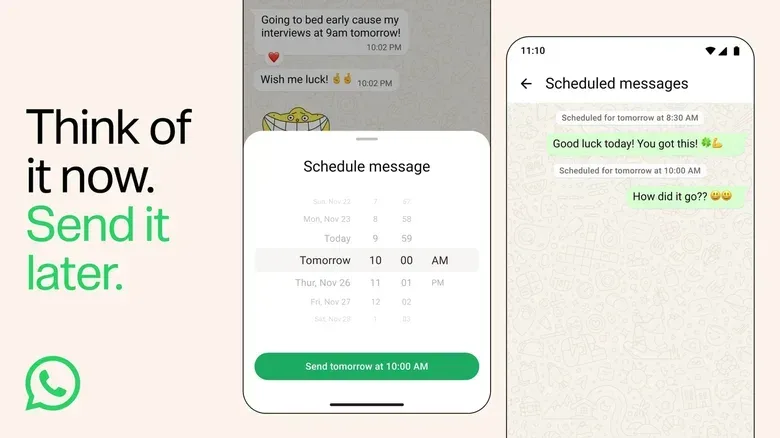
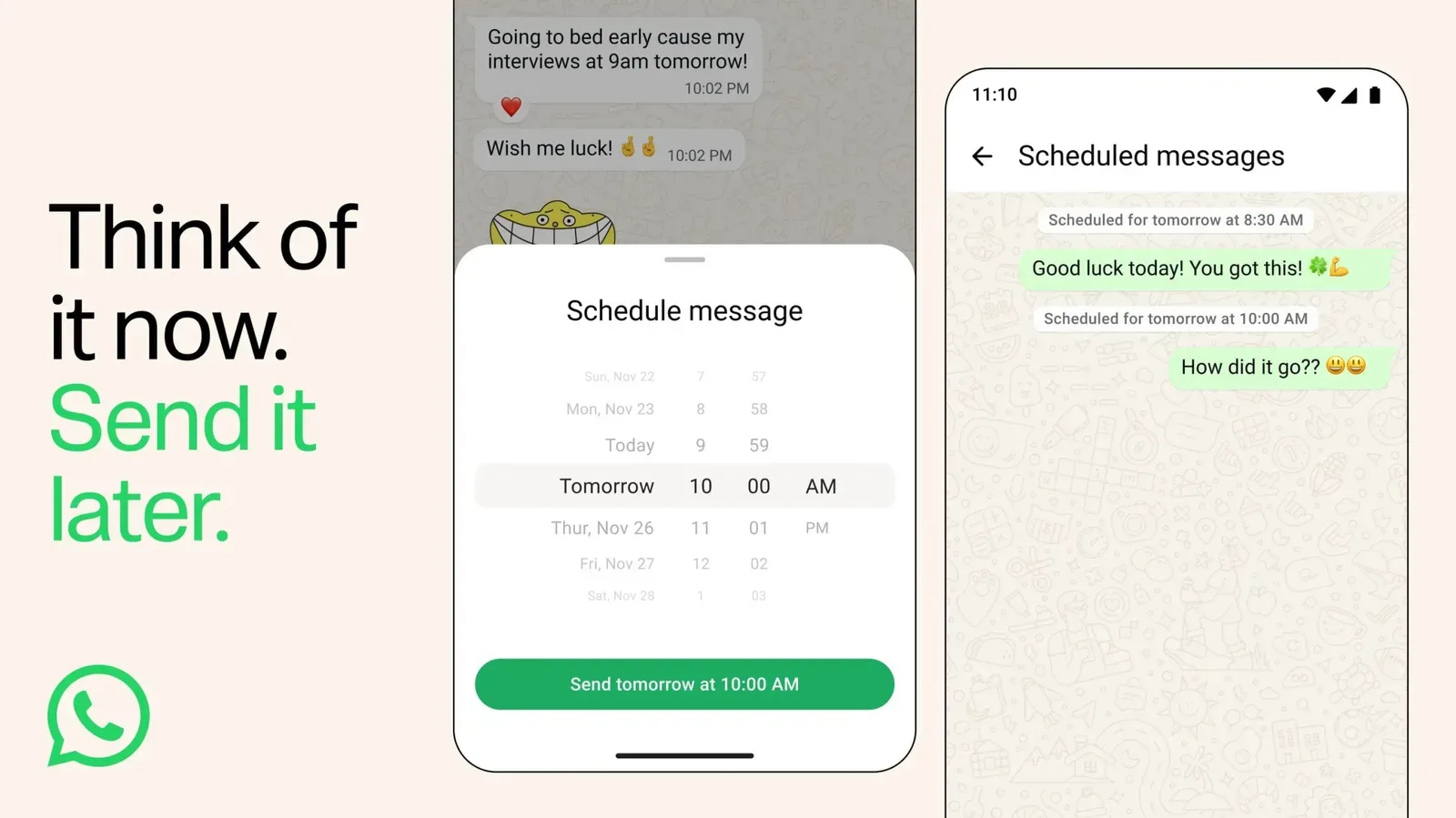
WhatsApp is adding scheduled messages, a long-requested convenience feature that lets people prepare a message now and have it sent later. The rollout is set to reach users globally in the coming weeks, with support for text, photos and videos.
The timing window runs from 10 minutes to 14 days in the future. Scheduled messages can be used in both individual conversations and group chats, making the option useful for everything from a simple reminder to a carefully timed group update.
How WhatsApp scheduled messages work
Once the feature is available on an account, the basic process is straightforward: compose a message, then press and hold the send button rather than sending it immediately. WhatsApp will provide a way to choose the desired date and time before the message is queued.
Recipients will not be told that a message was scheduled. When it arrives, it will appear like an ordinary message in the conversation. That detail matters because the feature is designed around timing, not around announcing that the sender prepared something earlier.
WhatsApp will also show users the messages they currently have queued for delivery. A sender can delete a scheduled message if plans change before its send time.
The confirmed limits at a glance
- Earliest send time: 10 minutes from scheduling.
- Latest send time: 14 days from scheduling.
- Supported formats: text, photo and video messages.
- Supported chats: one-to-one conversations and group chats.
- Recipient notice: none; the message displays as a regular update.
- Changes: queued messages can be viewed and deleted before they are sent.
Why this small feature has practical value
Messaging usually assumes that writing and sending happen at the same moment. That is ideal for a live conversation, but it is not always the best fit for reminders, celebrations or messages crossing time zones. Scheduled sending separates the act of composing from the act of delivering.
For example, someone can write a good-luck note in advance for a friend with a test or job interview, then set it to arrive closer to the important moment. A birthday greeting can be prepared at a convenient time and delivered at midnight in the recipient’s time zone. In a group chat, the same principle can help a message land when participants are more likely to see it.
The 14-day cap means this is not a tool for building a months-long messaging calendar. It is better understood as a short-term planning feature: useful for the coming days and the next couple of weeks, but not intended to replace a dedicated calendar, reminder app or longer-running automation system.
That distinction is useful when deciding how to use it. A message that depends on a particular person receiving information should still be treated with care. Scheduling can improve delivery timing, but it cannot guarantee that a recipient will see the message immediately, keep notifications enabled or be available to respond.
What “end-to-end encrypted” means here
WhatsApp says scheduled messages, like other personal messages on the service, are end-to-end encrypted. In plain terms, the content is protected so that only the sender and intended recipient or recipients can read it.
For a group chat, “recipient” naturally means the members included in that chat. The core point is that choosing a future delivery time does not change the stated privacy model for personal messages. A message being held for later transmission is still described as end-to-end encrypted.
Privacy is especially relevant for scheduled communications because people may prepare a personal note, a photo or a video well before it is meant to arrive. The feature adds delayed delivery without presenting it as a separate, less protected class of message.
A useful tool for considerate timing
The feature’s biggest benefit may be social rather than technical. It offers a way to respect different routines without relying on memory at exactly the right time. Someone who writes late at night can schedule a non-urgent message for the next morning. Someone coordinating across time zones can avoid doing mental arithmetic at the moment they need to send a greeting.
It may also reduce the pressure to keep a thought in mind until later. If the right message occurs to a user now, they can draft it while the context is fresh, choose a sensible delivery time and revisit or remove it from the pending-message view if circumstances change.
There is a modest etiquette benefit, too. An unscheduled late-night message may be harmless, but it can create the impression that a response is expected immediately. Scheduling gives the sender more control over when a note enters the recipient’s notification stream, while keeping the eventual chat exchange natural.
What scheduled messages do not change
Scheduled delivery is an addition to messaging, not a replacement for real-time communication. A scheduled message cannot account for last-minute changes unless the sender remembers to check and delete it. The ability to review pending messages is therefore an important part of the feature rather than a minor extra.
Users should also consider whether a planned note needs to be current when it sends. A birthday greeting may remain perfectly appropriate after being written in advance. A message about plans, availability or a fast-moving group discussion may not. The safest use cases are those where the content is unlikely to expire before delivery.
For users building routines around connected devices, the broader idea of choosing a time for communication will feel familiar. Smart-home tools already use timed routines for appliances and voice controls; for a related example, see our coverage of the Amazon Smart Plug and its routines. WhatsApp’s approach applies that same scheduling instinct to a personal conversation, with a deliberately limited two-week window.
Rollout and availability
WhatsApp says scheduled messages will become available globally in the coming weeks. Availability may therefore differ from one account to another during the rollout. Once the option appears, users can access it by pressing and holding the send button after composing a message.
The addition brings a familiar communication feature to WhatsApp while retaining the app’s ordinary chat presentation for recipients. For people who have ever remembered an important message at the wrong hour, wanted to send a photo at a more appropriate time, or needed to coordinate a group update without being present at the exact moment of delivery, that is likely to be enough to make the wait worthwhile.