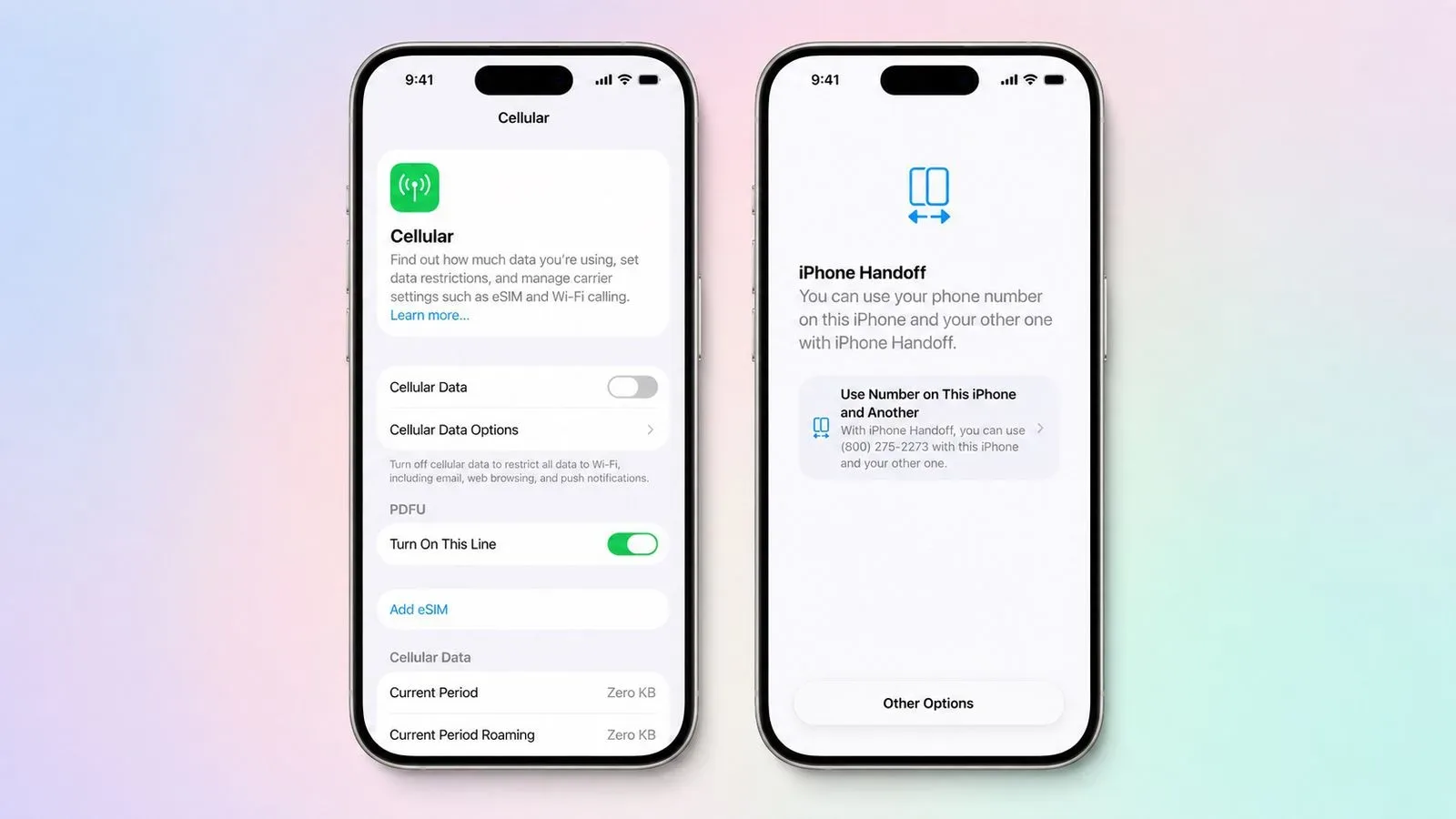
Two more major mobile carriers are set to join the iOS 27 iPhone Handoff rollout later this year. Verizon and EE are expected to support the feature, which is designed to let a person move between any two iPhones running iOS 27 while continuing to use the same phone number on both devices.
That description sounds modest at first: the same number on two phones. But it points toward a genuinely useful change for people whose daily tech setup is less “one phone, one person, one destiny” and more “one phone in a bag, another in a pocket, and neither is ever where it ought to be.” iPhone Handoff is intended to make switching devices less disruptive when the number itself needs to travel with the user.
The feature initially has support from T-Mobile and Deutsche Telekom. T-Mobile is charging $5 per month for its version of the service. Verizon and EE joining later in the year will broaden the carrier footprint, although neither timing beyond that general window nor pricing details for their implementations were provided.
What iPhone Handoff is meant to do
iPhone Handoff allows a user to switch between two iPhones on iOS 27 while using a single phone number on each device. The key distinction is that this is not simply having two separate phones with two independent lines. The premise is continuity: a user can change from one compatible iPhone to another without abandoning the number people use to reach them.
Apple’s familiar “Handoff” label has previously been associated with picking up tasks across devices, such as moving from one Apple screen to another. This iOS 27 feature applies that broad idea to the core purpose of a phone. In practical terms, it is about making an iPhone user’s number feel less permanently welded to one slab of glass and aluminum.
The announcement does not spell out every operational detail, and that restraint matters. There is no reason to assume that every calling, messaging, emergency-service, roaming, account, or device-management scenario works in exactly the same fashion across all participating networks. Carrier-backed services often come with eligibility rules and account requirements. Anyone interested should wait for the specific terms supplied by Verizon, EE, or Apple before treating iPhone Handoff as a universal replacement for a traditional single-device arrangement.
Why carrier support is the important part
iOS 27 is necessary, but the software alone is not the whole story. A phone number lives within carrier systems, which is why the feature depends on carrier participation. T-Mobile and Deutsche Telekom provide the initial support, while Verizon and EE are now slated to follow. That expansion is meaningful because a feature this personal becomes far more relevant when it reaches more networks rather than remaining a niche option attached to only one or two providers.
It also explains why availability may not look identical in every market. Verizon operates in the United States, while EE operates in the United Kingdom. Deutsche Telekom has its own footprint, and T-Mobile’s offering carries a stated monthly charge. The broad iOS 27 feature may have a shared name and purpose, but carrier policies can shape the real-world proposition: who can add it, what devices qualify, how number transfers are handled, and whether there is an extra fee.
For now, the clearest confirmed pricing detail is T-Mobile’s $5-per-month charge. Verizon and EE have not been assigned a price in the information currently available. That leaves a major question for prospective users. A modest monthly fee may be easy to justify for someone who regularly carries two iPhones. For a person who only occasionally wants a backup device, it could be the difference between a clever convenience and another subscription line item quietly farming coins from the kingdom.
Who could benefit from a two-iPhone setup?
The obvious audience includes people who already keep two iPhones active for different parts of their life. Someone might have a smaller device for errands and exercise, plus a larger one for workdays or travel. Others may maintain a newer phone and an older backup. A user could also have distinct personal and work hardware while still wanting contacts to rely on one familiar number.
iPhone Handoff could be especially appealing where the physical context changes often. A larger iPhone can be preferable for maps, writing, media, and day-to-day heavy lifting. A second handset might be more convenient when minimizing what is carried matters. The ability to move between them under the same number could remove a layer of friction that normally makes the second device feel like an emergency spare rather than a real companion.
There is also a collector-minded angle, though this is not a feature built specifically for collectors. People who keep an older iPhone in working order often have to decide whether it remains a Wi-Fi-only nostalgia machine, gets its own service, or lives dormant in a drawer until a current phone suffers an unfortunate encounter with gravity. A supported handoff system potentially makes a second phone more practical without requiring friends, family, and group chats to memorize a second number.
Still, iPhone Handoff is not a reason to presume old hardware will gain a new lease on cellular life. The stated requirement is two iPhones running iOS 27. Hardware eligibility for iOS 27 and any carrier-side conditions will determine what pairings are possible. The feature is about two compatible iPhones, not an all-access pass for every retired device with an Apple logo and a heroic battery-health percentage.
A wider iOS 27 picture
The carrier news arrives as iOS 27 brings a broader set of changes to Apple’s mobile ecosystem, including Siri AI, Liquid Glass controls, and expanded Apple Intelligence. For a look at that larger software release, see our coverage of iOS 27 and iPadOS 27.
Against those highly visible interface and AI additions, iPhone Handoff is the kind of feature that may sound more specialized but could become surprisingly important to the people it fits. New visual design can be noticed in seconds. Number continuity across two handsets is noticed when it prevents a missed call, avoids carrying the wrong device, or makes a backup phone useful at exactly the right moment.
It is also a reminder that some smartphone features sit at the intersection of software design and telecommunications policy. Apple can build the experience into iOS 27, but carriers remain central to making the service available. That shared responsibility is likely why the rollout is expanding network by network rather than appearing everywhere at the same moment.
What remains unknown
There are several details that have not yet been established for Verizon and EE. Their exact launch dates are not known beyond later this year. Their pricing is not known. Specific enrollment steps, plan limitations, device limits, regional restrictions, and any special treatment for travel or international use were also not detailed.
Those omissions are worth keeping in mind because the phrase “same number on two iPhones” invites plenty of natural follow-up questions. Can both handsets remain ready for all the same communications at once? How quickly can a user switch? What happens if one device is offline? How does the service interact with a carrier account shared by a family or business? None of those points should be filled in with guesswork before official documentation answers them.
For the moment, the solid takeaway is straightforward. iPhone Handoff is an iOS 27 capability for switching between two iPhones under the same number. T-Mobile and Deutsche Telekom are the initial supporting carriers, with T-Mobile charging $5 monthly. Verizon and EE are planned additions later this year. For users on those networks who have wanted their number to be a little less attached to one particular iPhone, the list of potential options is about to get longer.