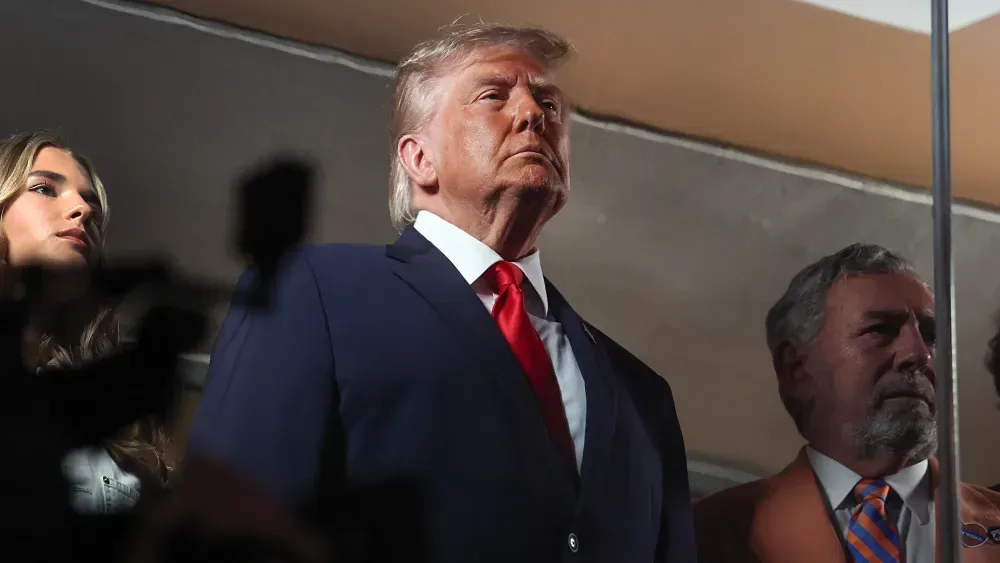
Donald Trump says he will personally finance television advertisements he describes as “patriotic,” following controversy over reported White House spending on spots that promote the president and his political message.
In a Truth Social post, Trump said he had decided to pay for the ads himself, using his own money and money raised for MAGA, Inc. He maintained that using U.S. funds for the advertising had been standard, but said he was changing course amid objections from critics.
The development is significant less because it settles the debate over the ads than because it changes the stated funding mechanism. The central dispute has been whether advertising paid for by taxpayers can reasonably be presented as a public-service message when it praises a sitting president and attacks ideological and media targets. Trump’s statement responds to the spending criticism by saying the ads will be funded privately, not by conceding that their content is inappropriate.
What the ads reportedly say
The television spots have aired across a broad mix of cable and broadcast outlets, including Fox News, Newsmax, CBS, Fox, NBC, MS NOW, CNN and ABC. Their message reportedly says Trump is fighting communism, socialism, Marxism and what it calls the “fake news media,” among other claims.
Those elements matter when evaluating the disagreement around the ads. A public service announcement, often shortened to PSA, generally describes a message intended to educate the public or encourage conduct thought to serve the public interest. The White House has characterized these spots in that vein: as reminders to love the country and understand why it is worth defending at home, at the border and abroad.
Critics, however, have focused on the promotional and political character of ads that foreground the president’s battles with ideological opponents and news media. The supplied information does not establish a legal finding on the matter. It does show two sharply different descriptions of the same material: the White House calls it educational and patriotic, while the controversy arose from the view that taxpayer money was being used for advertising that endorses Trump.
The reported taxpayer spending
Before Trump’s new statement, the White House was reported to have spent more than $440,000 in taxpayer funds on pro-Trump television ads. Officials defended that expenditure by arguing that the announcements were not campaign advertising because Trump was not on the ballot and the spots did not include a call to action.
A call to action in advertising is language asking an audience to take a specific step, such as vote, donate, make a purchase or visit a website. The absence of an explicit request is part of the White House’s defense. But it is also only one part of the broader public argument. Messaging may still be seen as political or promotional by viewers even if it never expressly instructs them to vote or donate.
Related coverage includes Trump Says He Will Personally Fund ‘Patriotic’ TV Ads.
Similarly, an ad can avoid being a conventional campaign spot while still attracting questions about its purpose, tone and funding. That distinction is at the heart of this episode. The administration’s explanation emphasizes national pride and civic education. The objections described in the report emphasize that the ads promote the president while using public resources.
What Trump’s funding pledge changes — and what it does not
Trump’s post suggests that future ads described as patriotic will be paid for with personal funds and money raised for MAGA, Inc. On its face, that would separate the new spending Trump describes from the reported taxpayer-funded ad buys that prompted backlash.
It does not erase the question surrounding the earlier expenditure. Trump’s comments describe a decision to fund ads himself going forward, while the reported spending of more than $440,000 concerns ads the White House had already defended. The available information does not specify which individual spots may shift to the new funding arrangement, when that shift takes effect, or whether every ad presently airing is covered by the pledge.
It also does not establish whether the private funding will alter the ads’ wording, visual presentation, placement or audience. Trump framed his decision as a change in who pays, rather than a change in the message. His post continued to present the advertisements as positive promotion for the United States and attacked the critics objecting to the prior use of U.S. money.
Why TV placement is part of the story
The ads’ presence on both cable-news channels and major broadcast networks gives the campaign a potentially wide reach. Cable networks can concentrate on audiences who already follow political coverage closely, while broadcast stations can place a message before viewers watching a broader range of programming. The supplied report identifies the networks carrying the spots, but does not provide impression figures, schedules, rates by outlet or details on the length and frequency of the placements.
That missing detail is worth keeping in mind. More than $440,000 identifies the reported scale of spending, but it does not by itself show how much airtime was purchased, which networks received the money, or how many viewers watched the ads. It also cannot tell readers how effective the campaign was. Spending and impact are not the same measurement.
For media audiences, the case is a useful example of how the label attached to a spot can become part of the message. Calling something a PSA emphasizes civic purpose. Calling it a pro-Trump ad emphasizes its relationship to a political figure. Both descriptions appear in the public arguments presented here, and each directs attention to different features: the White House’s stated educational objective on one side, and the president-centered, adversarial language on the other.
The administration’s defense
The White House has been consistent in describing the ads as patriotic rather than partisan. Its position is that the announcements remind Americans why the country is worth defending domestically, at the border and abroad. Officials have also stressed that Trump is not on the ballot and that the messages do not tell viewers to take campaign action.
That defense makes the intended distinction clear: the administration is positioning the advertising as government communication about civic values, not an electoral appeal. Yet the controversy demonstrates why the distinction is contested in practice. The messages reportedly praise Trump’s struggle against political ideologies and the media, subjects that are closely intertwined with partisan rhetoric.
Trump’s decision to say he will pay himself may lower the immediate temperature around the use of taxpayer funds, but it leaves the underlying disagreement intact. The issue is not merely whether the ads air; it is what they are, whom they promote, and whether public money should support messaging with that character.
What to watch next
The next useful details would be straightforward ones: whether taxpayer-funded placements end, whether new privately funded ads begin, and whether the content differs from the spots already described. Clear identification of the payer for future airtime would also be important to understanding how Trump’s stated change is being implemented.
For now, the confirmed point is limited but consequential. After the reported taxpayer spending and ensuing criticism, Trump says advertisements he calls patriotic will be funded with his own money and MAGA, Inc. fundraising. The White House continues to portray the campaign as civic-minded public communication, while critics’ objections have centered on its apparent promotion of the president.
The episode arrives in a media environment where the boundary between government information, political persuasion and personal branding is intensely scrutinized. As with wider debates over who controls major media strategy and distribution, including changes in leadership across large entertainment platforms, funding and control can shape how audiences interpret the purpose of a message. In this case, Trump has offered a direct answer on the funding question for the ads he describes going forward, even as disagreement over the ads’ substance remains.