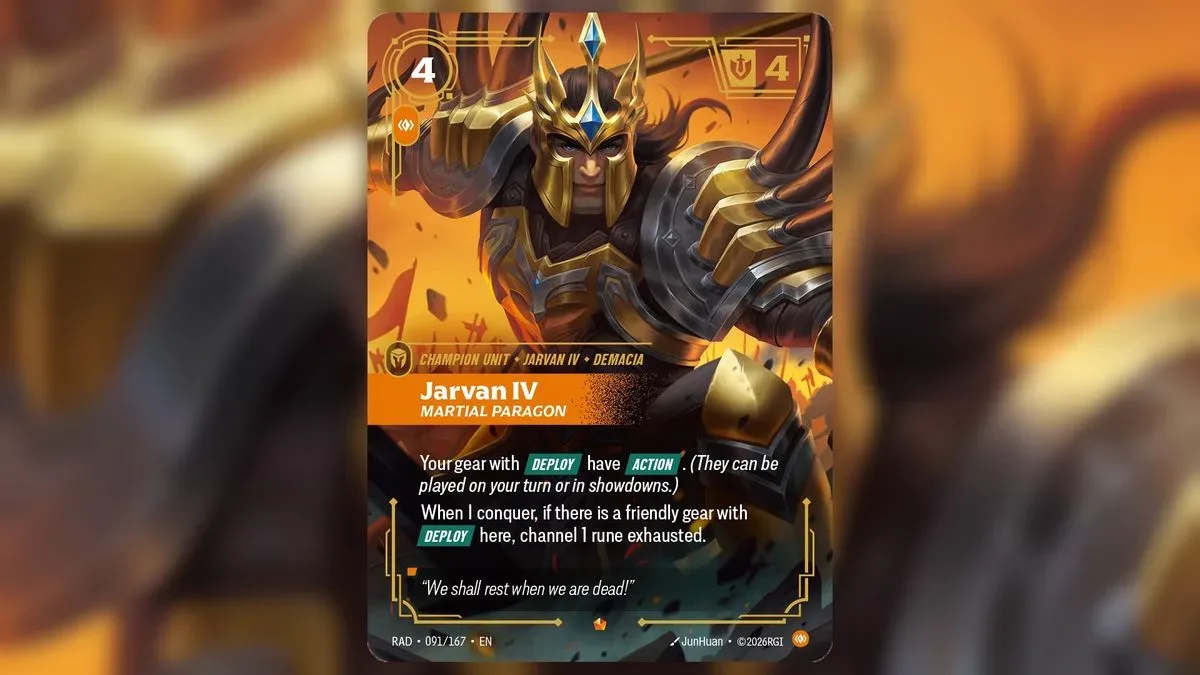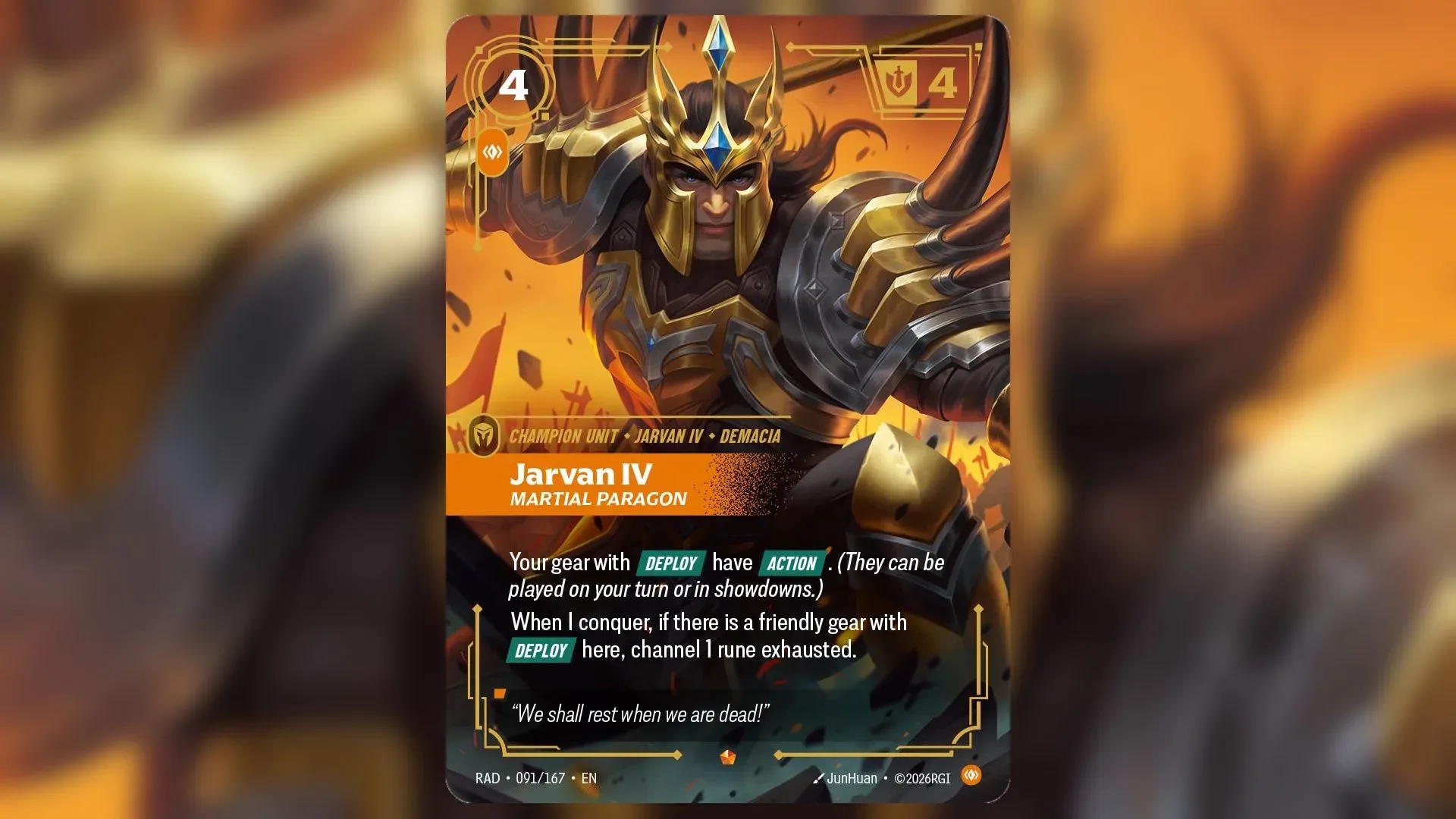
Riftbound: Radiance, the final Riftbound set scheduled for 2026, is due to release on October 23. Its newly detailed mechanics—Deploy, Show Off and Disarm—point toward a set interested in visible board positioning, tactical reveals and combat pressure. A newly revealed Champion Unit, Jarvan IV, Martial Paragon, puts one of those ideas at the center of his game plan: using Gear with Deploy to create flexible plays around Battlefields.
Jarvan costs 4 Energy and requires a recycled Body rune. He has 4 Might. Those baseline numbers establish him as a Champion Unit with a meaningful upfront investment, but the important text is tied to Gear. Gear cards with Deploy gain Action while Jarvan is present, allowing them to be played during showdowns instead of being restricted to a player’s regular turn. He also rewards successful Battlefield conquests: when he conquers a Battlefield, a friendly Gear with Deploy remaining there can let its controller channel an exhausted rune.
The result is a character package that appears to reward players for treating Gear as an active part of a conflict over Battlefields, rather than simply as cards placed before combat begins. Jarvan also has alternate art based on his beach skin, giving the character a second visual treatment alongside the standard version.
What Riftbound: Radiance adds
Radiance introduces three mechanics, each operating in a different part of a match.
For more context, explore September’s Gaming Tech Roundup Puts Switch 2 Protection, OLED Laptops and Controllers in Focus.
- Deploy: lets a player play a Gear card to a Battlefield. There is a significant risk attached: if the opposing player holds that Battlefield, the Gear is killed.
- Show Off: asks a player to reveal a card from their hand or board to receive a specified benefit.
- Disarm: reduces an enemy Unit’s Might when that Unit attacks.
In plain terms, Gear is the card type Jarvan works with, while a Battlefield is the location at which the Deploy decision matters. Might is the value Disarm reduces. The supplied details do not establish every wider rules interaction for those terms, but the individual mechanics are direct enough to show their central tension.
Deploy offers a way to establish Gear at a Battlefield, but it does not make that investment safe. The state of control over that Battlefield matters immediately. A player can put Gear into play there, yet that Gear is killed if the opponent is the one holding the location. That condition makes Deploy a positional mechanic, not merely an equipment-delivery mechanic. Before committing a card, players need to consider who currently holds the relevant Battlefield and whether their plan can actually convert that Gear into value.
Show Off, by contrast, concerns information. Revealing a card from the hand or board is a concrete cost or requirement because it makes that card known to the opponent, while the benefit depends on the individual card’s stated text. Disarm is more overtly combat-focused. Reducing an attacker’s Might can affect the strength of an attack at the moment it is launched, potentially changing what the defending player must answer or whether an attack remains appealing at all.
Related coverage includes Riftbound: Radiance Reveals Jarvan IV, Martial Paragon and His Gear-Focused Game Plan.
Why Jarvan IV is a Deploy centerpiece
Jarvan’s first ability changes the timing of Gear with Deploy by giving it Action. The practical implication stated by the card is that those Gear cards can be played during showdowns. This is a substantial difference from only being able to deploy them during a player’s own turn: the Gear can become part of a live response during a confrontation.
That flexibility is where the card’s identity begins. Deploy already asks players to care about which side holds a Battlefield. Adding Action means the decision need not always be made in advance, long before a showdown. A Jarvan player can potentially wait for a more relevant moment, then play an eligible Gear during the conflict. The caveat remains essential, however: Deploy’s condition still threatens Gear placed at a Battlefield the opponent holds. Action expands the available timing, but it does not erase the core positional danger.
His second ability links that Gear placement to a reward after conquest. Whenever Jarvan conquers a Battlefield, his controller may channel an exhausted rune if, by the end of the event, a friendly Gear with Deploy is still at that Battlefield. The wording makes the final board state meaningful. It is not enough simply to have played Deploy Gear there earlier; the Gear must remain friendly and still be at the conquered Battlefield at the relevant endpoint.
Channeling an exhausted rune is the resource-related payoff described on Jarvan’s card. An exhausted rune is one that has already been used or otherwise turned inactive under the game’s resource system; channeling it represents getting value from that exhausted rune again. The available details do not set out all possible uses for a channeled rune, so it would be premature to claim a full combo sequence. Still, the card clearly frames conquest plus surviving Deploy Gear as a way to generate further resource utility.
A sequence built around control, not automatic safety
The most straightforward reading of Jarvan’s intended play pattern is: establish or retain Gear with Deploy at a Battlefield, conquer that Battlefield with Jarvan, then gain the channel benefit if the Gear remains there. His Action-granting text helps make the Gear side of the plan more adaptable during showdowns. It is a compact loop that gives each part a role:
- Deploy Gear creates a presence at a Battlefield.
- Jarvan makes that Gear more flexible by granting Action.
- Jarvan conquers the Battlefield.
- The Gear that remains enables the exhausted-rune channel trigger.
The key word in that sequence is remains. Radiance’s Deploy rule has already warned that a Gear played to an opponent-held Battlefield is killed. Jarvan therefore seems less like a card that ignores the risks of Deploy and more like one that raises the rewards for navigating them well. Players weighing whether to put Gear into a contested location will be balancing a possible immediate tactical use against the chance of losing that Gear before it contributes to a conquest payoff.
That reading is analysis rather than a confirmed deck list or match result. No full Jarvan deck, card pool breakdown or tournament performance has been provided. But the interaction printed on the Champion itself is specific: he wants Gear with Deploy, wants those cards to matter during showdowns, and wants friendly Deploy Gear to survive where he conquers.
How the new mechanics could pull in different directions
Radiance’s three named mechanics give players reasons to pay attention to different forms of commitment. Deploy commits a Gear card to a Battlefield. Show Off commits information by revealing a card. Disarm pressures an attacker’s combat math by lowering its Might. Jarvan is firmly on the Deploy side of that equation, but he will enter an environment where attacks can be weakened and revealed information can generate benefits.
For Jarvan players, that means the timing granted by Action may be especially valuable. A Gear with Deploy that can be played during a showdown is not just a card placed early and left exposed; it can be held until a moment when the Battlefield battle is more defined. Yet it still must be directed at a Battlefield, and Deploy’s kill condition means ownership of that space cannot be ignored.
For opponents, the publicly stated information makes the priority clear even without knowing every card in the set: stopping Jarvan from conquering, or ensuring the needed Deploy Gear does not remain at the Battlefield, interrupts the channel payoff. That does not establish precise counters or rules outcomes, but it identifies the two conditions Jarvan’s controller is trying to satisfy.
The character theme is notably coherent. Jarvan IV’s League of Legends identity is associated here with a “flag and drag” style of play, and the card translation is less about simply presenting a recognizable Champion than about making placement and movement across a contested space feel central. Gear is the tool, Battlefields are the objective, and conquest is the moment where the plan pays out.
Release schedule and card reveals
Additional cards from Riftbound: Radiance are scheduled to be revealed through October 9. The set’s official release is set for October 23, 2026. As the final Riftbound release of the year, Radiance has a clear identity already: it adds a location-sensitive Gear mechanic, a reveal-for-benefit mechanic and an attack-focused Might reduction mechanic.
Jarvan IV, Martial Paragon offers an early example of how those mechanics can be used to build a Champion around a particular card type rather than just a collection of standalone effects. His 4 Might, 4 Energy cost and recycled Body rune requirement set the entry point; his Gear text supplies the reason to construct around him. Whether that package becomes a major competitive strategy will depend on the rest of the Radiance card pool, but the available design direction is easy to read: deploy with care, win the Battlefield, and make sure the Gear survives long enough to matter.