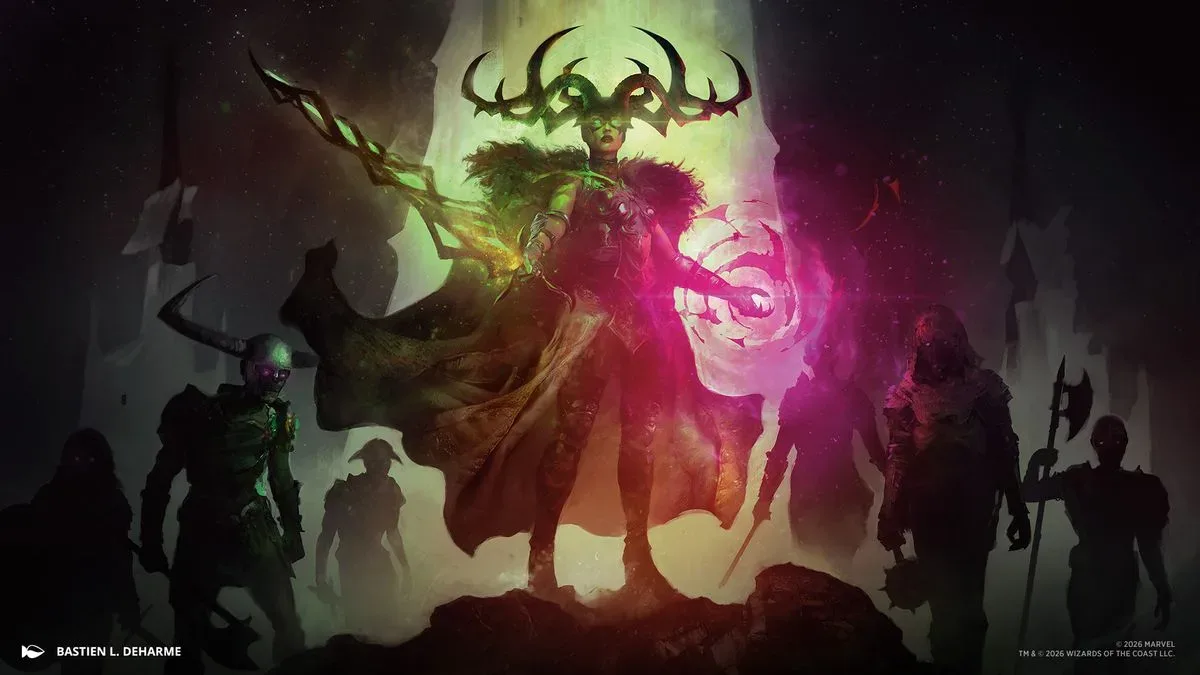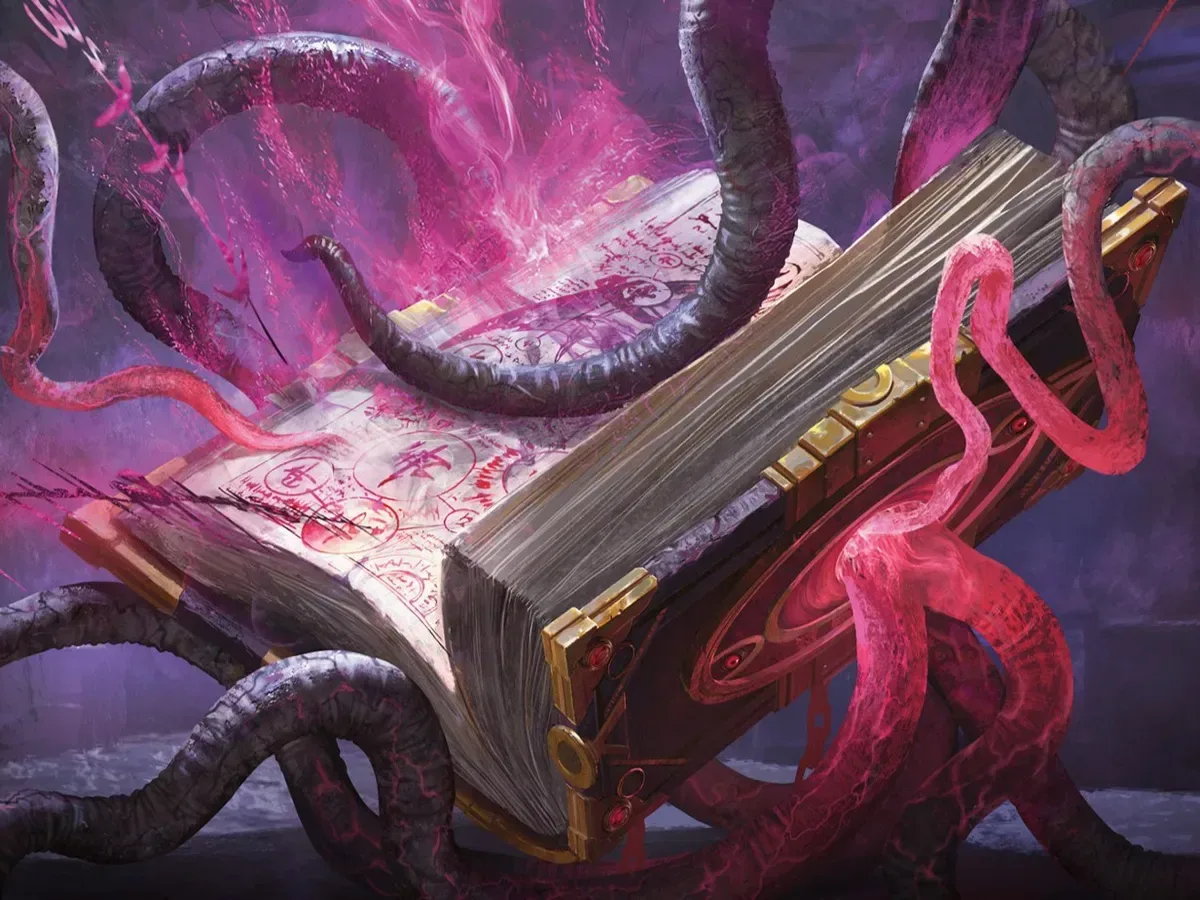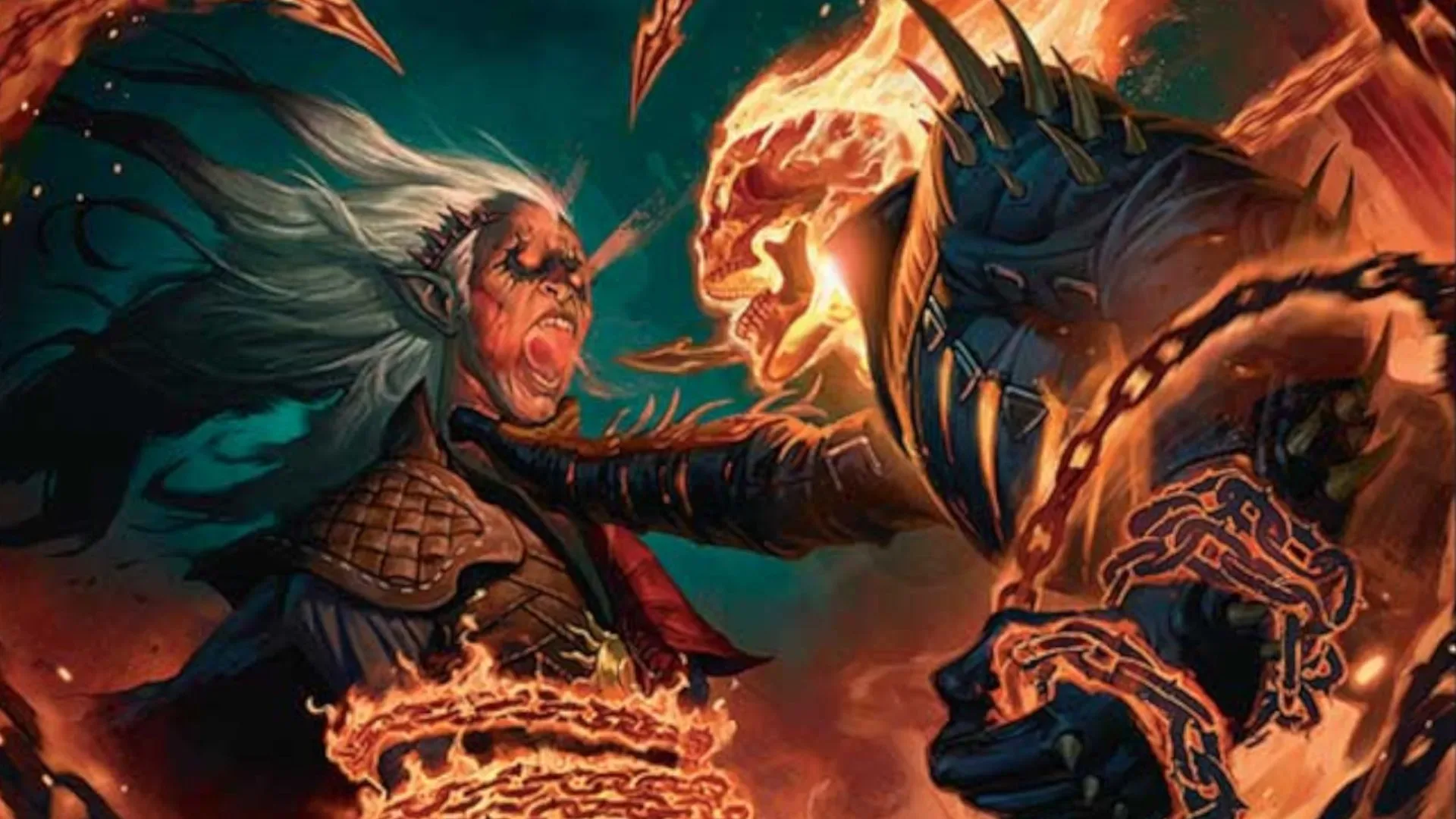
Magic: The Gathering’s upcoming Darkhold Destiny crossover will introduce a brand-new character to the Marvel universe. The character has not yet been revealed, but its origin is already notable: it grew from a gameplay and story problem the Magic design team could not solve by assigning an existing Marvel hero or villain to the needed role.
Darkhold Destiny is Magic’s third Marvel crossover and is built around supernatural themes, dark magic, and team-ups involving a pantheon of gods. Its release is scheduled for April 9, 2027. While further card reveals are still ahead, the original character is among the set’s most consequential unknowns—not simply another adaptation of familiar comic-book material, but a Marvel-approved addition developed specifically through the needs of a trading-card game.
That is a rare proposition in any licensed crossover. A card game has to make characters legible in a compact package of rules, artwork, name, flavor, and deck-building function. Marvel, meanwhile, has to ensure that a new figure belongs in its universe and can stand beside an enormous cast with established histories and unmistakable visual identities. Darkhold Destiny’s new character emerged where those two requirements met.
A missing role in a supernatural set
Principal game designer Dillon Deveney described repeatedly encountering a “narrative hole” while building the set. There were existing Marvel characters who could fit parts of the dark-magic setting, but trying to force them into this particular creative and mechanical role did not feel right. The issue was not a lack of Marvel characters. It was that the team needed a specific combination of story purpose and gameplay expression that it felt was not already available.
That distinction matters. Licensed sets can look, from the outside, like an exercise in matching recognizable heroes to powerful cards. In practice, the process is more restrictive. A character may be iconic, but their defining traits may not support the mechanic a set requires. Alternatively, their identity may be so particular that redesigning them around a new role weakens the thing that makes them recognizable.
Deveney’s account suggests the team eventually decided it would be better to make the strongest possible card for an established character on that character’s own terms, rather than squeeze them into a role designed for someone else. That left room for an original solution.
When the proposal was taken to Marvel, the response was receptive. Marvel had reportedly been exploring a broadly similar kind of character without finding a version that fully worked. The collaboration therefore became less about requesting permission to add a one-off game piece and more about two creative groups helping one another resolve a shared idea.
Why card design can require a new character
Head designer Mark Rosewater framed the design challenge in simple terms: a good Magic card needs to identify the single most exciting thing about its subject. That is especially important for a crossover character with decades of comic-book appearances, alternate versions, powers, allies, and enemies.
Related coverage includes Magic: The Gathering's Darkhold Destiny Will Introduce a Brand-New Marvel Character.
In Magic, a card’s rules text has limited space and must remain understandable during play. Its mana cost, card type, abilities, power and toughness where applicable, and relationship to the rest of a deck all need to work together. Adding every possible superpower would not create a more faithful design; it would create an unfocused or potentially disruptive card.
Mechanics are the rules and systems that determine how a card functions. A mechanic may represent a character’s powers, but it also affects balance and how players construct decks. Narrative throughline, by contrast, means the unifying story or creative logic that connects the set’s cards, characters, and themes. Darkhold Destiny’s development challenge was to align both: the character needed to make sense in Marvel’s supernatural space while also doing something valuable and coherent within Magic’s game system.
That helps explain why creating somebody new could be more faithful than heavily altering somebody old. If an existing Marvel figure has a highly specific identity, the most respectful adaptation may be a card that celebrates it. A new character can be built around the needed mechanical concept from the beginning, with their lore and visual design shaped to support it.
From many ideas to a small group of pitches
The final version was not created in a single brainstorm. Deveney said the character seen in the eventual set represents one possibility among roughly a hundred ideas discussed during development. That wider ideation process was narrowed to five pitches taken forward into a formal presentation.
Those numbers do not reveal what the character does or who they are, and they should not be read as a preview of five competing cards. They do illustrate how much refinement sits behind a character intended to become part of a licensed fictional universe. The final pitch had to meet the internal needs of Darkhold Destiny, give Marvel an appealing new creative asset, and leave enough room for the character to feel meaningful rather than merely functional.
For players, the eventual reveal should be interesting on two levels. First is the ordinary question of gameplay: which colors, card type, abilities, and deck archetypes will the new character support? Second is the creative question: how will the set communicate that this figure belongs in Marvel rather than feeling like an unrelated Magic original wearing superhero trappings?
Neither answer has been detailed yet. The only confirmed point is that the character is wholly original and created through the partnership behind Darkhold Destiny. It would be premature to infer their powers, allegiance, rarity, format use, or whether they will appear beyond this release.
Adaptation, not preservation under glass
Darkhold Destiny’s development was described as a collaborative “yes, and” process: Magic’s team brought concepts forward, while Marvel gave feedback and latitude to adapt characters for a different medium. Rosewater said an early concern had been changing established characters too much. Over time, the team learned that the goal was to make the best Magic versions of Marvel characters, rather than produce exact replicas of every prior depiction.
That approach recognizes a basic truth about long-running fictional worlds. A comic character can be interpreted differently across comics, animation, and the Marvel Cinematic Universe while retaining the traits that make them identifiable. A Magic card is another adaptation, one that must add the demands of game balance, visual clarity, and a particular set’s theme.
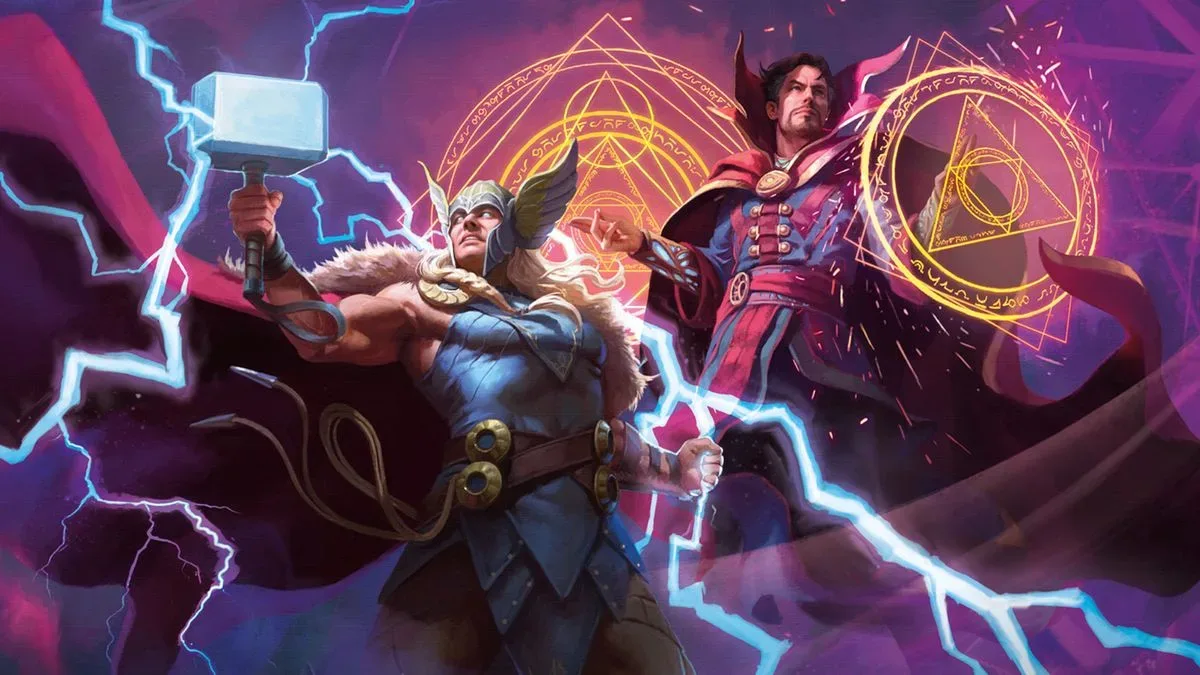
Creative flexibility does not mean there are no limits. Deveney gave Thor’s helmet as an example of a protected visual element: the shape and placement of its wings are important to Thor’s silhouette. Other details, such as the cape, may allow more freedom. A silhouette is the distinctive outer shape through which a character can be recognized even without fine visual detail. For an icon like Thor, maintaining that visual shorthand is part of preserving identity.
Art director Meredith Mulroney emphasized the care involved in that work. Character art needs to retain the elements audiences recognize while giving the character a convincing place in Magic’s presentation. That is doubly relevant to the new Marvel creation. It will not have generations of visual history to rely on, so its initial design will carry much of the responsibility for communicating who it is.
What accessibility means for Darkhold Destiny
The set’s creators also stressed that deep Marvel knowledge should enhance the experience without becoming a barrier to entry. Deveney applied a familiar comics principle to the game: every comic can be a reader’s first comic, and every Magic set can be a player’s first set.
For Darkhold Destiny, that implies two complementary goals. A veteran Marvel fan should be able to notice details, references, and character choices that reward their familiarity with the material. A newcomer should still be able to understand the cards and their broad themes without feeling as though they need years of continuity knowledge first.
This is a particularly useful principle for a crossover set because it may draw in more than one type of player. Some people will arrive because they already play Magic and want a new supernatural-themed release. Others may be Marvel fans curious about the card game. Still others will be interested in Commander, Magic’s multiplayer format, where a legendary creature or other eligible card can shape the identity of a deck.
Darkhold Destiny is planned to include four Commander decks, along with Play Boosters, Collector Boosters, two Scene Boxes, bundles, and a Draft Night set. A Commander deck is built for Magic’s Commander format, which is commonly played in multiplayer games and centers deck construction around a designated commander. Boosters are randomized card packs; the named Play and Collector versions are distinct product types, though the specific contents of Darkhold Destiny’s packs have not been outlined here. Scene Boxes are also listed among the products, but their exact Darkhold Destiny contents have not been specified.
That product range gives the set several potential entry points, but it does not confirm where the new character will appear. Players and collectors should treat the character’s card treatment, rarity, product placement, and full mechanics as unrevealed until officially shown.
A notable test of crossover design
The original Marvel character is a significant development because it expands the usual logic of crossover releases. Rather than only translating pre-existing fictional material into Magic cards, Darkhold Destiny will contribute a new piece of Marvel fiction shaped by Magic’s design needs.
It is also a reminder that adaptation involves choices, not just illustration. The team needed a character who could carry a particular gameplay role, fit a supernatural story framework, satisfy Marvel’s own creative ambitions, and be presented in a way that can welcome players who know little about either continuity. The resulting character is the product of extensive exploration, multiple formal pitches, and a negotiated understanding of what can change and what must remain visually true to Marvel’s world.
Until the reveal, the strongest takeaway is not a prediction about a future standout card. It is the process behind it: Darkhold Destiny’s new hero or villain was created because adapting the right existing character would have meant compromising either that character’s identity or the set’s needs. The eventual debut will show how successfully Magic and Marvel turned that absence into someone new.
For a separate look at how game systems can make rewards feel more consequential, see our analysis of Phantom Blade Zero’s weapon refund system.