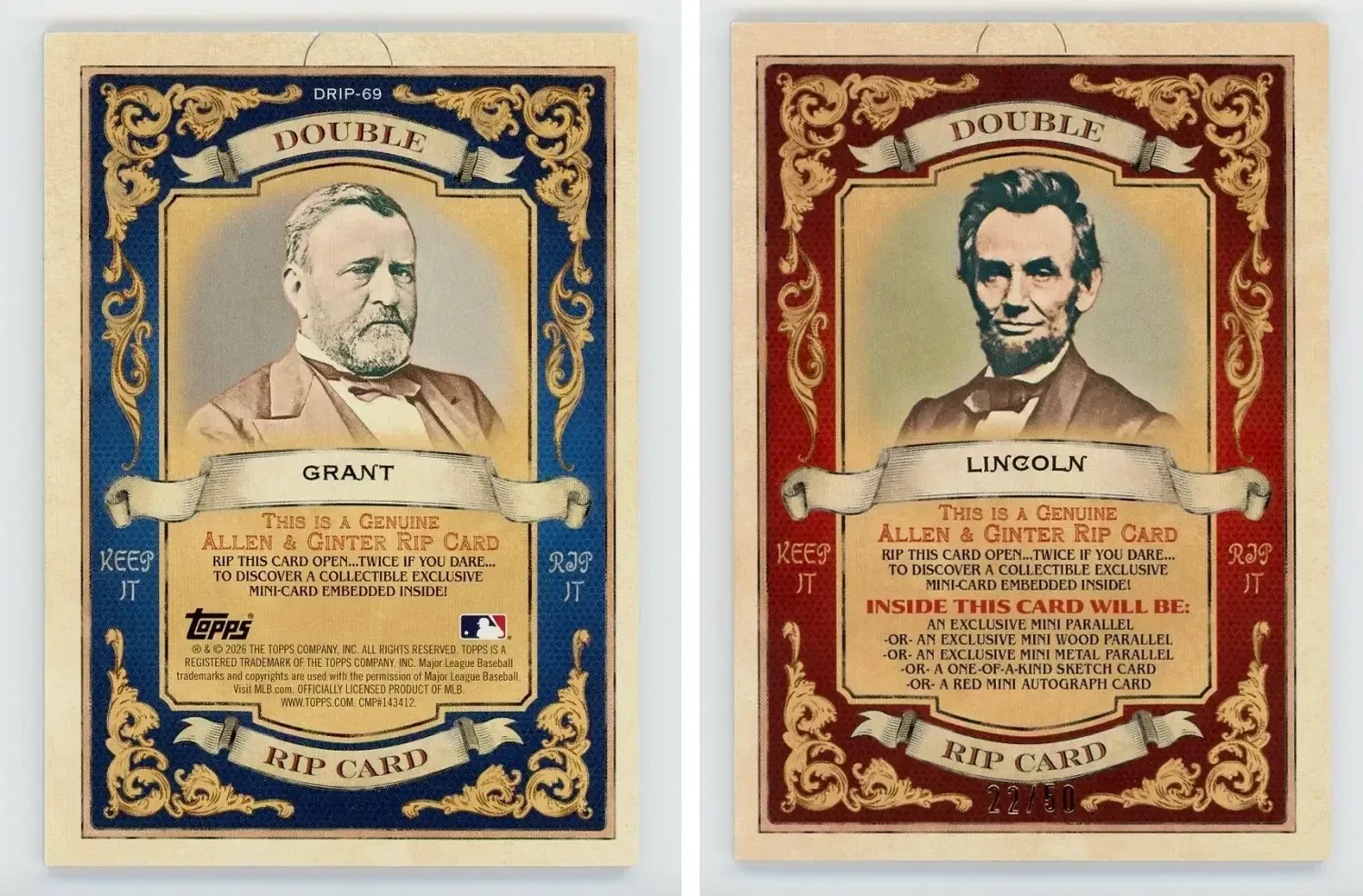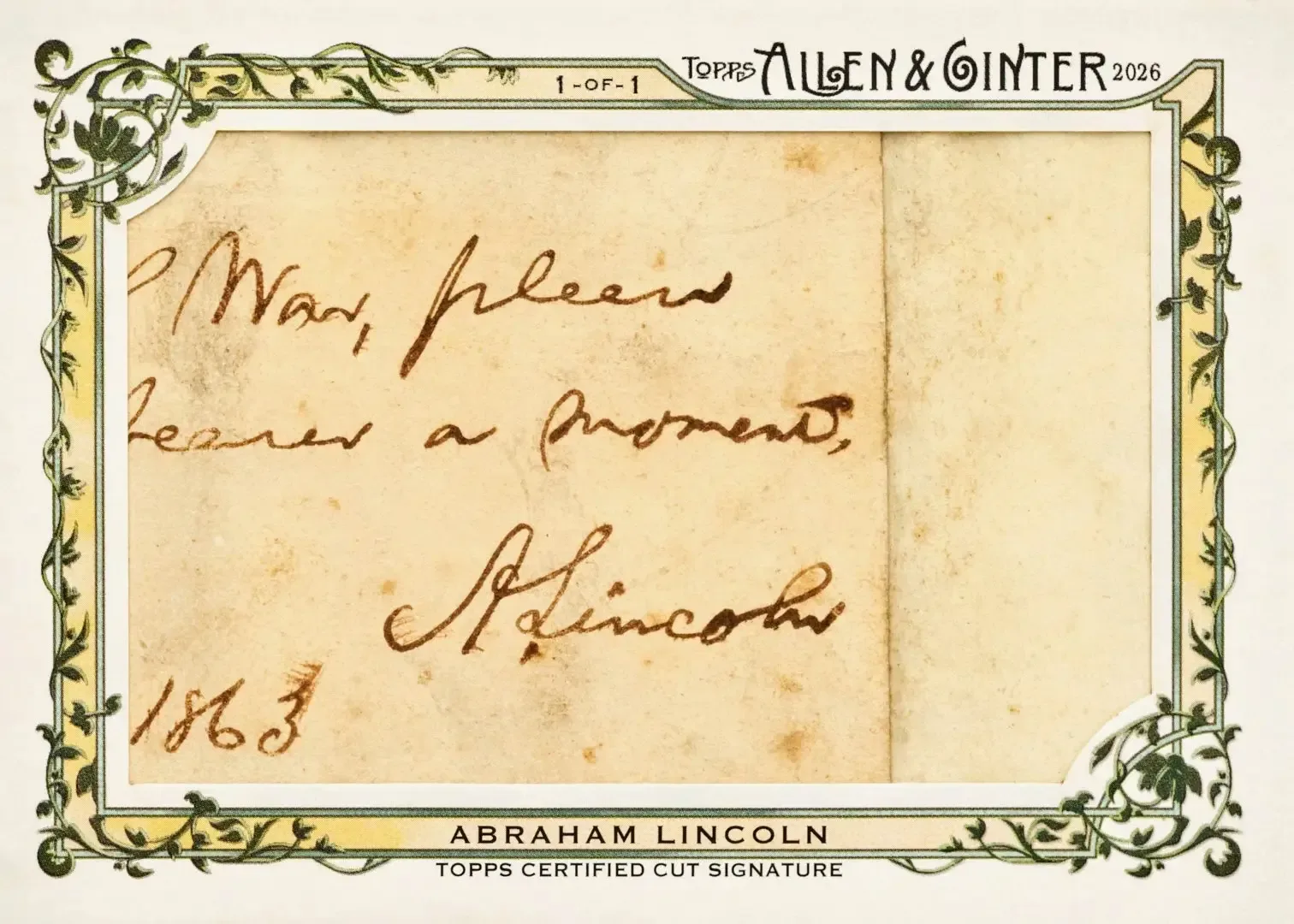
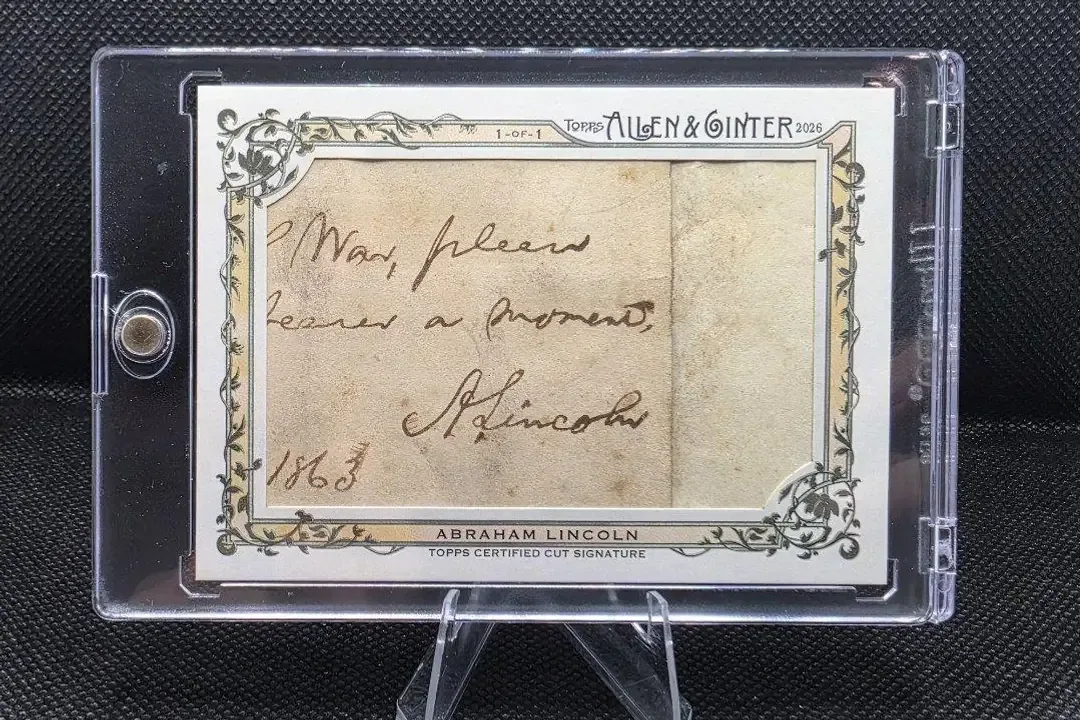
A one-of-one Abraham Lincoln cut autograph from the 2026 Topps Allen & Ginter checklist has been pulled and is expected to reach the auction block in December. The card, carrying an autograph from the 16th U.S. president, was found by Chris Sipe in a $6.99 fat pack purchased at a Target store in Colorado Springs.
It is the kind of pull that makes the phrase “one in a lifetime” feel slightly inadequate. Modern trading cards routinely use the term 1/1 for unique parallels, printing plates, and premium inserts. This is different in a crucial way: the card is not merely the only version of a contemporary design. It incorporates a historic Lincoln signature, making the item sit at the intersection of card collecting, autograph collecting, and American historical memorabilia.
The card will be offered through Heritage Auctions as part of a December sale. An auction listing presents a public market test for an item whose closest comparisons are limited, old, and materially different from the newly pulled Allen & Ginter card.
A pack purchase that became a major pull
Sipe, a Cincinnati native and lifelong Reds and Bengals fan now living in Colorado Springs, had been browsing Target when he stopped at the card section and bought the fat pack. He initially shuffled past the autograph while reviewing the pack’s contents before realizing what he had pulled.
For more context, explore Hip Hop Beauty’s Texas Southern Stop Adds a Student Marketplace to Its Art, Beauty and Music Conversation.
That sequence is a useful reminder of what makes cut-signature cards unusual. A cut autograph is a card containing a clipped piece of an original signed document or other signed material. Rather than signing the trading card directly, as a current athlete or entertainer might, a deceased signer is represented through an authenticated signature fragment incorporated into a new card product.
For a historic figure such as Lincoln, the appeal is therefore not solely about the 2026 card release. The central artifact is the autograph itself. The Allen & Ginter presentation, one-of-one designation, and placement in a prominent modern brand add another layer of collectibility, but buyers will also scrutinize the signature’s visual quality, the size and completeness of the cut, and how successfully the card frames the historical material.
Sipe said he felt the card belonged with a collector who would appreciate it. The sale could also help fund savings toward a house. Although he has returned to collecting only recently, his personal collection is focused mainly on Cincinnati Reds and Bengals material. He also indicated that a special Frank Thomas item could be on the wish list after the sale; Thomas was a favorite from his childhood collecting years.
Why Allen & Ginter matters to this result
Not every Lincoln-signed card would be evaluated identically by the market. Brand, product positioning, and the card’s role in a release can influence bidding, especially when a historic autograph is presented in a modern pack-pulled format.
Allen & Ginter is particularly suited to an inclusion like this because its identity stretches beyond conventional sports-card subjects. A historic political figure does not look out of place in a product known for broad, eclectic checklists. Here, the Lincoln autograph was also a highlighted part of the 2026 release rather than an obscure afterthought discovered years later.
That distinction does not create a guaranteed price. It does, however, give potential bidders a clearer story around the card: a publicized 1/1 was placed in packs, unexpectedly pulled from a retail fat pack, and brought promptly to auction. Provenance, or the documented chain of an item’s history and handling, can matter considerably in historic-autograph categories. The pack-pull origin supplies a straightforward modern chapter to that history.
The card’s December sale will also reveal whether crossover demand is as meaningful as collectors expect. Possible audiences include high-end card buyers, collectors of presidential signatures, Lincoln specialists, and bidders attracted to the unusual retail-pull narrative. Those groups may value the same card for different reasons, which is precisely why isolated sales can be hard to forecast.
Additional details surrounding the upcoming lot are available in this December auction overview.
The available Lincoln card comparisons
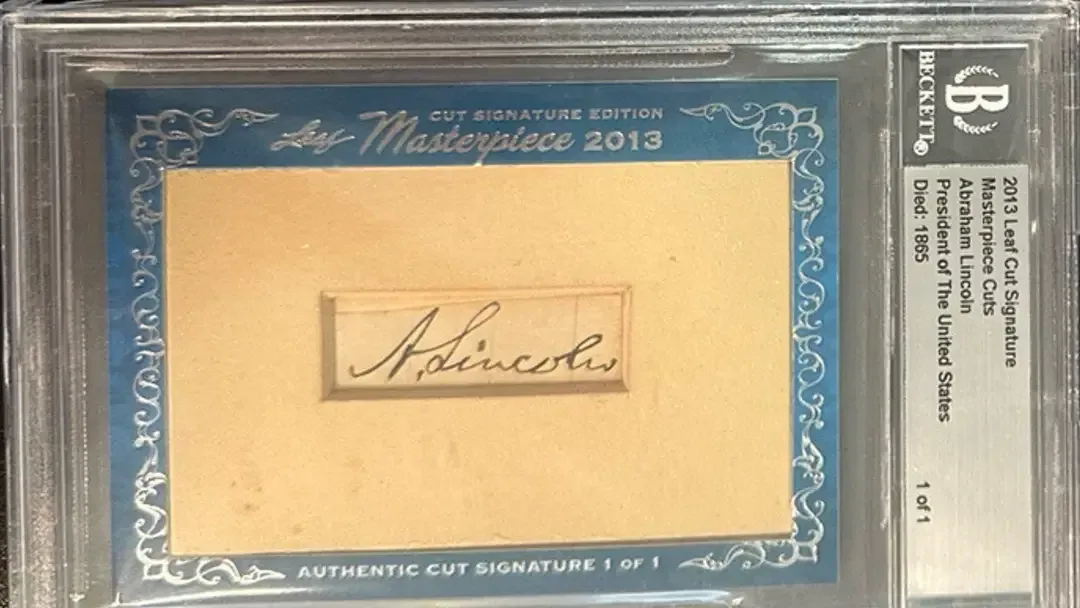
There are some relevant recent sales, but none is a perfect match. The strongest reported standalone comparison is a 2013 Leaf Cut Signature card that sold for $17,000 in November 2024. That card contained Lincoln’s familiar “A Lincoln” signature. Card Ladder currently estimates its value at around $37,000, but an estimate is not the same as a completed transaction. It should be treated as a market-data reference rather than a confirmed present-day sale result.
The 2024 result is also now two years old, and there have not been other recently reported sales of a full Lincoln cut autograph in the available sales data. That lack of frequent trading creates uncertainty. It can elevate anticipation for the new auction, but it also means there is no neat, current price ladder from which to derive a reliable valuation.
One smaller 2026 sale underscores why autograph content matters. A non-licensed card containing a cutout limited to the word “Abe” sold for $2,500 in June. That is not a direct comparison to a full Lincoln signature on a featured 1/1 Allen & Ginter card. Still, it demonstrates the wide range that can exist between a very limited signature fragment and a more substantial autograph presentation.
Licensed, in this context, refers to a card product issued with formal rights connected to the relevant brand, subject matter, or other intellectual-property elements. The term can affect collector perception, although historical-autograph cards are ultimately more complicated than an ordinary player-card comparison: the signature fragment, its authenticity, card maker, design, scarcity, and market visibility all play roles.
Can it challenge Lincoln’s strongest card auction result?
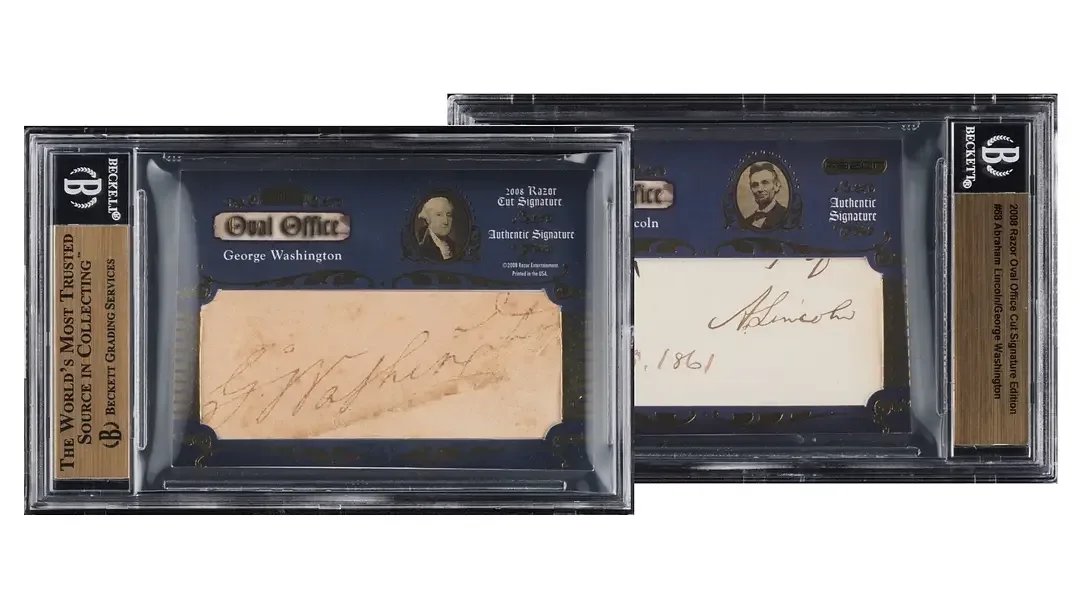
A higher benchmark exists, though it involved more than Lincoln alone. A 2008 Razor Oval Office Cut Signature Edition card pairing George Washington and Abraham Lincoln autographs sold for $27,000 in September 2022. It remains the reported high sale among the cited Lincoln-autograph card results.
That dual-signature format makes the $27,000 result important but imperfect as a comp. A Washington-Lincoln card offers a two-president pairing that a standalone Lincoln item cannot reproduce. Conversely, the Allen & Ginter card has its own strengths: it is a 1/1 from a highly visible current release, was a specifically promoted chase autograph, and carries the immediate attention that comes from an improbable retail pull.
Card Ladder estimates the value of the Washington-Lincoln dual autograph at nearly $45,000, but the actual sale occurred in 2022. Without a newer public transaction, that estimate should not be mistaken for a settled market price. The December auction may help clarify how bidders currently weigh a full Lincoln cut autograph against the combination of signature content, card branding, and rarity.
What bidders should separate from the headlines
- Completed sales: The $17,000 standalone Lincoln sale from November 2024, the $2,500 “Abe” fragment sale from June 2026, and the $27,000 Washington-Lincoln dual-signature sale from September 2022 are concrete past transactions.
- Valuation estimates: Figures around $37,000 for the 2013 Leaf card and nearly $45,000 for the 2008 dual-signature card are estimates, not new completed bids.
- Market expectations: The idea that the Allen & Ginter card could move well beyond earlier examples is a reasonable possibility, not an established outcome.
- Card-specific factors: The 1/1 designation, Allen & Ginter branding, signature presentation, and pack-pulled provenance make this card distinct from every available comparison.
A sale worth watching, not pre-pricing
There is a temptation to turn a unique card into a single projected number, especially when a familiar historical name is attached. The evidence supports a more measured view. Lincoln-signed cards have achieved five-figure auction results, and the strongest cited result involving Lincoln reached $27,000 as part of a dual-autograph card. Yet the limited number of recent full-signature comparables leaves a genuine gap in the market record.
That gap is what makes the forthcoming auction notable. A result below a speculative estimate would not diminish the card’s historical interest. A result above prior Lincoln card sales would not necessarily reset every Lincoln autograph overnight. It would instead be a fresh data point for a rare category where individual cards can vary dramatically.
For Sipe, the card began as an unplanned $6.99 purchase during an ordinary retail stop. For the eventual buyer, it will be an opportunity to acquire a singular piece of modern trading-card history built around one of the most recognizable signatures in American collecting.