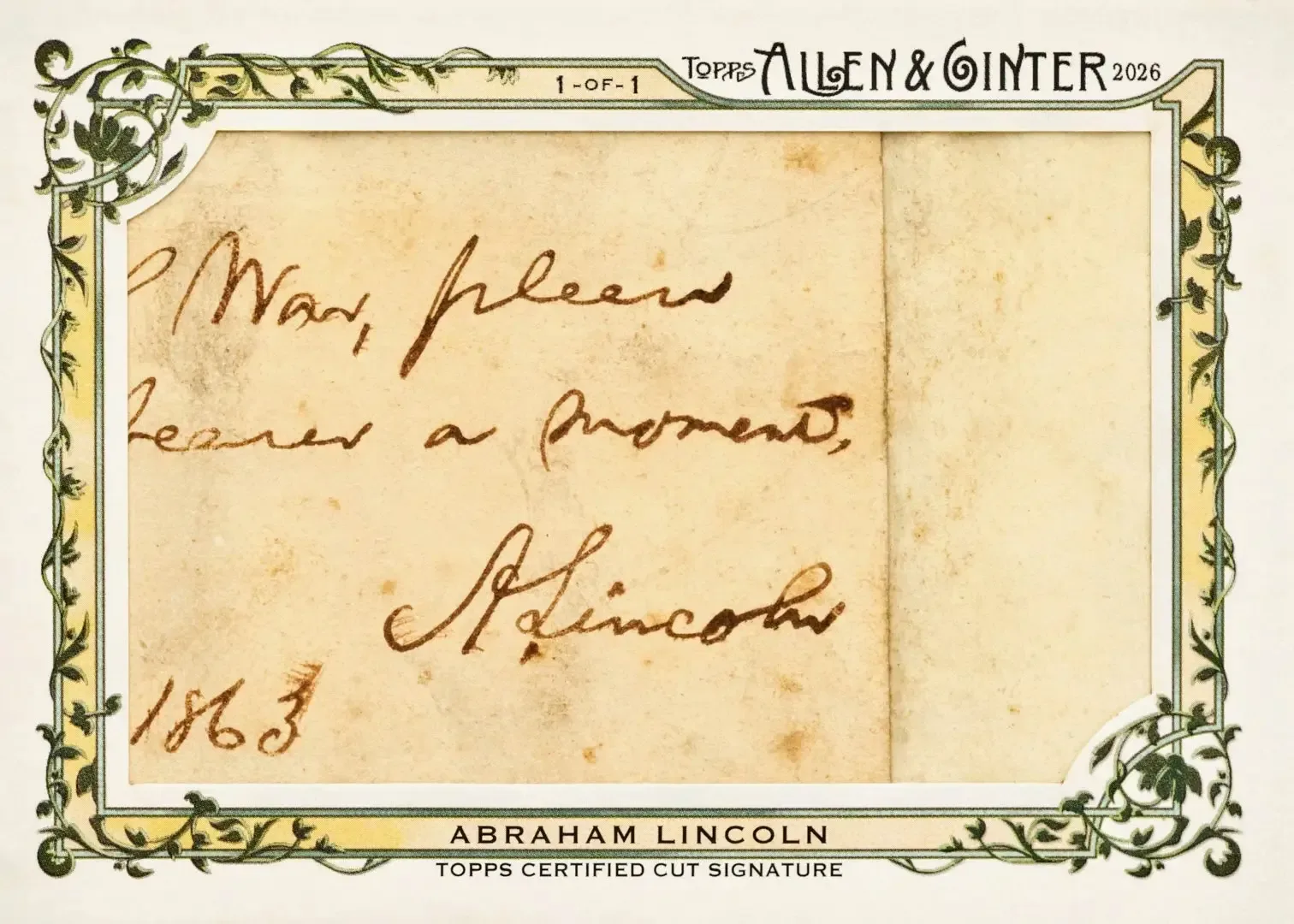
Topps Allen & Ginter is putting an extraordinary piece of Americana at the center of its 2026 release: a one-of-one cut autograph of Abraham Lincoln. The product is scheduled to release October 7, and the card gives collectors a chance—however remote—to pull the signature of the 16th U.S. president from a modern hobby box.
That sort of crossover is fundamental to Allen & Ginter’s identity. Although baseball is a major part of the checklist’s appeal, the line has long made room for subjects well beyond the diamond. Its mix can encompass historical material, culture, nature and deliberately unexpected themes. A Lincoln autograph is therefore an especially high-profile expression of the formula: a document-derived signature presented in a contemporary trading-card product.
The timing also gives the insert added thematic weight. Topps is marking its 75th anniversary in 2026, the same year as the 250th anniversary of the signing of the Declaration of Independence. Lincoln’s place in American history makes the card an obvious headline chase for a release leaning into that wider heritage. Additional 2026 Allen & Ginter product details identify the Lincoln cut autograph as a centerpiece of the set.
What a cut autograph card means
A cut autograph is not typically a card signed directly by its subject. Instead, the manufacturer incorporates an authentic signature taken from a signed historical item into a newly made card. The autograph may have originated on a document, letter, album page or another signed piece before being cut down and embedded within the card design.
For more context, explore Keys Factory’s Ocarina of Time Switch 2 Accessories Bring Hyrule Style to Joy-Con Covers and Game Cases.
That distinction matters for collectors. In the case of a historical figure such as Lincoln, a pack-pulled autograph necessarily depends on an existing signature rather than a signing session. The appeal lies in the convergence of two collecting worlds: an autograph connected to a major historical figure and a certified modern trading-card presentation.
The supplied information describes the Lincoln card as a 1/1, meaning only one copy of that specific card has been made. “One of one” is a common rarity designation in modern cards, but it does not automatically settle every question a buyer may have about the broader autograph market. There can be other Lincoln-signed artifacts, and even other Lincoln autograph cards from different releases. What the designation establishes is scarcity within this particular 2026 Allen & Ginter issue.
For anyone fortunate enough to pull a card of this stature, the important practical questions extend beyond the initial excitement. The card should be protected promptly and handled as little as possible. Its long-term significance will involve the card itself, the presentation of the cut signature, and the documentation and authentication standards behind the embedded autograph. Those are considerations for any historic cut-auto collectible, not a guarantee of a particular market result.
Why Lincoln is a major subject for the set
Lincoln’s historical significance requires little embellishment. He served as the nation’s 16th president during its most devastating internal division. Before the presidency, he represented Illinois for one term in the U.S. House of Representatives, serving from 1847 to 1849. He later ran for a Senate seat against Stephen A. Douglas in 1858 and lost.
That contest helped establish a nationally recognizable rivalry that returned in the 1860 presidential election. Lincoln became the first presidential nominee of the Republican Party, while the Democratic Party was divided, with Douglas representing Northern Democrats and John C. Breckenridge representing Southern Democrats. Lincoln won the election with 39.7% of the vote.
Those facts help explain why a Lincoln signature is more than merely another celebrity insert. Collectors are pursuing an autograph connected to a figure whose life and presidency are central to the study of the United States in the 19th century. The card’s design and one-of-one label make it a modern hobby item, but the signature itself is intended to carry the historical gravity.
Allen & Ginter’s old-card inspiration
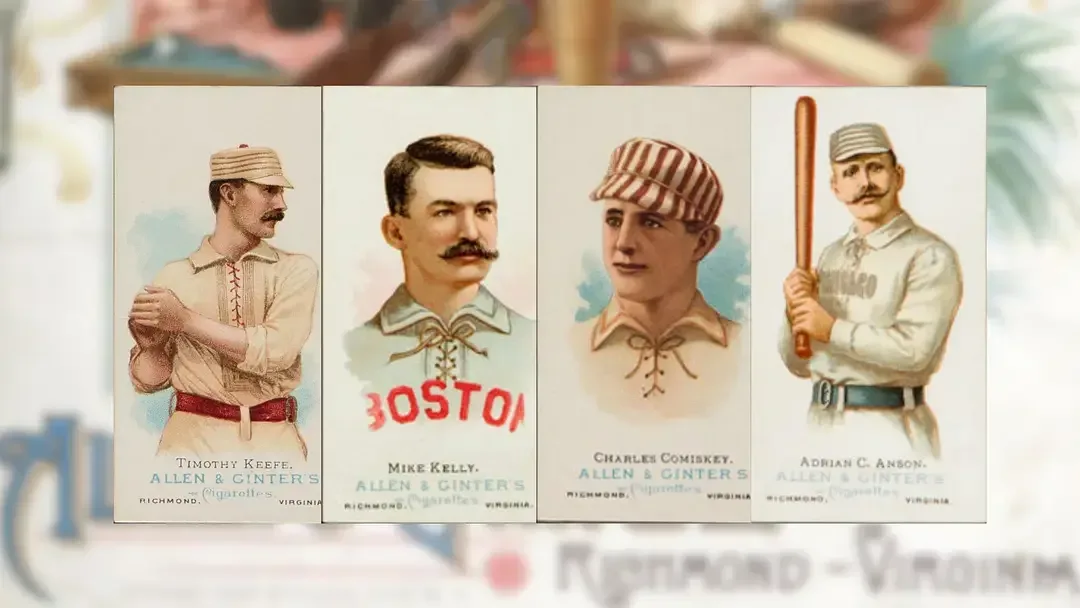
The Allen & Ginter name has roots in the early era of card collecting. Informal baseball cards existed as early as the 1860s, but Allen & Ginter issued its N28 “World Champions” set in 1887. That 10-card release included baseball figures such as Charles Comiskey, Cap Anson and Mike “King” Kelly.
Topps revived Allen & Ginter in 2006, drawing visual inspiration from the small cigarette cards associated with the original line. The modern product retains that mini-card sensibility while taking its subject matter in expansive directions. Alongside athletes, its inserts can spotlight birds, beaches and even cold-cut sandwiches. That willingness to pair serious collectible targets with unabashedly strange subjects is part of why the brand has maintained a distinctive place among baseball-adjacent releases.
The Lincoln card fits the historic side of that approach. It is not an attempt to make Allen & Ginter a conventional presidential-memorabilia product; it is a particularly rare example of the line using its broad canvas to spotlight Americana. For collectors who usually prioritize baseball, it can be a memorable surprise inside a familiar format. For autograph and history collectors, it offers a reason to look at a product they might otherwise overlook.
Recent precedent shows how a headline pull can emerge
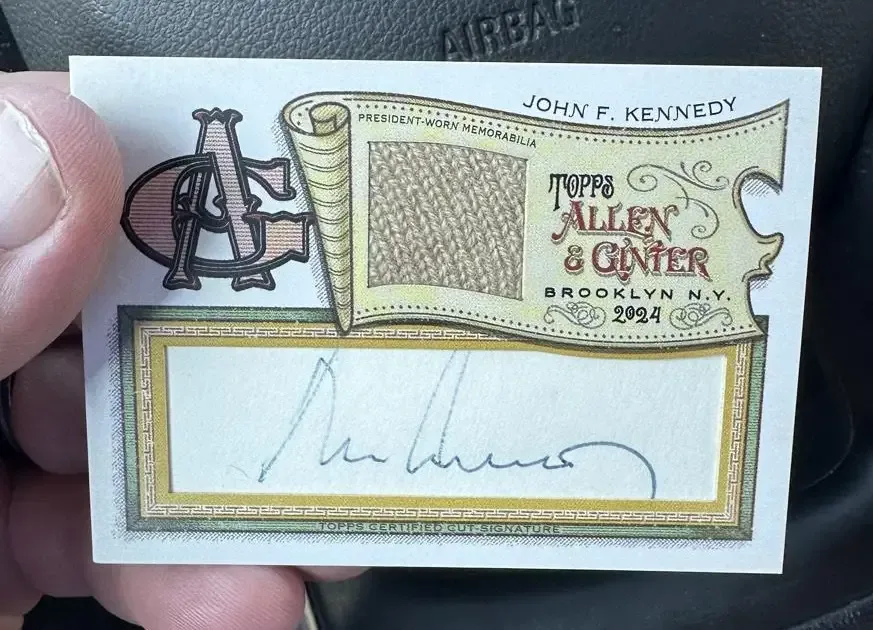
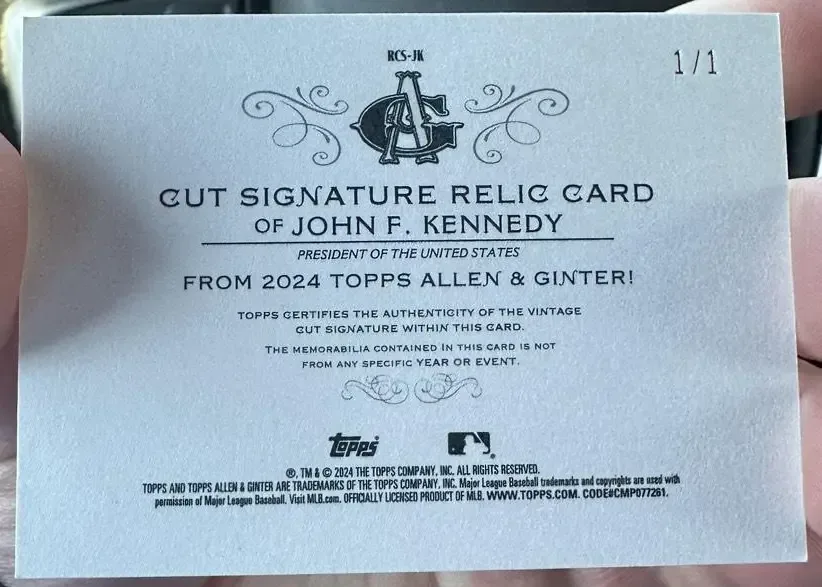
Allen & Ginter’s historical-relic concept is not theoretical. In 2024, collector Robert Marsh pulled a one-of-one John F. Kennedy relic autograph card from a hobby box while traveling to swim lessons with his daughter, Ari. Marsh initially believed the pack contained another relic before recognizing the Kennedy connection. The card included a Kennedy autograph and a piece described as president-worn memorabilia.
That experience captures why product-headline cards command attention before release. A one-of-one can be promoted for months, but ultimately it enters the world in a single pack, opened by one person. There is no indication who will uncover the Lincoln card, when it might appear, or whether it will be kept, graded, sold or displayed. Its location in the product is inherently uncertain.
Marsh’s Kennedy pull also highlights the local-shop dimension of the hobby. He contacted Dugout Sports Cards in Columbia, Missouri, after the discovery. Shop owner Chais Blakemore noted that pulling a featured card from a store’s product is a remarkable event, especially when the card is tied to history. The shop has also seen a dual autograph-relic booklet featuring Babe Ruth and Lou Gehrig pulled from its inventory.
Those moments are not evidence that buying a box is a sound way to obtain a specific rare card. They are reminders of the appeal of sealed-product collecting: the possibility of an unexpected discovery, shared immediately with family, friends, a shop or the wider hobby community. For a one-of-one Lincoln autograph, the odds of any individual box containing the card are necessarily extremely slim.
The market context—and the limits of a comparison
There is at least one useful reference point for the demand surrounding Lincoln cut autographs. A Lincoln cut autograph from 2022 Topps Transcendent sold for $16,350 in April 2023. That sale demonstrates that Lincoln-signed modern cards can draw substantial interest.
It should not be read as a prediction for the 2026 Allen & Ginter card. Different cards can vary substantially based on the autograph’s presentation, condition, provenance, product, buyer demand and the circumstances of a sale. A one-of-one designation creates scarcity, but market value is determined only when buyers and sellers actually meet. The 2022 result is context, not a price guide for an unreleased card.
Still, the comparison explains why the chase will matter to more than master-set builders. A Lincoln cut autograph has cross-category potential: baseball-card collectors familiar with Allen & Ginter, autograph collectors focused on historical signatures, and buyers interested in American political history may all see something different in the same card.
What collectors can reasonably expect
The clearest expectation is simple: the Abraham Lincoln autograph is a singular chase card in a release designed to make room for singular subjects. It will not be paired in a booklet with another president, based on the available product information. That makes the card a standalone centerpiece rather than part of a presidential dual-autograph concept.
Collectors opening 2026 Allen & Ginter should also keep the product’s character in mind. The line is built around variety, from baseball to Americana to eccentric inserts. The Lincoln card is the top-end historical possibility, not a promise that a typical box will produce comparable material. A chase card adds drama to a release; it does not make the chase predictable.
For the hobby, that unpredictability is the point. Somewhere in the 2026 run is one card containing Abraham Lincoln’s signature, housed in a format descended from an 1887 card series and released during a milestone year for both Topps and the Declaration of Independence. Whether it surfaces immediately or stays hidden for a while, it is poised to become one of the release’s most closely watched pulls.