Magic: The Gathering | Star Trek is scheduled to arrive on November 13, 2026, bringing Star Trek characters into Magic’s trading card game framework. For collectors, though, the most conspicuous cards named so far are seven Headliner cards carrying actor autographs: William Shatner as Captain James T. Kirk, Patrick Stewart as Captain Jean-Luc Picard, Kate Mulgrew as Captain Kathryn Janeway, Ethan Peck as Mr. Spock, Jeri Ryan as Seven of Nine, Brent Spiner as Data and LeVar Burton as Geordi La Forge.
These are described as ultra-rare cards found in special packs, and their autographs are hard-signed. In card-collecting terms, a hard-signed autograph is a signature written directly on the physical card, rather than a reproduction of a signature printed as part of its design. That distinction is likely to be central to their appeal: each card joins Magic’s game piece identity to a tangible signature from a performer associated with a different corner of Star Trek.
The set’s Headliners span the original series, The Next Generation, Voyager, Picard, and the newer portrayal of Spock. That range makes the checklist less about one crew and more about the franchise’s long-running intergenerational handoff. Here is a ranked look at the seven revealed autograph Headliners, weighing character recognition, performer connection and the individual art details supplied for each card. This is an editorial ranking, not a statement of pull rate, market value or gameplay power.
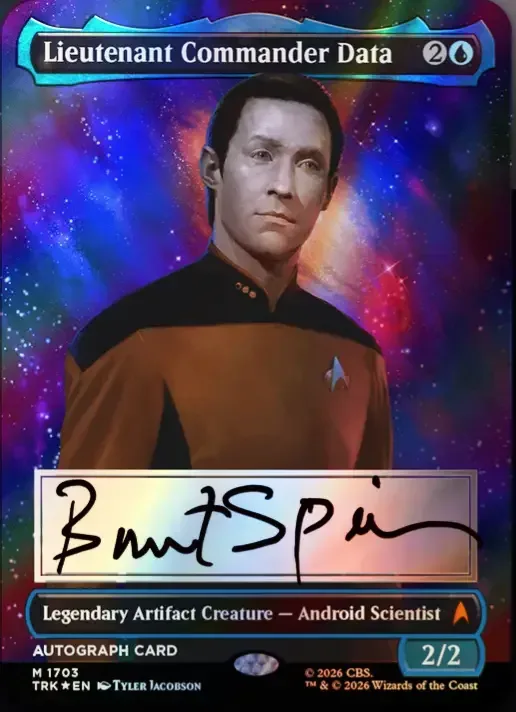
7. Brent Spiner Auto — Lieutenant Commander Data (TRK 1703)
Artist: Tyler Jacobson.
Data’s Headliner, numbered TRK 1703, bears Brent Spiner’s autograph. Spiner played the android officer in Star Trek: The Next Generation and in the films that followed, so the card connects an unmistakable character to the actor whose performance defined him across both television and film.
Its place at number seven is not a dismissal of Data’s importance. Rather, it reflects just how top-heavy this particular autograph lineup is. Every card here carries a major character and a recognizable performer. Data remains an especially strong fit for a Magic crossover because the medium can frame a familiar screen persona in newly commissioned fantasy art while retaining the character’s central identity.
Jacobson’s art credit is also important collector information. In a crossover set, a card’s attraction is not solely the licensed character or the signature; the commissioned interpretation becomes part of the object’s identity. Collectors tracking TRK 1703 will want to differentiate the actor, character, card number and artist rather than treating “a Data autograph” as a complete description.
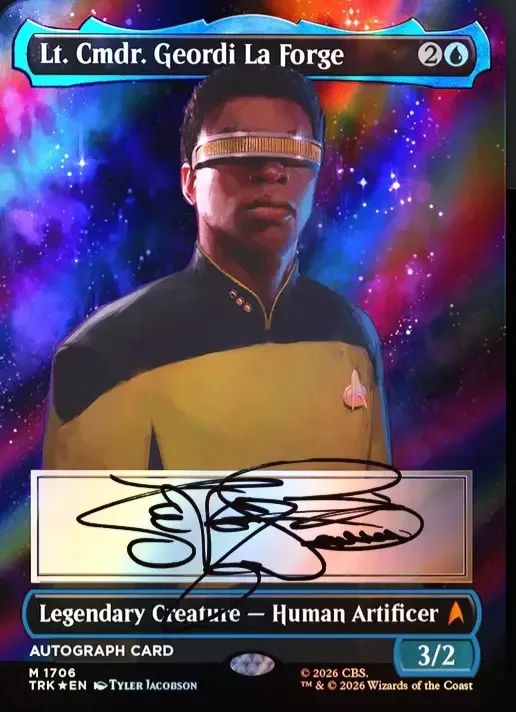
6. LeVar Burton Auto — Lt. Cmdr. Geordi La Forge (TRK 1706)
Artist: Tyler Jacobson.
TRK 1706 features LeVar Burton as Lieutenant Commander Geordi La Forge, again with art by Tyler Jacobson. The supplied description places Geordi against a rainbow-colored cosmos, a visual choice that gives the card a more overtly colorful presentation than a straightforward bridge portrait might.
Burton’s career connection stretches beyond Star Trek, including Roots and Reading Rainbow. That broader cultural visibility gives this card an appeal that can reach past dedicated Magic players and Trek completionists. The signature belongs to an actor with several widely recognized roles, while the card itself focuses on his Starfleet character.
As a practical collecting point, the full card name matters: Lt. Cmdr. Geordi La Forge, not simply “Geordi,” and TRK 1706, not a generic franchise label. Sets with multiple autograph headliners invite imprecise listings and casual shorthand. Keeping the exact card number and artist attached to the name is the simplest way to identify the specific version being discussed.
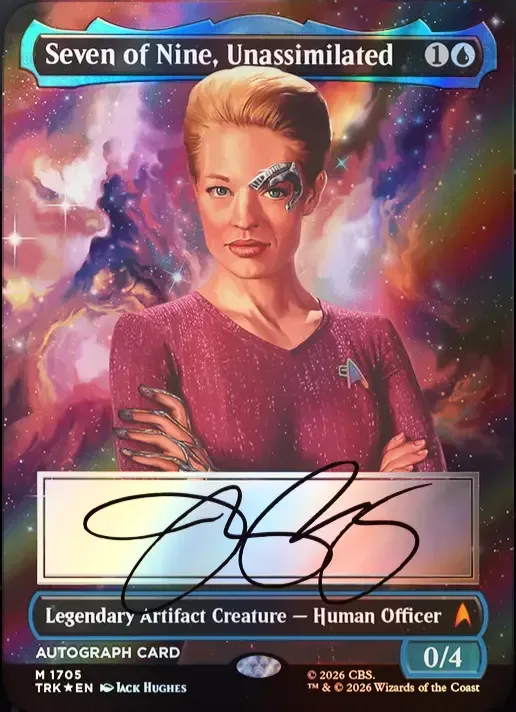
5. Jeri Ryan Auto — Seven of Nine, Unassimilated (TRK 1705)
Artist: Jack Hughes.
Jeri Ryan signed TRK 1705, Seven of Nine, Unassimilated. The card depicts the character known from Star Trek: Voyager and Star Trek: Picard, with a portrait by Jack Hughes. The supplied description characterizes Seven as a strong Starfleet officer and eventual captain, presented in a confident pose.
The subtitle “Unassimilated” does useful work here. Magic card names often distinguish a particular version of a character through a subtitle, and that wording makes this more specific than a bare character name would be. For collectors, it is part of the official identifier alongside TRK 1705. For fans, it signals the particular framing the card is using rather than attempting to summarize every era of Seven’s story.
This card is a bridge between two Star Trek series and, therefore, between audiences who may have encountered Seven in different contexts. Its value as a collectible is not something the available information can establish, but the character’s cross-series presence and Ryan’s direct autograph give it an obvious place among the release’s headline chases.
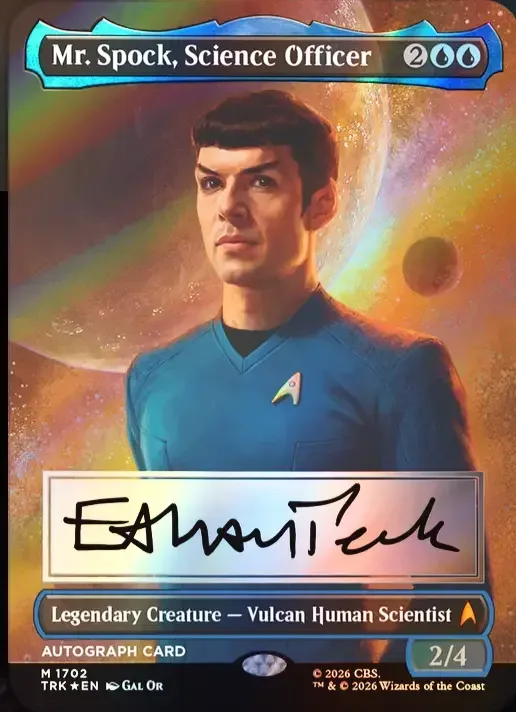
4. Ethan Peck Auto — Mr. Spock, Science Officer (TRK 1702)
Artist: Gal Or.
Ethan Peck’s signed card is TRK 1702, Mr. Spock, Science Officer, illustrated by Gal Or. Spock first appeared on television 60 years before this card’s presentation, and the Headliner uses Peck’s portrayal to represent a character whose legacy extends across many versions of Star Trek.
That makes this an unusual but compelling entry. It is not an autograph card for the actor most immediately associated with the original television incarnation of Spock. Instead, it foregrounds a newer performer playing one of the franchise’s foundational characters. The result is a reminder that Star Trek continuity is also performance continuity: roles endure, while actors interpret them for new generations.
“Science Officer” is more than decorative wording. In a Magic-style card name, a subtitle can establish the specific character expression being represented. Here it emphasizes Spock’s Starfleet function and gives the card a clearly professional, service-oriented identity. The familiar Vulcan salute phrase, “Live long and prosper,” remains inseparable from the character’s cultural footprint, but the appeal of this Headliner comes from its precise combination of Peck, Spock and Gal Or’s art.
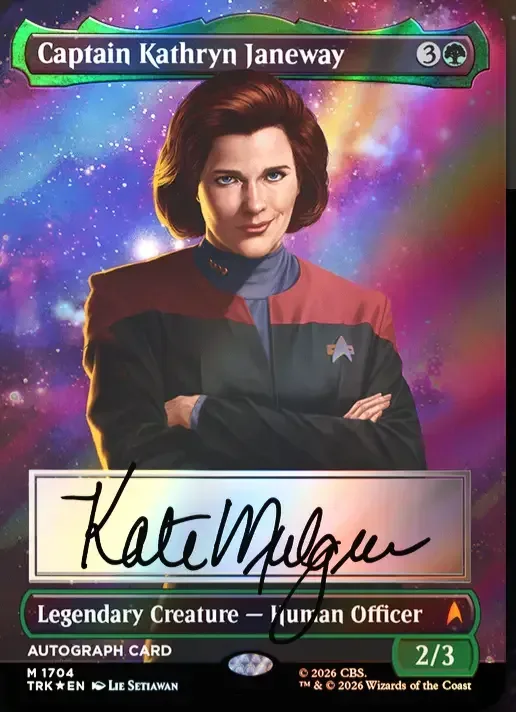
3. Kate Mulgrew Auto — Captain Kathryn Janeway (TRK 1704)
Artist: Lie Setiawan.
Kate Mulgrew autographed TRK 1704, featuring Captain Kathryn Janeway and art by Lie Setiawan. Janeway commanded the USS Voyager in the Delta Quadrant, a premise that makes her one of the set’s most naturally commander-like inclusions even before considering how the card may function in Magic. No card mechanics have been provided here, so the ranking concerns character stature and collectible significance rather than rules text.
Janeway brings a distinct captain’s perspective to the lineup. Kirk and Picard are monumental figures in Star Trek’s screen history, but Mulgrew’s signature ensures that the release’s captain selection is not restricted to those two eras. Her Headliner broadens the historical scope of the autograph program and gives Voyager a clear centerpiece.
The card should be identified as Captain Kathryn Janeway, TRK 1704, with Setiawan credited for the art. Those details may appear routine, but autograph-card collecting depends heavily on exactness. A signature, a character, a card number and an artist credit together define the particular collectible; leaving any one out can blur it with another version that may exist elsewhere in the set or in future Trek products.
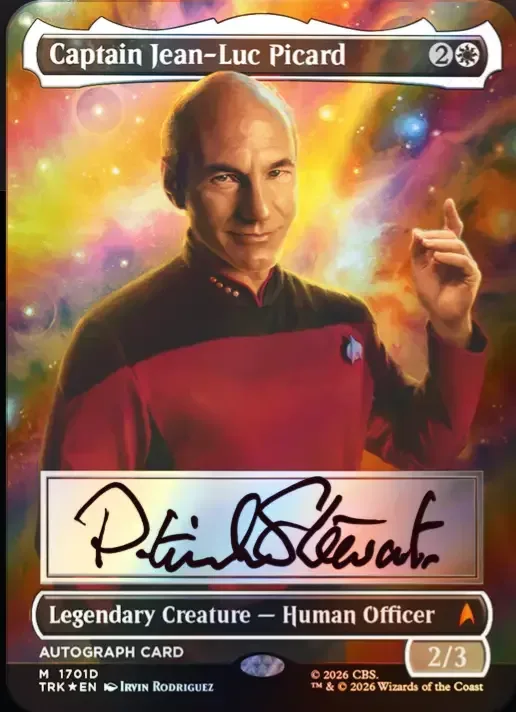
2. Patrick Stewart Auto — Captain Jean-Luc Picard (TRK 1701D)
Artist: Irvin Rodriguez.
The second-ranked Headliner is Patrick Stewart’s signed Captain Jean-Luc Picard card, TRK 1701D, illustrated by Irvin Rodriguez. Picard’s arrival in Star Trek: The Next Generation, which followed the original series by two decades, established a different kind of commanding presence for the franchise. Stewart’s theatrical background and distinctive voice became closely identified with the captain.
This is also a card whose numbering invites attention. TRK 1701D is not the same identifier as TRK 1701, the number used by the Kirk Headliner. The added letter is consequential when cataloging a collection, creating a direct but distinguishable parallel between the two captains at the top of this list.
The supplied material refers to Stewart as the late Sir Patrick Stewart. Within the set’s context, his signature makes the card an especially weighty artifact: a Magic card featuring original artwork, a franchise-defining captain and an autograph from the performer associated with that portrayal. It sits just behind Kirk largely because the original captain’s place in Star Trek’s starting point gives that final card a narrow editorial edge.
Collectors interested in signed screen memorabilia may also find a useful comparison point in the wider world of franchise collectibles, including the different formats covered in Star Wars 50th-anniversary figure releases. The formats are very different, but both illustrate how long-running science-fiction properties package specific eras, characters and performers for collectors.
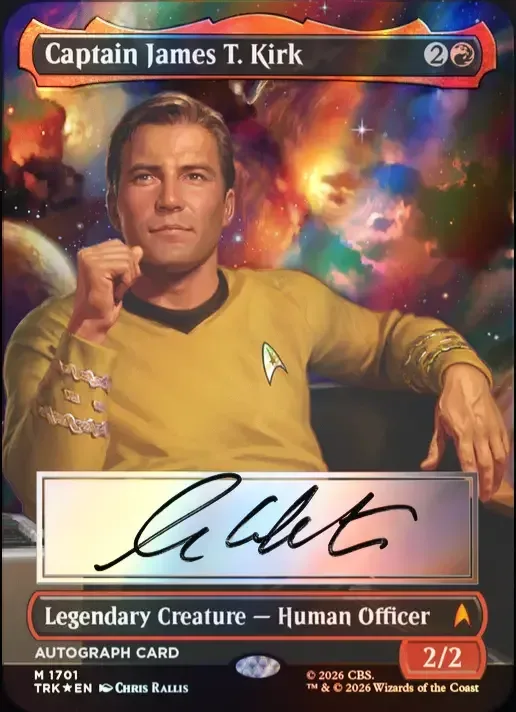
1. William Shatner Auto — Captain James T. Kirk (TRK 1701)
Artist: Chris Rallis.
At number one is William Shatner’s black-ink autograph on Captain James T. Kirk, numbered TRK 1701 and illustrated by Chris Rallis. Kirk is the original captain at the heart of Gene Roddenberry’s 1966 Star Trek series, and Shatner’s signature connects the Magic release directly to that foundational role.
The card’s strength is straightforward: it unites one of speculative fiction’s best-known captains with the actor who originally played him. Kirk has subsequently been portrayed by Chris Pine and could be played by others in the future, but Shatner remains central to the character’s first screen identity. In a set built around actor-signed Headliners, that lineage carries considerable symbolic force.
TRK 1701 also functions as an elegant counterpart to Picard’s TRK 1701D. The shared 1701 reference makes their relationship immediately legible without making them interchangeable. Kirk’s card is not merely a familiar character rendition; it is a specifically numbered Headliner with Rallis art and Shatner’s black-ink signature.
For Magic collectors, these seven cards create a chase defined by more than rarity. For Star Trek collectors, they translate actors and characters into Magic’s established card format. And for people who overlap between both hobbies, the practical checklist is unusually clear: verify the exact character title, actor, card number, credited artist and the presence of the hard-signed autograph. The set’s November 13 release will determine how these cards enter collections, but the revealed lineup already covers a substantial stretch of Star Trek’s on-screen legacy.