Threads is testing a feature called Threads Friends, a smaller-audience sharing option that lets people post to a selected group of up to 50 followers rather than to the platform at large. The early test is currently limited to Ireland, Italy and Japan, and there is no confirmed timetable for a wider rollout.
The basic idea is familiar: users make a list of people they want to share with, then choose that audience for certain posts. Those posts are not meant to be visible to everyone else on Threads. In the app’s own playful terminology, the selected friends may also be called “Thriends,” which is exactly the kind of word a social platform invents when it has noticed its name contains most of another word.
For a service built around broadly visible conversation, the test is a notable shift in emphasis. It gives users a way to separate a public-facing Threads presence from the lower-stakes updates, niche jokes and personal conversations they may prefer to reserve for a more familiar crowd.
What Threads Friends is testing
Threads Friends functions much like a close-friends list: a user selects specific followers, then can share posts with that group alone. The maximum size described for the test is 50 people.
That limit matters. A private account and a friends-only audience are not necessarily the same thing. An account-level privacy setting defines who can generally see a person’s activity. A close-friends-style control instead gives that person the ability to make an audience choice one post at a time. Someone may still want a public profile, for example, while keeping a particular conversation, running gag or personal update within a group they know.
Threads is also helping participants build a starter list. It can suggest followers a person frequently interacts with, though the eventual list can be customized. That combination is practical: recommendations may remove some setup friction, while customization is essential because frequent interaction is not a perfect definition of friendship, trust or relevance.
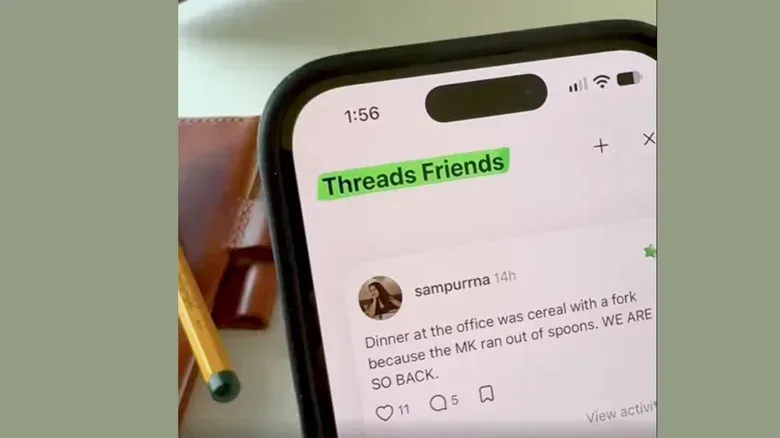
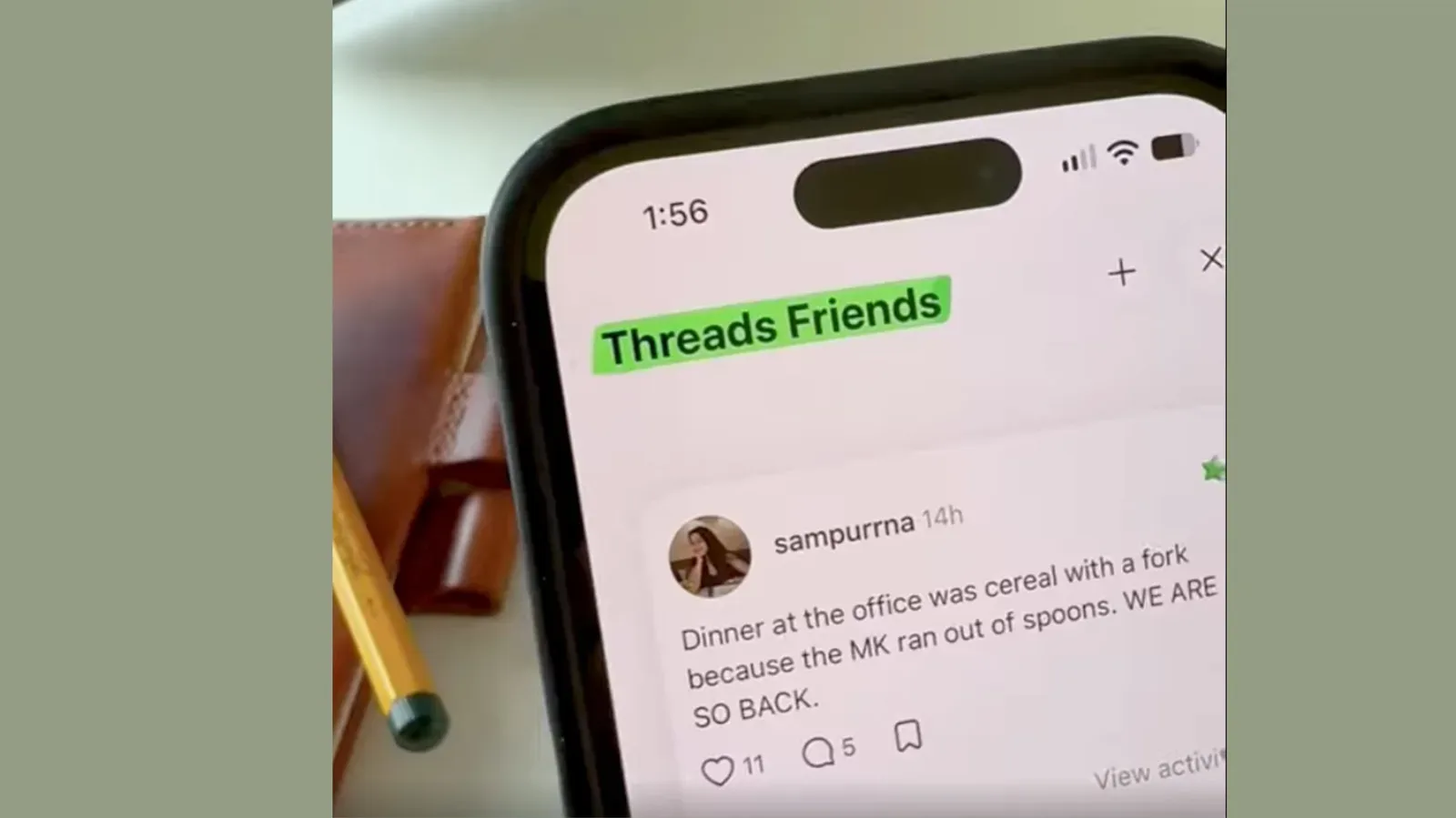
Once the list exists, participants can use a green bubble at the top of their feed to view friends-only posts shared in the previous 24 hours. In other words, Threads Friends is not only a restriction placed on individual posts. It also has its own viewing surface for recent updates from the selected group.
A feed for recent friends-only posts
The 24-hour feed is one of the more consequential details in the test. It appears designed to make smaller-group posting feel like a distinct social space rather than a hidden setting attached to otherwise ordinary updates.
Related coverage includes Threads Tests Friends-Only Posts for Groups of Up to 50.
In practical terms, that can change how people use the feature. A group-only post is less likely to compete with the full volume of public-feed content if recipients have a dedicated way to find it. It may encourage quick check-ins and timely exchanges, since the interface emphasizes what friends have posted recently.
It is important, however, not to read more into that 24-hour window than has been described. The available details say the feed shows friends’ posts shared during the last 24 hours; they do not establish that posts themselves expire after 24 hours, nor do they spell out every behavior involving replies, sharing or other interactions. Those distinctions will matter if the experiment expands, but they have not been detailed.
Why the list needs to be customizable
Automatic suggestions based on frequent engagement could be useful for people who follow a large number of accounts. The feature can surface likely candidates instead of requiring a user to search through every follower from scratch.
But engagement data has obvious limits. A person might regularly reply to a creator, colleague or community account without wanting that account in a smaller personal circle. Conversely, a trusted friend may not appear often in replies or reactions at all. Allowing users to alter the list is therefore not merely a convenience; it is the central control that lets the audience reflect an actual relationship rather than an activity pattern.
For users, the sensible interpretation is straightforward: suggestions are suggestions. The meaningful privacy decision is who remains on the final list. A smaller-audience tool only works as intended when people can clearly decide who belongs in that audience.
The obvious comparison: Twitter Circles
Threads Friends has a clear predecessor. Twitter introduced Circles in 2022, offering a way for users to limit posts to a chosen group of up to 150 people. The feature was discontinued around a year later.
The comparison is useful because it identifies the product category, not because it proves the two implementations will behave identically. Threads’ announced test limit is 50 people, one-third of Circles’ 150-person cap. That smaller number suggests a more intentionally intimate audience, though the reason for the chosen limit has not been stated.
Both concepts address a long-running tension in social media. Public posting can make discovery, conversation and community possible, but it can also make every update feel as though it must suit coworkers, acquaintances, relatives, strangers and longtime friends simultaneously. A smaller sharing group gives users another audience layer between “everyone” and “do not post.”
Whether that layer becomes a lasting habit is a separate question. It needs to be easy to configure, clear at the moment of posting and simple for recipients to recognize. It also needs enough activity to avoid becoming a list users make once and then forget. The dedicated green-bubble feed seems aimed at that latter problem by giving friends-only content a place to surface.
What the test means for people outside the three countries
Most users, including users in the United States, will not be able to create or manage a Threads Friends list during this initial test. The experiment is confined to Ireland, Italy and Japan for now, and no broader expansion has been announced.
There is one cross-border wrinkle: a person outside those test markets can see friends-only posts if somebody participating in the test adds them to their list. So the ability to receive this kind of post is not necessarily confined to the same countries as the ability to set up the feature.
That distinction may matter to users who notice a friends-only post from an account located in a test region. Seeing one does not mean the feature has launched in the viewer’s country, nor does it establish that every account has access. It simply reflects the selected audience chosen by the person who made the post.
Privacy, as described—and what remains unspecified
The core promise is clear: posts selected for Threads Friends are not visible to other people on the platform outside the chosen list. That is the relevant audience boundary being tested.
At the same time, “more private” should be understood precisely. The feature is an audience-selection tool, not a claim that a post cannot be copied, captured or discussed by someone who can see it. The supplied details also do not describe every moderation, retention, reply or distribution rule. Users who care about those particulars will need further product documentation if the test becomes available to them.
This is not a reason to dismiss the feature. It is simply the right way to interpret it. Smaller-group sharing can reduce the number of intended viewers dramatically, which is valuable for many ordinary social uses. It does not eliminate the need to think carefully about what is being shared and with whom.
A small product test with a bigger posting question behind it
Threads Friends is ultimately an experiment in audience control. It recognizes that a single account can serve multiple social roles: public voice, hobby space, friend group, professional contact point and casual conversation hub. One universal audience is often a poor fit for all of them.
The feature’s 50-person cap, customizable suggestions and separate recent-posts feed show how Threads is approaching that problem. Rather than changing the visibility of an entire profile, it is testing a lightweight group for particular posts and a dedicated space where those posts can be found.
There are still major unknowns. No detailed feature images have been released, and there is no confirmation of a rollout beyond Ireland, Italy and Japan. Product design director Laura Javier has previewed the appearance of a friends-only post and highlighted the “Thriends” Easter egg, but the public information remains limited to the test’s basic mechanics.
For now, Threads users should treat this as exactly what it is: a regional experiment, not a platform-wide launch. Still, it points toward a potentially useful middle ground for a service whose public conversation can often feel like a crowded room. Sometimes the post really is for the room. Sometimes it is for 50 people—or, perhaps, just the Thriends who will get the joke.
Threads is not alone in iterating on how digital feeds present information and social context; platform interface decisions remain a broader part of consumer-tech coverage, as seen in reporting on the new OLED iPad mini’s display approach. In this case, the central interface question is less about pixels than people: who gets to see a post, and where they will find it.