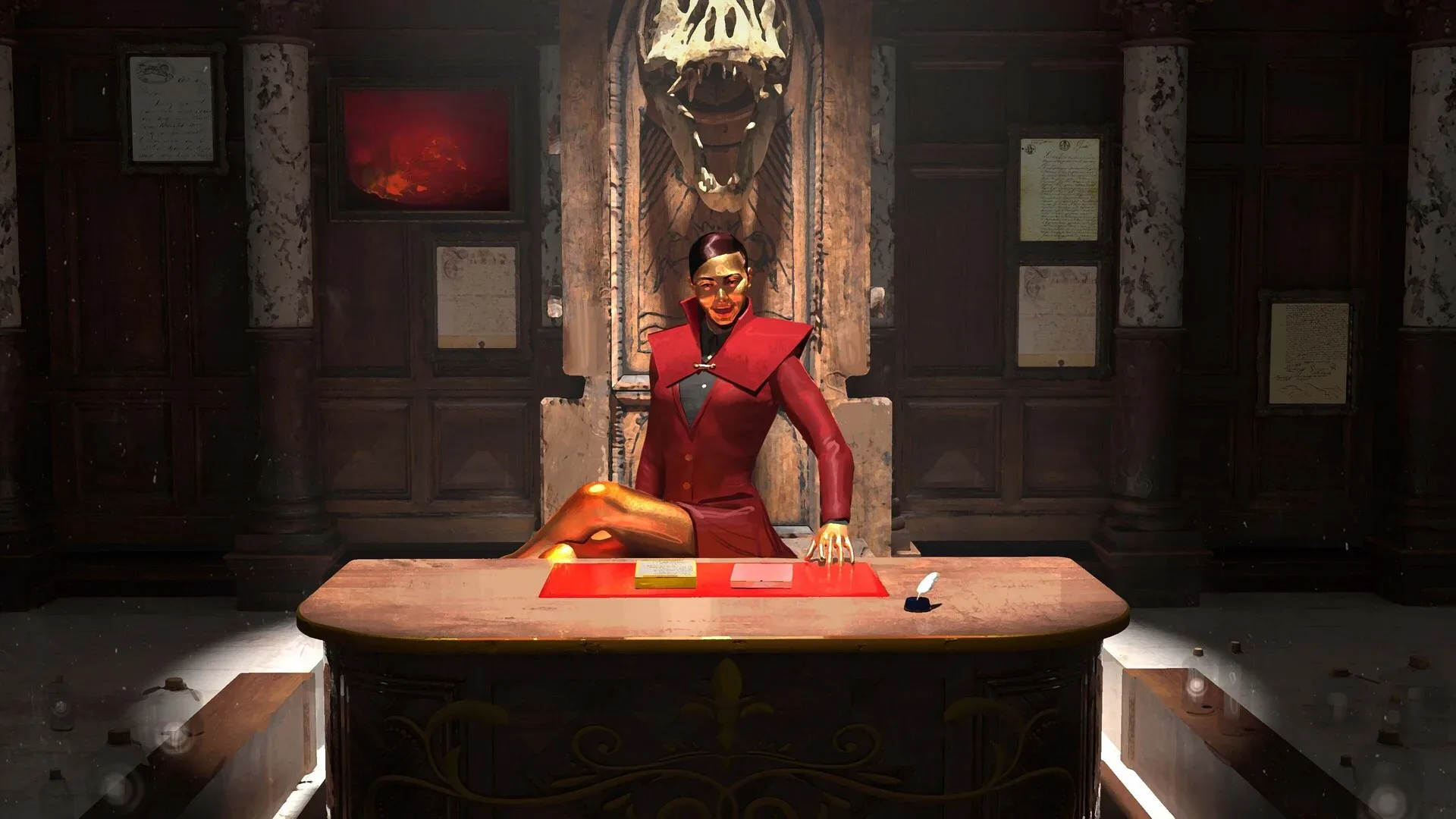
Thousand Hells: The Underworld Heists takes the decision-first instincts associated with King of Dragon Pass and points them at a much smaller, more vulnerable party. Rather than guiding an entire kingdom through a continuing chain of political and social choices, players enter a mutable underworld with a crew of up to five people and a particular objective: recover someone, acquire something, or otherwise return from death’s bad neighborhood with more than a cautionary tale.
That narrower scale does not appear to make the game simpler in the ways that matter. A run can last roughly 40 minutes to an hour, yet it can ask players to manage relationships, choose a leader for each crisis, decide which crew member’s unusual talents might apply, and live with choices after they are made. The central promise is not power fantasy. It is a compact adventure in which the party’s composition and the story a player tells can change what survival even looks like.
A familiar philosophy, aimed at a smaller expedition
King of Dragon Pass, first released in 1999, earned its reputation as a cult role-playing game by making narrative decisions the foundation of kingdom management. Its dilemmas carried consequences for a people rather than merely functioning as decorative text between resource screens. Thousand Hells appears to preserve that interest in meaningful prompts while changing the frame: this time, the player is responsible for a handful of individuals making an underworld raid.
That distinction has practical consequences. Kingdom-scale games can make a ruler’s decision feel abstract because the affected population is large and the results unfold across a wide system. A five-person crew puts pressure on individual capability and personality. If the wrong specialist takes charge at a strange door, or a character’s fears become relevant in a hostile realm, the error is immediately personal. The game’s stakes are not just whether a quest marker advances, but whether the people brought along can keep functioning in a place designed to distort ordinary expectations.
For players who enjoy games where writing is part of the mechanics rather than merely the delivery system, that focus is compelling. The underworld does not sound like a static setting with a prescribed list of correct answers. It is described as shifting, drawing on a broad mix of early civilizational beliefs, and willing to treat language, irony and narrative as forces with material effects. That gives an encounter involving a poem, a curse or a story more potential weight than it would have in a world governed by straightforward physical logic.
Tiles turn a crew’s identity into available options
Each campaign begins with player-selected traits and three additional crew members. The recruits can include archetypes such as lockpicks and academics, but the important detail is that classes and individual characteristics add their own tiles to the group’s possibilities. In this context, a tile represents an action or idea that can be brought to bear on an encounter. It is less like a conventional attack button and more like a visible expression of the party’s experience, temperament or training.
Every encounter requires one character to lead. That character can also draw on a limited number of tiles belonging to the rest of the crew. The rule creates two linked decisions: who should be put forward, and which supporting ideas are valuable enough to borrow. A thief may be an obvious first choice before a locked mechanism, but selecting the philosopher instead can still become the irrevocable reality of the scene.
That no-take-backs structure is crucial. If a game permits players to undo an uncomfortable choice instantly, the dramatic function of a decision becomes mostly cosmetic. Here, an accidental or overconfident selection can remain part of the expedition’s history. The practical lesson is to slow down before assigning the leader, but the more interesting implication is thematic: a descent into this underworld is not a puzzle to be solved through perfect information. It is a story produced by commitments made under pressure.
It also means that a seemingly eccentric hire could be valuable precisely because the setting is eccentric. A sailor or poet may not look indispensable next to a lockpick at the start of a job, yet the available evidence suggests that traditional usefulness will not always be the measure below. If words can alter stone and a dry passage can become a sea, a person who understands songs, travel, ritual or social performance may have an answer that a more overtly practical specialist lacks.
What “permutations” means for a campaign
The game’s many permutations refer to the changing combinations of crew, traits, encounter circumstances and decisions that shape a run. It does not necessarily mean that every outcome is random or that every party sees an entirely separate game. It means that the same broad goal can develop differently when a player hires different people, puts another leader in charge, or takes a different approach to a god, shade, army or monster.
That is especially suited to a campaign length of under an hour. A shorter run makes failure—or a partial success—less punishing in terms of time, while still allowing it to generate a memorable account of what went wrong. One early expedition can return with only one of two intended rescues, for example, and still count as a successful emergence from an otherwise lethal realm. Another can unravel quickly after upsetting a god tied to the raging ocean. The range between those results is the point: the underworld is built to be revisited rather than cleanly mastered on a single descent.
Players interested in other systems-heavy PC play may find our look at Android games on Windows, emulators and their trade-offs useful for a separate discussion of platform choices. In Thousand Hells, however, the more immediate issue is not hardware optimization but planning around uncertainty.
An underworld where interpretation is a survival skill
The most distinctive idea in Thousand Hells is that its setting can make symbols and stories operational. Semiotics is the study of signs and how they convey meaning: the relationship between a thing, the sign used to represent it, and the meaning a reader or listener makes from that sign. In ordinary game terms, a key opens a door because the game says it is a key and the door accepts that key. In this underworld, the relationship between words, tales and objects appears less stable. A story may help reshape the problem rather than simply describe it.
This is not just literary decoration. It gives a rational basis for a party composition that includes people whose skills would otherwise seem indirect. It also makes irony dangerous. When irony overrides hard physics, the literal plan may not be the best plan; what a thing signifies, who believes it, or how an action is framed could matter as much as its immediate physical effect.
Players may have to win favor from gods and lesser divine figures, question shades to navigate labyrinths, repel packs of beasts, pass unnoticed among marching armies, or deal with ghouls whose curses combine old hauntings with more modern folkloric unease. These are varied problems, but they share a design principle: each asks the crew to read a situation rather than simply overpower it.
That approach also helps explain why the game’s underworld can be frightening without relying only on combat. A maze is threatening when it is difficult to map. It is more threatening when reliable geography is not guaranteed. A curse is a threat when it damages a character. It becomes a broader strategic concern when the group must decide whether a warning, aversion or story detail is actually an omen for something soon to come.
The crew’s emotional state is part of the risk
Exposure to a formless realm can make party members manic, adding another layer beyond their skill tiles. The player is not merely matching a specialist to a lock, enemy or ritual; they may also need to prevent the team from becoming too unstable to carry out the plan. This reinforces the smaller scale of the game. A ruler can treat morale as a population-level number. A crew leader must deal with the particular people who are panicking, becoming erratic or encountering exactly the things they warned they could not handle.
Those warnings can cover alcohol, insects or seductive demons, and at least one stated aversion is likely to become relevant. That is a useful bit of information for prospective players: recruitment is not only about accumulating broad utility. It is also about accepting liabilities. Bringing a character with a valuable action tile may be worthwhile even if their fear could complicate a later encounter. Leaving them behind may avoid one hazard while removing an answer to another.
The best preparation, then, is likely conceptual rather than prescriptive. Build a crew with varied ways of engaging the world; read character details closely; avoid assuming that the apparently strongest or most sensible person should lead every scene; and expect an incomplete result to be part of a run’s story, not automatically evidence of failure. The game’s reported first-pass success was itself unusual enough to stand out, while later campaigns became much more turbulent.
Why the small-party format fits the premise
Thousand Hells: The Underworld Heists looks poised to make its party roster the core of its replayability. A mechanic that asks players to select people, inherit their quirks, choose their actions and shoulder their emotional consequences is well matched to an underworld that refuses to hold still. The result is an adventure-book-like structure with more than branching text: the branches are influenced by who the crew is and what concepts they have available when reality behaves strangely.
There is no promise here of a safe route, a universal party build or a tidy recovery after every mistake. Instead, the attraction is the chance to come away with a specific account of a descent: the god offended too early, the recruit whose obscure talent suddenly mattered, the terrible leader assignment that could not be undone, and the objective only partly achieved. In a realm where stories can exert force, those are not side anecdotes. They are the game’s central currency.