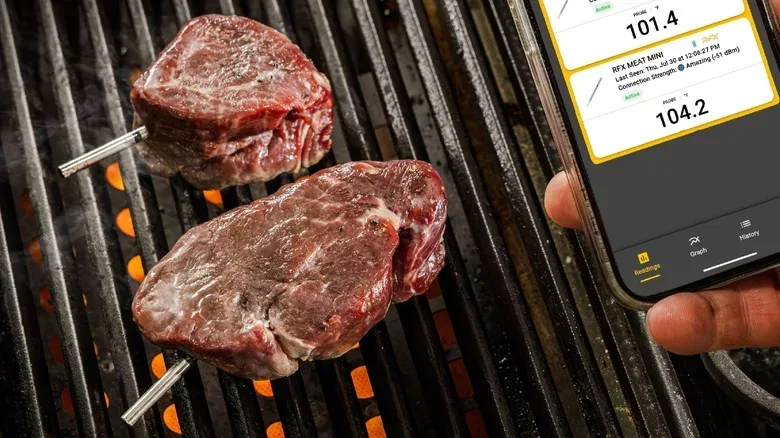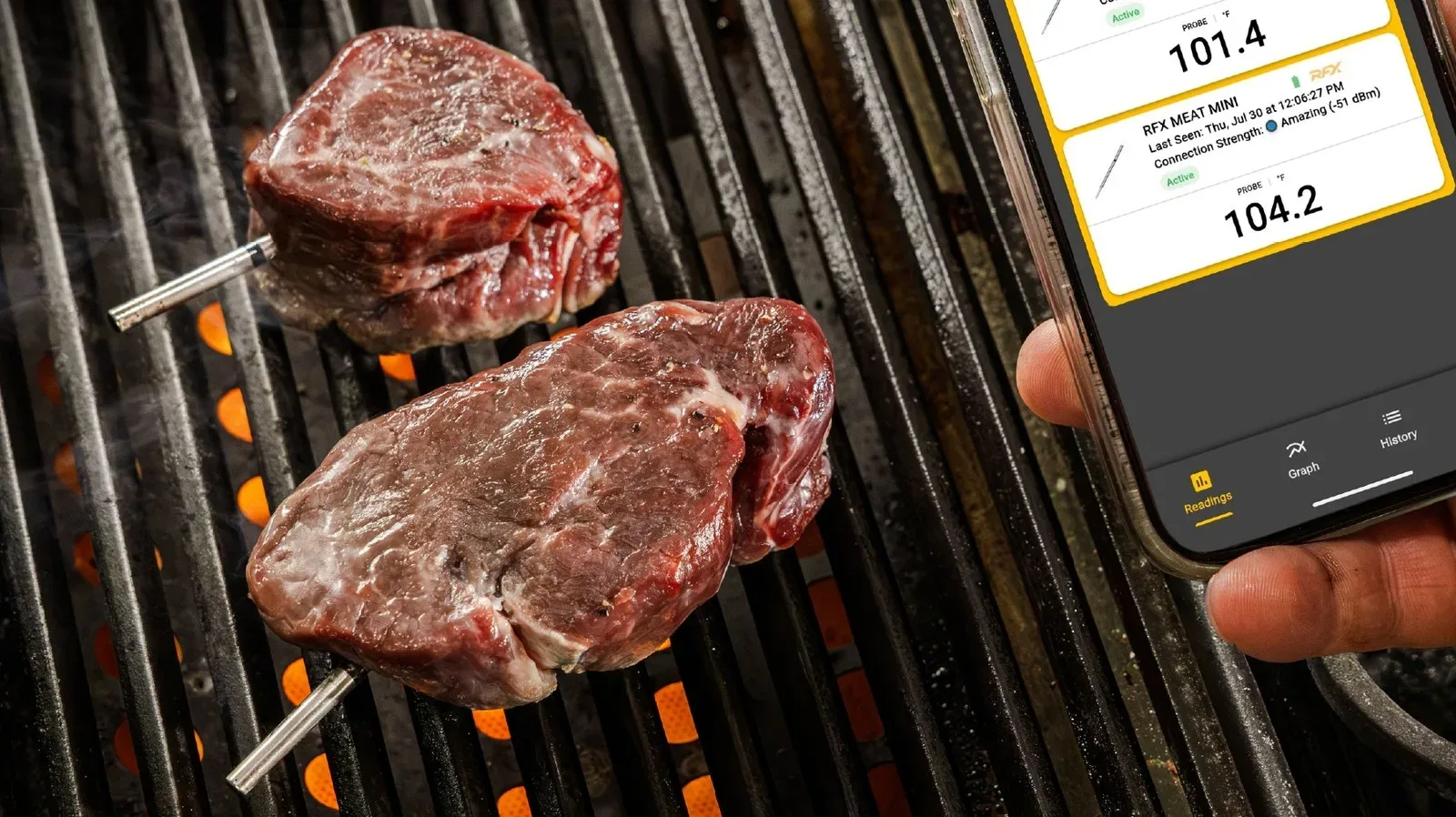
Wireless meat probes are often designed around the dramatic stuff: a brisket holding steady through an overnight smoke, a large roast, or a whole bird occupying most of a grill. ThermoWorks’ new RFX Meat Mini takes aim at the less theatrical but very common problem of monitoring smaller portions. Its shorter body and shallower insertion requirements are intended for cuts such as filet mignon, individual salmon portions, smaller poultry pieces and other food where a longer probe can be awkward or impractical.
The Mini is available now for $99, matching the regular price of the full-size RFX Meat when that model is not discounted. It preserves most of the larger probe’s headline specifications: four internal temperature sensors, an IP69K waterproof rating, dishwasher-safe construction, heat resistance up to 1,000 degrees Fahrenheit, and a charging block that uses a AAA battery. The important change is physical fit.
A smaller probe addresses a very specific cooking limitation
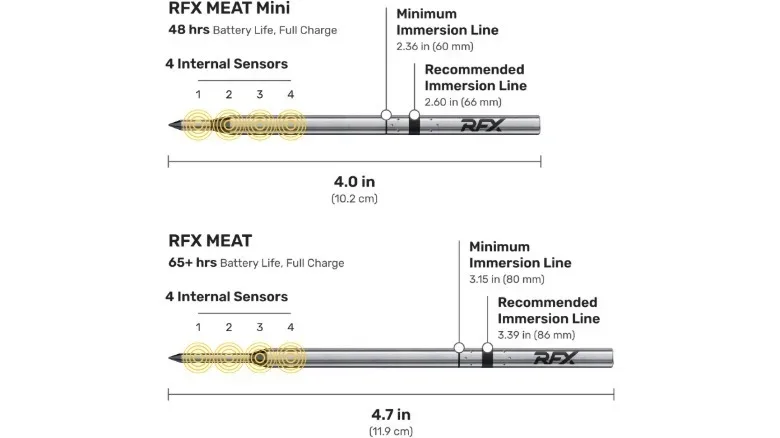
The original RFX Meat measures 4.7 inches, with a 3.15-inch minimum immersion line. That creates an obvious limitation for thin or compact food. A probe must be inserted far enough for its temperature-sensing section to sit properly in the food, yet a small steak or fish portion may simply not offer that much usable depth without the probe extending through the far side or sitting in the wrong place.
The RFX Meat Mini reduces its minimum immersion line to 2.36 inches and its maximum immersion line to 2.6 inches. Those measurements are the heart of the product rather than a minor revision. They make the Mini a more plausible option when the cook wants live temperature monitoring but is not preparing a large roast.
For more context, explore NFL Card Market Watch: J.J. McCarthy, Jaxon Smith-Njigba and Cleveland’s Sudden Hobby Heat.
“Immersion” here refers to how much of the probe needs to be inside the food for the device to measure as intended. It is not a claim that every food exactly 2.36 inches thick will work identically; placement, shape and where the desired internal temperature should be measured still matter. But the smaller threshold gives cooks more room to position the probe in foods that could not comfortably accommodate the full-size model.
What remains the same: the RFX system’s connection design
The Mini does not connect directly to a phone through Bluetooth or directly to a home router through Wi-Fi. Instead, it uses a 433MHz radio-frequency connection to an RFX Gateway. The Gateway then connects with the home network and the ThermoWorks app, enabling remote temperature checks on a phone.
That architecture has a practical catch: the Gateway is required. A shopper buying only the $99 probe does not have a complete remote-monitoring setup unless they already own the Gateway. ThermoWorks is offering a 20 percent discount on the Mini when it is purchased with either the RFX Gateway or the RFX Meat Starter Kit, which includes the Gateway.
It also describes the system’s core advantage. Grill and smoker walls can interfere with wireless signals, particularly when the probe is sealed inside a metal cooking chamber. The 433MHz radio system is designed to be less susceptible to that interference than Bluetooth or Wi-Fi in this use case. The Gateway acts as the bridge: probe to Gateway over the dedicated radio link, then Gateway to the local network and app.
For a cook, the benefit is less about the radio terminology than about avoiding the familiar failure mode of a connected device that loses its signal precisely when the lid is closed. It does not eliminate the need to consider Gateway placement and home-network access, but it separates the challenging grill-to-receiver link from the home-network portion of remote monitoring.
Four internal sensors and a separate ambient probe
The RFX Meat Mini includes four internal temperature sensors. Multiple sensors can help a probe capture readings across its sensing area rather than relying on a single point alone. The source material does not specify how the app presents those readings or how it selects them during a cook, so buyers should avoid assuming more detailed software behavior than has been stated. Still, the retained four-sensor design means the Mini is not positioned as a stripped-down, short-form version of the RFX Meat.
The Gateway can also accept a separate wired ambient-temperature probe. Ambient temperature means the temperature of the air surrounding the food inside the grill, smoker or oven. That is a different measurement from the food’s internal temperature, and the distinction matters during a long cook.
Some wireless food probes place an ambient sensor at the exposed end of the probe. ThermoWorks’ gateway-plus-wired-ambient approach avoids placing that measurement on the food probe itself. The stated reason is evaporative cooling: moisture evaporating from food can cool the area immediately around it. During longer cooks, that local cooling effect can make an ambient sensor positioned beside the food less representative of the cooking chamber’s broader air temperature. A separately placed wired probe gives the cook more flexibility to measure the grill environment away from that effect.
In practical terms, the system separates two questions that are often mixed together: “How hot is the food at its center?” and “How hot is the space cooking it?” The Mini is chiefly about making the first question workable for smaller cuts; the Gateway’s ambient-probe support helps with the second.
Battery life is shorter, but the stated figure remains substantial
The principal trade-off beyond physical length is runtime. ThermoWorks rates the RFX Meat Mini for up to 48 hours per charge. The full-size RFX Meat is rated for more than 65 hours. That difference is real, especially for operations repeatedly cooking at volume, but 48 hours covers far more time than a typical home grilling session and remains longer than many slow barbecue cooks.
The Mini’s charging block is powered by a AAA battery, which ThermoWorks says is sufficient for more than 175 charges. A docked-when-not-in-use routine should make the Mini’s shorter runtime a manageable compromise for many home cooks. Anyone who wants maximum time away from the charging block, however, should note that the larger RFX Meat retains the longer stated endurance.
It is worth reading “up to” in the normal sense of a manufacturer battery estimate: it is a stated maximum, not a promise that every usage pattern will reach exactly 48 hours. No additional testing conditions are provided here, so there is no basis to make a more precise battery-life claim.
Durability specifications suit high-heat, messy cooking
The Mini carries an IP69K rating. In the terms relevant to kitchen cleanup, ThermoWorks says that rating means the probe is dishwasher safe. The unit is also specified to withstand temperatures up to 1,000 degrees Fahrenheit. Together, those figures indicate a probe made for the heat and residue associated with grills and smokers, while limiting the chore of hand-cleaning a device after each cook.
Those specifications should not be confused with a guarantee that every cooking scenario is appropriate. A product’s stated maximum temperature is a heat-tolerance figure, while successful probe placement remains a separate issue. The probe still needs to be placed in food rather than exposed unnecessarily to conditions outside the normal intended setup.
Who should pick the Mini rather than the regular RFX Meat?
The decision comes down less to feature lists than to the food most often being cooked. The Mini makes sense for people who routinely grill smaller steaks, fish portions or compact poultry cuts and want a wireless probe that can reach the appropriate part of the food without requiring the depth of the 4.7-inch original.
- Choose the RFX Meat Mini if shallow placement is the primary concern and a 48-hour stated runtime is ample.
- Choose the full-size RFX Meat if larger cuts dominate the menu and the longer stated battery life is more valuable than the Mini’s smaller immersion requirements.
- Plan for an RFX Gateway if starting from scratch, because the Mini’s 433MHz connection depends on it for app and home-network monitoring.
- Consider the wired ambient probe setup if tracking the cooking chamber separately from the food is important, particularly over a lengthy cook.
At the same $99 regular price as its larger sibling, the Mini is not framed as a lower-cost entry point. It is a more specialized size option within the same connected system. For cooks frustrated by trying to fit a long wireless probe into a small cut, that specialization is the entire appeal: a monitoring tool shaped for the food actually on the grill, rather than only for the biggest project in the smoker.