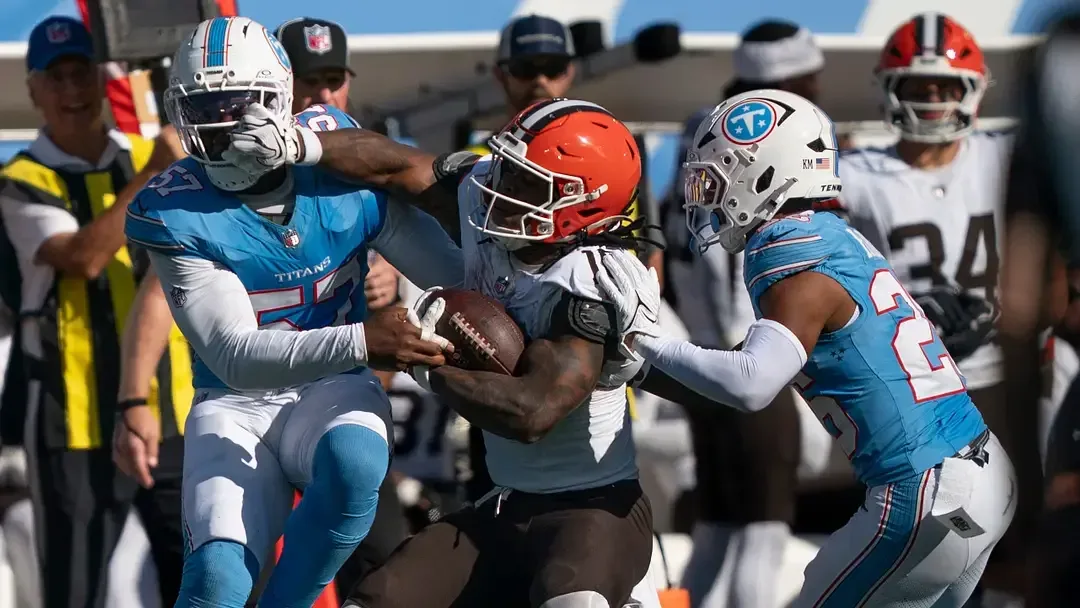
Seven weeks into the 2026 NFL season, the football-card market has found three very different kinds of excitement: a quarterback with only five quarters of work for his new team, a receiver producing at an almost cartoonishly high rate, and a Browns roster turning an unexpected 5-2 start into a potentially important product storyline.
That is a lot of momentum for a hobby that can react faster than a defensive coordinator after an explosive play. It is also exactly why collectors should separate what has already happened from what a card price is forecasting. A recent sale is evidence that buyers paid a given amount at a given time; it is not a permanent rating stamped on a player’s helmet.
J.J. McCarthy, Jaxon Smith-Njigba and several Cleveland players each have a compelling case for greater hobby attention. Their situations are not equal, however. McCarthy is the high-variance quarterback play, Smith-Njigba has the strongest production case, and the Browns represent a broader team-break thesis tied to a scheduled 2026 NFL Topps Chrome release on November 18.
J.J. McCarthy’s Giants Moment Has Moved His Prizm Market
McCarthy’s arrival as New York’s starting quarterback followed Jaxson Dart’s season-ending injury, an abrupt turn that placed the former Vikings quarterback at the center of a team suddenly carrying postseason hope. The Giants enter their Week 8 bye after a surprising win over Houston, and McCarthy threw for 252 yards while recording only eight incompletions in that game.
The sample is plainly tiny: five quarters in New York. Yet quarterback cards do not wait around for a thesis defense. Collectors often price the possibility of a franchise-changing player well before there is enough evidence to establish one. That tendency can create sharp movement in either direction, particularly for a former first-round pick stepping into a prominent market.
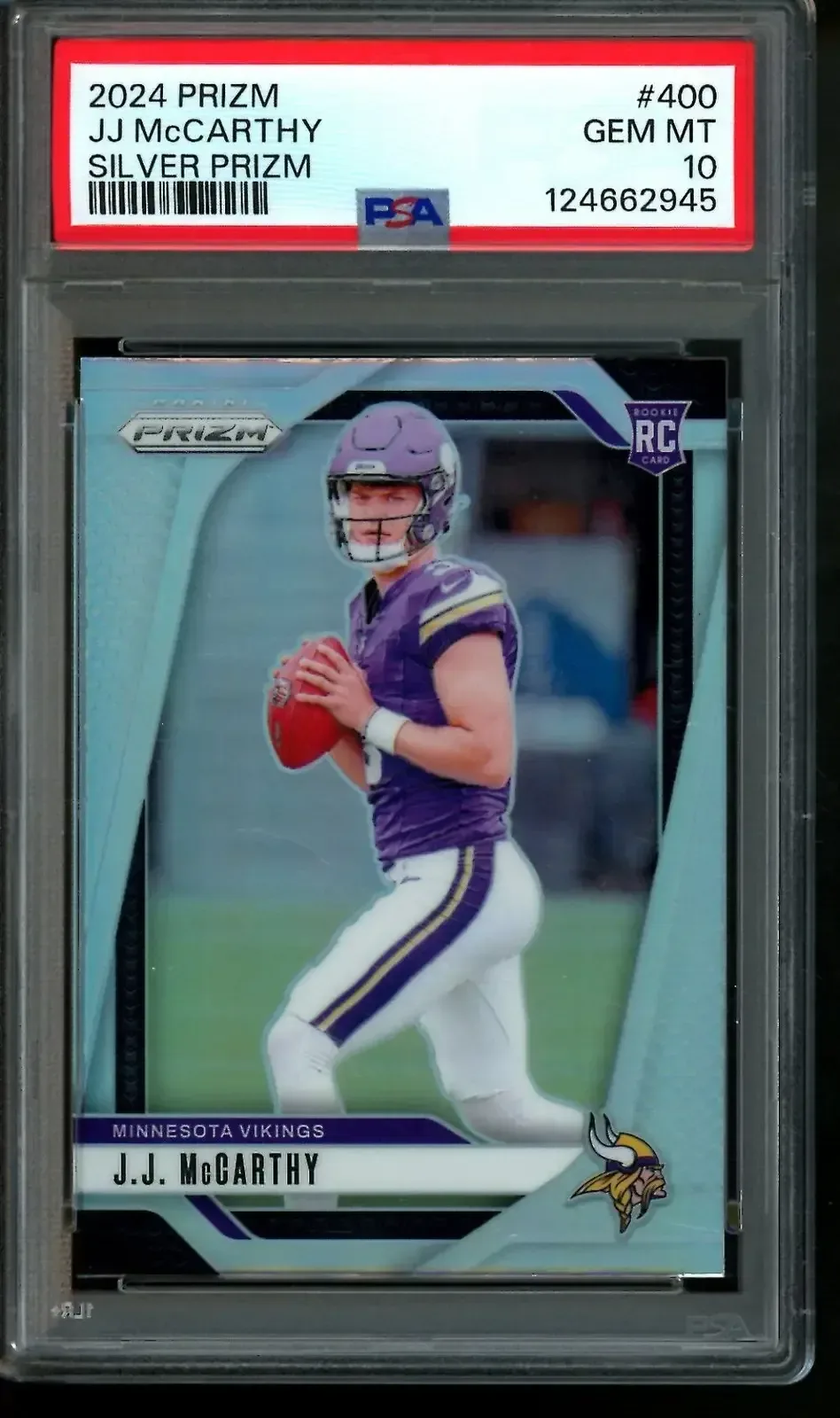
McCarthy’s 2024 Panini Prizm Silver Prizm rookie card in PSA 10 condition reportedly sat around $200 before his trade. Multiple sales above $300 have occurred only a handful of weeks later. That is a notable move, especially with the bye week interrupting the on-field momentum that usually feeds a player’s market.
What does “Silver Prizm” mean?
Prizm is a card brand, while a Silver Prizm is a parallel version distinguished from the regular base card by its reflective finish. In modern sports cards, parallels are alternate versions of a card that can carry different visual treatments and varying scarcity. They are often watched closely because they provide a recognizable, relatively standardized benchmark across players in the same product.
“PSA 10” refers to a top grade from Professional Sports Authenticator. Grading evaluates a card’s physical condition, including elements such as centering, corners, edges and surface. A PSA 10 does not guarantee future value, but it gives buyers a commonly understood condition designation, which can make sales comparisons more straightforward than they are for raw, ungraded copies.
The rise from roughly $200 to $300-plus therefore reflects more than a generic bump in interest. It is movement in a highly legible card: a rookie-year Silver Prizm, carrying a top grade, attached to a quarterback now leading the Giants. That combination is about as hobby-friendly as a clean two-minute drill.
The reasons to slow down before calling it a takeover
The central question is not whether McCarthy’s start has mattered. It has. The question is what a buyer believes the price already includes. A premium paid after five quarters may be paying for his performance against Houston, the possibility of a Giants playoff berth, the appeal of a New York quarterback, and the belief that he can retain the job beyond the immediate moment.
There are meaningful hurdles ahead. Beginning in Week 11, New York is projected to play all but one remaining opponent with a winning record before a potentially meaningless Week 18 game against Philadelphia. Stronger competition does not erase what McCarthy has done, but it makes the next stretch a much sterner test of the optimism now surrounding him.
There is also the Dart factor. The existing hobby investment in Dart means any genuine quarterback controversy could complicate how collectors frame the Giants’ long-term quarterback picture. Injury-created opportunity can establish a player, but it can also leave a market vulnerable if the organization’s future is less settled than a short run of wins suggests.
For collectors, the practical takeaway is simple: distinguish between buying McCarthy because the card is important to a personal Giants or quarterback collection and buying because the recent price line must keep climbing. Those are different decisions. The first can tolerate volatility. The second depends on a great deal going right in games that have not happened yet.
Jaxon Smith-Njigba Has the Production Argument—and Then Some
If McCarthy’s market is powered by opportunity and projection, Jaxon Smith-Njigba’s case begins with output. Through seven weeks, the Seattle receiver has 867 receiving yards and eight touchdowns. CeeDee Lamb, the next-closest player in both categories, has 651 receiving yards and six touchdowns.
The 216-yard gap between Smith-Njigba and Lamb is especially striking in context. It is roughly comparable to the difference between Lamb and Mike Evans, who sits 21st in receiving yards. Put less politely: Smith-Njigba is not merely leading the room; he has moved several rows ahead and started choosing the music.
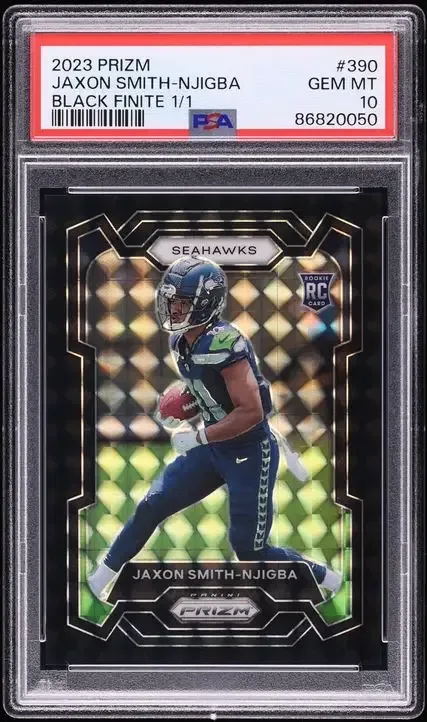
Smith-Njigba was last season’s Offensive Player of the Year, but his current start still places him in a conversation often dominated by established names such as Ja’Marr Chase and Justin Jefferson. The market is responding. Sales of his flagship 2023 Silver rookie in PSA 10 have recently landed around $340, compared with preseason levels around $200 to $220.
Why a “flagship” rookie matters
In collecting language, a flagship card is generally a widely recognized, core rookie issue rather than an obscure insert or a highly specialized release. The appeal is practical: more collectors know what it is, more sales tend to exist for comparison, and demand can be broader when a player catches fire.
That does not mean a flagship PSA 10 is automatically rare, nor does it mean every sale at $340 establishes a universal market floor. Individual sales can differ because of auction timing, buyer urgency, listing quality and other ordinary market factors. Still, repeated sales in a similar range are useful signals that the rise is not limited to one unusually aggressive bidder.
Smith-Njigba’s profile currently has something McCarthy’s does not: seven weeks of league-leading statistical separation. For the card market, that matters because it gives collectors a measurable foundation for the excitement. It also creates a different risk. The more spectacular the pace, the more any slowdown can feel like disappointment even if the player remains excellent.
A historic chase is possible, not promised
The longer-term narrative around Smith-Njigba is tied to what he could do across two seasons. Calvin Johnson’s 3,645 receiving yards from 2011-12 remain the record for a two-season span, with Antonio Brown’s 3,532 yards from 2014-15 next. Reaching or passing those totals would require Smith-Njigba to maintain an extraordinary level.
That possibility helps explain the widening hobby interest. Records and legacy arguments tend to give card markets sturdier stories than a single hot month. But “in range” is not the same as “on course,” and a two-season benchmark is a long way from being settled in Week 7 of one campaign. Injuries, defensive adjustments and the basic difficulty of sustaining elite production all remain real variables.
Collectors considering a purchase after the move from the low-$200s to around $340 are effectively deciding whether the market is still underestimating his ceiling or appropriately charging for his dominant start. Neither answer can be known now. What can be said is that Smith-Njigba’s price rise is attached to a far more substantial statistical case than a one-game spike.
For a broader look at how collector attention can build around limited-time goals and highly specific targets, see this coverage of the Poké Ball Pattern Vivillon community goal. The subjects differ, but the collecting principle is familiar: urgency and a clear narrative can focus demand quickly.
Cleveland’s 5-2 Start Could Make the Browns a Team-Break Target
The Browns entered the season as a long shot to win the AFC North, with +2200 odds cited before the year began. They are now 5-2, only the second Cleveland team since the franchise returned in 1999 to start that well. Their Week 8 meeting with Pittsburgh will leave one of the two clubs alone atop the division.
For card collectors, a competitive team can be more than a backdrop. It can concentrate attention on multiple players at once, especially when the roster contains emerging rookies and a release date is approaching. Cleveland’s situation has that potential with 2026 NFL Topps Chrome due November 18.
What is a team break?
A team break is a format in which participants buy rights to cards from one team in a sealed-product opening. Rather than purchasing an entire box or case, a Browns buyer would receive the Cleveland cards pulled from that break. The appeal is focus: someone interested in the Browns’ rookies does not have to acquire every card from every team to chase them.
The downside is equally important. Buying a team slot does not guarantee a particular player, a big hit or even a satisfying number of cards. It is a purchase of a chance at whatever the product yields. If a team’s prices rise because of a winning streak, the cost of that chance can rise before collectors know how plentiful or desirable the cards will be.
Cleveland’s appeal is not limited to a single name. Rookie receivers KC Concepcion and Denzel Boston have delivered significant fourth-quarter plays and helped create explosive moments for an offense otherwise not built around them. Quinshon Judkins has added three games of more than 70 total yards across his past four appearances. Those ingredients give a prospective Browns break more possible points of interest than a one-player chase.
Deshaun Watson remains part of the picture, too. Preseason speculation had focused on whether he might yield the quarterback job to a younger passer, with Shedeur Sanders frequently mentioned. Instead, Cleveland has stayed competitive through a ball-control approach and timely game-winning drives, albeit against a relatively favorable early schedule.
That is why the Steelers game and the ensuing schedule matter to the hobby narrative. A division lead would give the Browns’ story more weight, while losses would test how much of the current attention is tied to team success versus interest in individual rookie talent. A strong season could make Cleveland an attractive team-break spot in Topps Chrome. It cannot make any sealed opening predictable.
Three Stories, Three Different Kinds of Risk
The cleanest way to view this week’s hobby movement is to avoid treating every rising card as the same bet.
- McCarthy: The clearest quarterback upside and the shortest meaningful sample. His recent PSA 10 Silver Prizm sales show the market has reacted quickly to his Giants opportunity.
- Smith-Njigba: The strongest on-field case, built on an enormous lead in receiving yards and touchdowns through seven weeks. His price increase reflects a player whose performance is already forcing a larger league-wide conversation.
- Cleveland: A roster-and-product angle rather than one definitive card thesis. The team’s record, rookie contributors and the November 18 Topps Chrome date could make Browns slots more interesting—and potentially more expensive—in breaks.
None of this requires declaring a player a permanent superstar or a card an automatic investment. Modern football-card markets move on expectations, and expectations have a habit of changing between Sunday afternoon and Monday morning. The more useful approach is to know what is driving the attention, know what could disrupt it, and decide whether that uncertainty belongs in a collection.