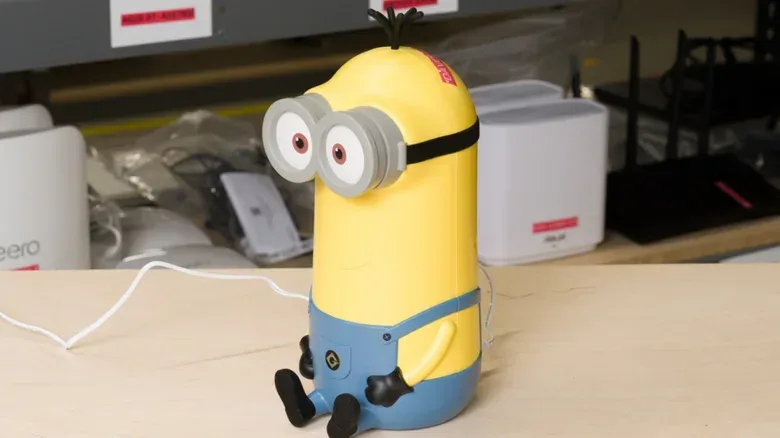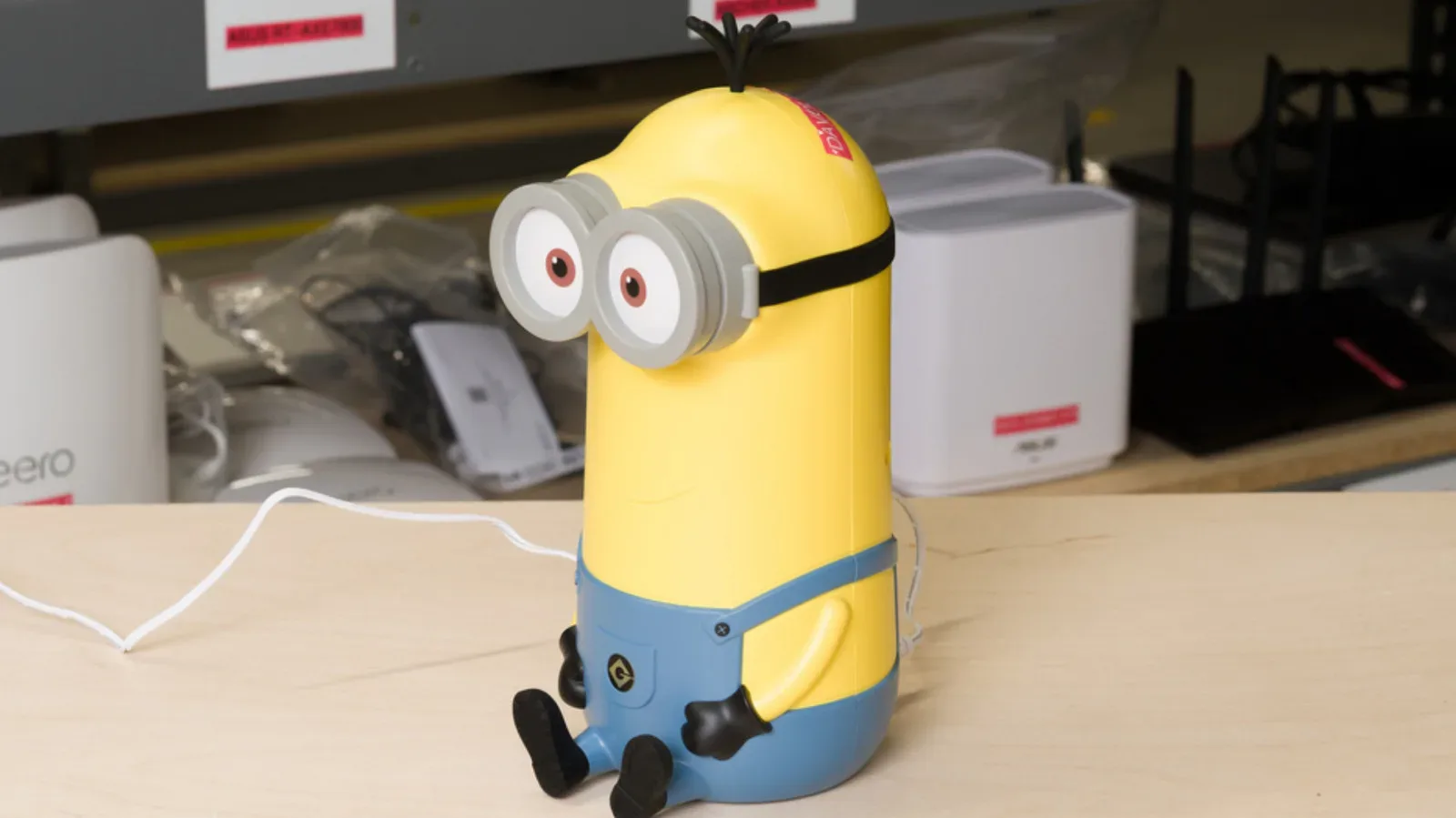
The tall Minion-shaped Wi-Fi router named Kevin may look like the kind of novelty hardware invented for a joke post, but it is a real networking product—and a surprisingly consequential example of how US communications rules can affect consumer tech.
Davolink’s Kevin and Bob routers are licensed Minions designs, built by a South Korean networking company better known for supplying gateways and access points to major domestic carriers. Kevin recently found a far larger audience after circulating online as an unusually capable Wi-Fi 6E router with a conspicuously yellow, one-eyed chassis. Its sudden popularity reportedly emptied an Amazon listing priced at $62.99.
The strange part is not that an internet-famous Minion router exists. It is that its future in the US is governed by the same FCC framework now affecting a broader set of foreign-produced routers. The policy does not make the existing Kevin and Bob models contraband, and it does not require owners to discard them. But it does mean that Davolink cannot simply submit a new Minion router for the usual approval process and bring it to the US market unless it receives an exemption.
That makes the headline less “the FCC hates Minions” and more “a licensed novelty router has encountered a very un-novel regulatory barrier.” For people considering one of the existing units, the practical questions are whether the product fits their network, what support window is in place, and why a future Wi-Fi 7 edition is not an easy follow-up.
What Kevin and Bob actually are
Davolink showed its Minions routers at CES in January 2023 under an exclusive design agreement with Universal, then began selling them in South Korea later that year. The pair are not merely decorative shells for basic networking equipment. They are separate products with different capabilities.
Kevin, model DVW-632, is the larger router. Standing 9.6 inches tall, it is a tri-band Wi-Fi 6E model with an AXE5400 rating, WPA3 security and mesh support. It has a 2.5 Gbps WAN port, plus one gigabit LAN port. Its advertised wireless-band figures are 573 Mbps on 2.4 GHz and 2.4 Gbps apiece on 5 GHz and 6 GHz.
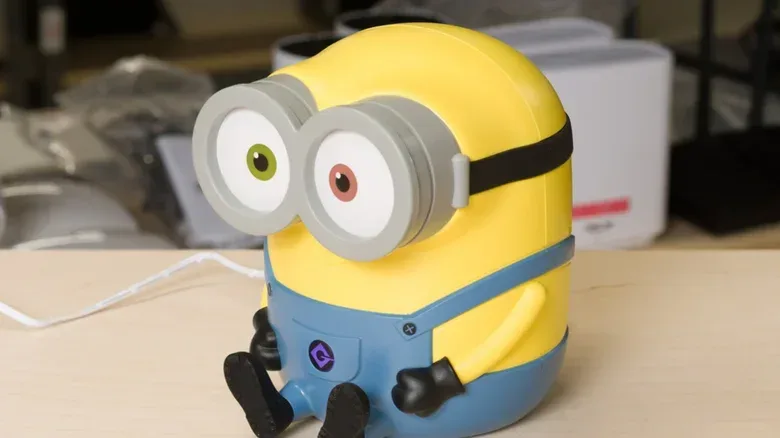
Bob, model DVW-642, is smaller and less ambitious. It is a dual-band Wi-Fi 6 router with a gigabit WAN port and a stated maximum rating of 1.77 Gbps.
Those labels benefit from some translation. Wi-Fi 6E is Wi-Fi 6 with access to the 6 GHz band, in addition to the familiar 2.4 GHz and 5 GHz bands. In broad terms, the extra band can provide another stretch of wireless spectrum for compatible devices. A tri-band router has radios for three bands; Kevin’s are 2.4 GHz, 5 GHz and 6 GHz. Bob is dual-band, so it lacks 6 GHz.
An AXE5400 label is also not a promise that a single laptop, phone or console will receive 5.4 Gbps. It is a class rating created by adding the claimed maximum throughput across the router’s bands. Kevin’s total comes from its 573 Mbps 2.4 GHz figure and two 2.4 Gbps figures for 5 GHz and 6 GHz. Actual results depend on the device, the band it supports, the surrounding wireless environment and the internet connection.
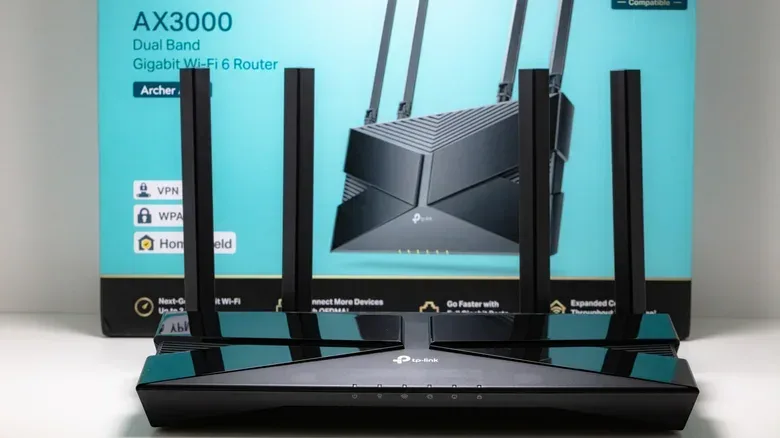
Kevin’s wireless credentials put it in the same class as TP-Link’s Archer AXE75. Comparative testing has found Kevin ahead on speed and range, but the physical-port layout is a meaningful caveat. The Archer has four gigabit LAN ports, while Kevin has just one. That matters to a household using wired connections for a desktop computer, console, streaming box, NAS or other fixed devices. Kevin can still accommodate more wired gear, but doing so requires adding a network switch.
That trade-off is especially worth noting for gaming setups. A wired connection is often preferred where possible for consistency, and a single LAN port can disappear quickly. Anyone building a shared entertainment network should separate the appeal of the character design from the number of Ethernet connections the setup actually requires. For a reminder that game hardware has long mixed functional design with distinctive personality, see this look at Sega controller history.
Why a router needs FCC authorization
Wireless devices generally need FCC equipment authorization before they can be sold in the United States. That process is central to this story. The issue is not a recall of devices that already passed authorization; it is the availability of authorization for additional equipment after a policy change.
On March 23, the FCC added “routers produced in a foreign country” to its Covered List. The move followed a national-security determination received three days earlier from an interagency body convened by the White House. Equipment on the Covered List cannot obtain the FCC authorization needed for sale in the US unless an exception applies.
The word produced is important. One legal interpretation holds that it can include any major stage of production, including design and development, rather than being limited to a company’s national identity or the final assembly site. In other words, this is not a rule aimed at the Minions brand, nor is it described as a test of whether a router looks conventional or cartoonish. A yellow cylindrical router and a plain black router can face the same restriction if they fall into the covered category.
That distinction also helps explain why Kevin and Bob are still legal to buy and use. The FCC authorized the two routers between November 2023 and February 2024, before the March Covered List addition. Products already authorized can continue to be imported, sold and used. A buyer is not purchasing an unauthorized wireless device merely because the policy later changed.
Existing hardware is allowed, but updates are the longer-term question
Regulatory status is only one part of a router’s lifespan. Routers are security-sensitive equipment because they sit at the point where a home network meets the internet. Their firmware—the embedded software that runs the device—can require patches for security issues, bug fixes and compatibility problems.
The Covered List treatment also bars changes to already-authorized devices, including software updates. However, the FCC has waived that restriction for matters such as security patches and compatibility fixes until at least January 1, 2029. Its engineering office has also said it will recommend incorporating that waiver into the rules.
For Kevin and Bob owners, that establishes an important but qualified support expectation. Critical updates are supported under the current waiver through the end of 2028. If the waiver is not made permanent and its date does not change, Davolink would have to stop patching the routers after 2028. That is not the same thing as a statement that the routers will stop functioning on that date. Rather, it is a potential limit on the manufacturer’s ability to provide new firmware under the existing regulatory structure.
The issue is not theoretical in the abstract. The US government’s vulnerability database has one entry for a Davolink product: a weak-password vulnerability affecting the DVW-3200N router in 2018. It received a severity score of 9.8 out of 10 and was fixed through new firmware. That historical entry concerns a different model, so it should not be treated as evidence of a flaw in Kevin or Bob. It does, however, demonstrate why the ability to issue firmware updates matters for networking products over time.
WPA3, included on Kevin, is the current Wi-Fi security standard listed for the device. It is a useful feature, but it does not eliminate the broader need for software maintenance. Security is a continuing process: protections can be improved, vulnerabilities can be discovered and compatibility demands can change.
Why Wi-Fi 7 Minions are not expected soon
Wi-Fi 7 is the next Wi-Fi generation after Kevin’s Wi-Fi 6E platform. The notable advances identified for Wi-Fi 7 here are 320 MHz channels and the ability for a device to use multiple bands at once. Those are changes that could matter to compatible devices and dense home networks, but they would require a new router model rather than a routine update to Kevin.
That is where the Covered List policy becomes most visible to shoppers. Davolink’s existing Minions routers can remain in circulation because they received authorization before the March action. A new Wi-Fi 7 Minion would need to clear the post-March approval landscape, and Davolink does not currently have the necessary exemption publicly identified.
The relevant exemption is called a Conditional Approval. It can be granted by the Department of Defense or the Department of Homeland Security and lasts for up to 18 months. The requirements are unusually substantial for a consumer-router brand: applicants must identify the origin of every component and of the firmware, explain why production is taking place outside the US, and commit to a dated US-manufacturing plan. That plan must include spending figures and quarterly progress reports.
ASUS, Eero and Netgear have received Conditional Approvals. The listed approval dates are April 14 for Netgear, April 22 for Eero and September 9 for ASUS. Davolink has not publicly said whether it has applied. The company has also reported operating losses since 2022, which adds uncertainty without proving what it will decide about an application or US manufacturing plan.
What prospective buyers should take from this
For shoppers, the most useful reading is neither panic nor a promise that a collectible-looking router is a future-proof network centerpiece. Kevin and Bob are authorized existing products, and their current legal position is clear: they can be imported, sold and used in the US. The March policy does not erase that authorization.
- Kevin is the more capable option: it is Wi-Fi 6E, tri-band, supports mesh networking and has a 2.5 Gbps WAN port.
- Port count may be the deciding limitation: Kevin has only one gigabit LAN port, so multiple wired devices require a switch.
- Bob is a different tier: it is a smaller dual-band Wi-Fi 6 product with a gigabit WAN port and a 1.77 Gbps top rating.
- Firmware support has a current regulatory backstop through 2028: the waiver presently permits security and compatibility updates until at least January 1, 2029, but the long-term rule is not settled.
- A newer Minion model is uncertain: the existing models’ authorization does not automatically open the door for a Wi-Fi 7 successor.
The oddity of the story is exactly what makes it useful. An attention-grabbing character tie-in has exposed a policy distinction that is easy to miss: keeping an already-authorized router on sale is very different from launching a new one. Kevin and Bob have permission to remain in the current market. Their manufacturer’s ability to refresh the lineup, and eventually to maintain the existing devices under the rules after the present waiver, is the unresolved part.