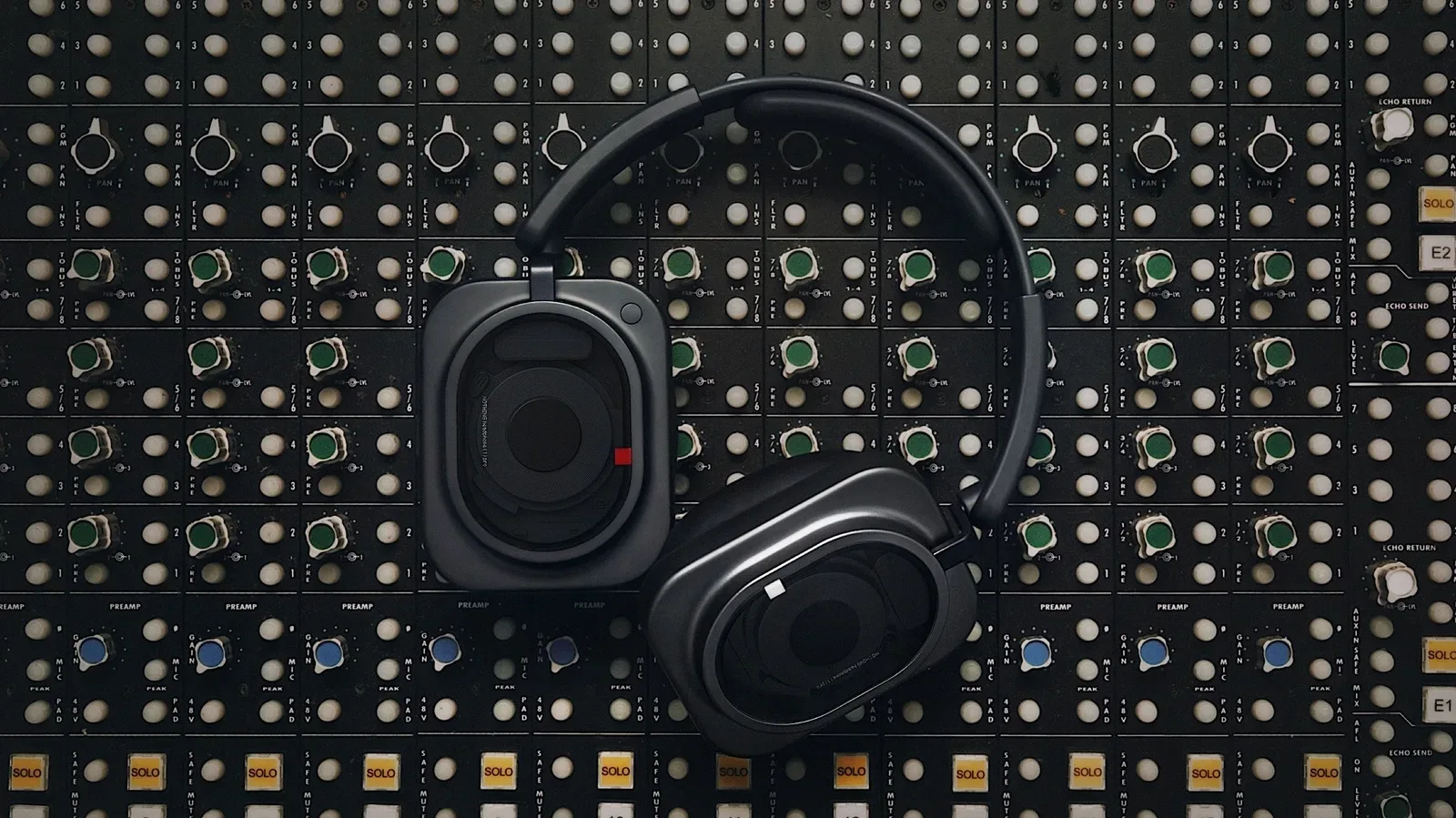
Technics has introduced the EAH-A1000, a new flagship pair of over-ear adaptive noise-cancelling headphones built around a particularly specific audio claim: reducing distortion before software processing has to step in and clean up the mess.
The headline hardware is a set of 40 mm magnetic fluid drivers. This is Technics’ first use of magnetic fluid driver technology in one of its over-ear headphone models. The company is positioning the approach as a way to let the driver move while reducing the unwanted vibration and distortion that can accompany larger drivers.
That is the kind of specification that can sound like a side quest item description, so it is worth separating the terminology from the promise. A driver is the component inside a headphone that converts an electrical signal into the physical movement that creates sound. Its diaphragm has to move accurately across quiet passages, dense mixes and sharp changes in volume. Distortion, in this context, means the output is no longer a perfectly faithful version of the intended signal. Technics’ stated goal with the EAH-A1000’s magnetic fluid design is to better control that movement.
The headphones also use an SST edge, described as surround sound technology found in some Technics speakers, as another measure intended to minimize distortion. Together, the magnetic fluid drivers and SST edge make the A1000 a hardware-led attempt at cleaner playback rather than merely a checklist of wireless features.
What the magnetic fluid approach is meant to address
A 40 mm driver is not unusual for an over-ear headphone. What distinguishes the EAH-A1000 is the magnetic fluid implementation around that driver. Technics says the technology allows movement while reducing vibrations and distortion associated with large drivers.
For listeners, the practical implication is not necessarily that every track suddenly becomes a revelation. Instead, the value proposition is in control: complex audio, bass-heavy material and passages where multiple elements compete for space are the situations where lower unwanted vibration and distortion could matter most. That remains a design objective rather than a listening verdict; no independent sound assessment is established here.
Still, it is a more substantive angle than treating “flagship” as a synonym for a shinier finish and a more imposing carrying case. Technics is identifying a specific mechanical part of the headphone system as the focus of its next-generation model.
Noise cancellation uses four microphones per side
The EAH-A1000’s adaptive noise-cancellation system uses three feed-forward microphones and one feedback microphone on each side. That is four microphones per earcup, or eight across the full headset.
Feed-forward microphones listen to sound outside the headphones, providing the system with information about the surrounding environment. Feedback microphones monitor sound inside the earcup. In broad terms, combining the two gives the noise-cancelling system more than one reference point when it tries to reduce outside sound.
Technics says the arrangement is designed to optimize cancellation based on both ambient noise and headphone fit. Fit is meaningful because the physical seal between earpad and listener affects how outside noise reaches the ear. A noise-cancelling system working around a different seal may need to respond differently even in the same room. The claim here is not that the EAH-A1000 can erase every sound, but that its microphone configuration is intended to adapt its response to the conditions in use.
That distinction matters for shoppers comparing ANC specifications. Microphone counts alone do not settle the quality of noise cancellation, comfort or call performance. They do, however, indicate the sensor arrangement Technics is using for the feature. The EAH-A1000 is clearly built around both external and internal acoustic monitoring rather than a simpler outside-only setup.
LDAC and USB Audio offer two paths to higher-quality listening
On the connectivity side, the EAH-A1000 supports LDAC and lossless listening through USB Audio. These are related to audio quality, but they are not interchangeable features.
LDAC is a Bluetooth audio codec. A codec is the method used to encode and transmit audio wirelessly between devices. Its inclusion gives compatible devices a higher-quality Bluetooth option than basic wireless playback paths. However, it remains a wireless connection and compatibility is part of the equation.
USB Audio is the wired alternative named for the EAH-A1000. Technics says it enables lossless listening, meaning the audio signal can be transmitted without discarding information through lossy compression. For someone who wants to use the headphones at a desk or with a compatible device, this is the clearest route in the published specifications toward a lossless setup.
The practical buying question is therefore not simply whether one option is “better.” It is whether a prospective owner’s devices and habits match either path. A listener who primarily moves between several Bluetooth devices may put more weight on multipoint support. Someone who listens at a computer may be more interested in USB Audio. The A1000 presents both choices, rather than asking buyers to select one listening model exclusively.
Three-device multipoint is an unusual convenience feature
Technics says the EAH-A1000 can maintain multipoint connectivity with up to three devices. Multipoint refers to headphones being connected to more than one source device, reducing the need to fully disconnect and re-pair when moving between them.
Two-device multipoint is the more familiar configuration, so support for three devices is a notable part of the A1000’s feature set. It could be useful for a person who alternates between a phone, a computer and another audio source. Exactly how switching behaves in every scenario has not been detailed, and the specification should not be read as a promise of seamless behavior in every application. But the capability itself gives the EAH-A1000 a broader device-management pitch than the standard two-device setup.
It is also a feature that makes sense alongside the headphone’s lossless USB Audio support. The A1000 is positioned for listening across different types of devices and connection methods, not solely as a wireless mobile accessory.
The 45-hour battery figure needs an important qualifier
Technics lists battery life at up to 45 hours of continuous playback. That is a potentially strong headline number, but there is one major unanswered detail: the company has not specified how much of that estimate includes active noise cancellation.
ANC draws power, unlike passive listening, so battery figures can vary depending on whether noise cancellation is running. Without a stated ANC-on figure, buyers should treat 45 hours as the maximum claimed playback time rather than assume it represents every usage mode.
This is not a reason to dismiss the rating. It is simply the responsible way to interpret an “up to” battery claim when a power-hungry feature is central to the product. Anyone comparing the EAH-A1000 with other premium ANC headphones should look for equivalent listening conditions before treating runtime totals as directly comparable.
What is still unknown
Technics has not shared pricing or specific availability details for the EAH-A1000. Those omissions are significant because the product is described as a flagship model, and its ultimate value depends heavily on where it lands in the premium headphone market.
Other useful details are also outside the current information, including the precise battery estimate with ANC enabled and how the three-device multipoint implementation handles particular combinations of devices. The specifications do establish the core direction, though: large magnetic fluid drivers for lower-distortion ambitions, a multi-microphone adaptive ANC layout, LDAC, lossless USB Audio and an uncommon three-device multipoint option.
For readers weighing headphone formats more generally, Joking Joystick has also covered the distinct proposition of Baseus’ Inspire XC1 open-ear earbuds. The EAH-A1000 sits on the opposite end of the design spectrum: a full over-ear model whose stated priorities are controlled driver movement, isolation-oriented adaptive noise cancellation and flexible connections.
The EAH-A1000’s most interesting detail is ultimately not the familiar premium-headphone vocabulary. It is Technics putting magnetic fluid driver technology into an over-ear design for the first time and making reduced vibration and distortion the product’s central technical argument. Price, release specifics and ANC-on endurance will determine how complete that argument becomes for prospective buyers.