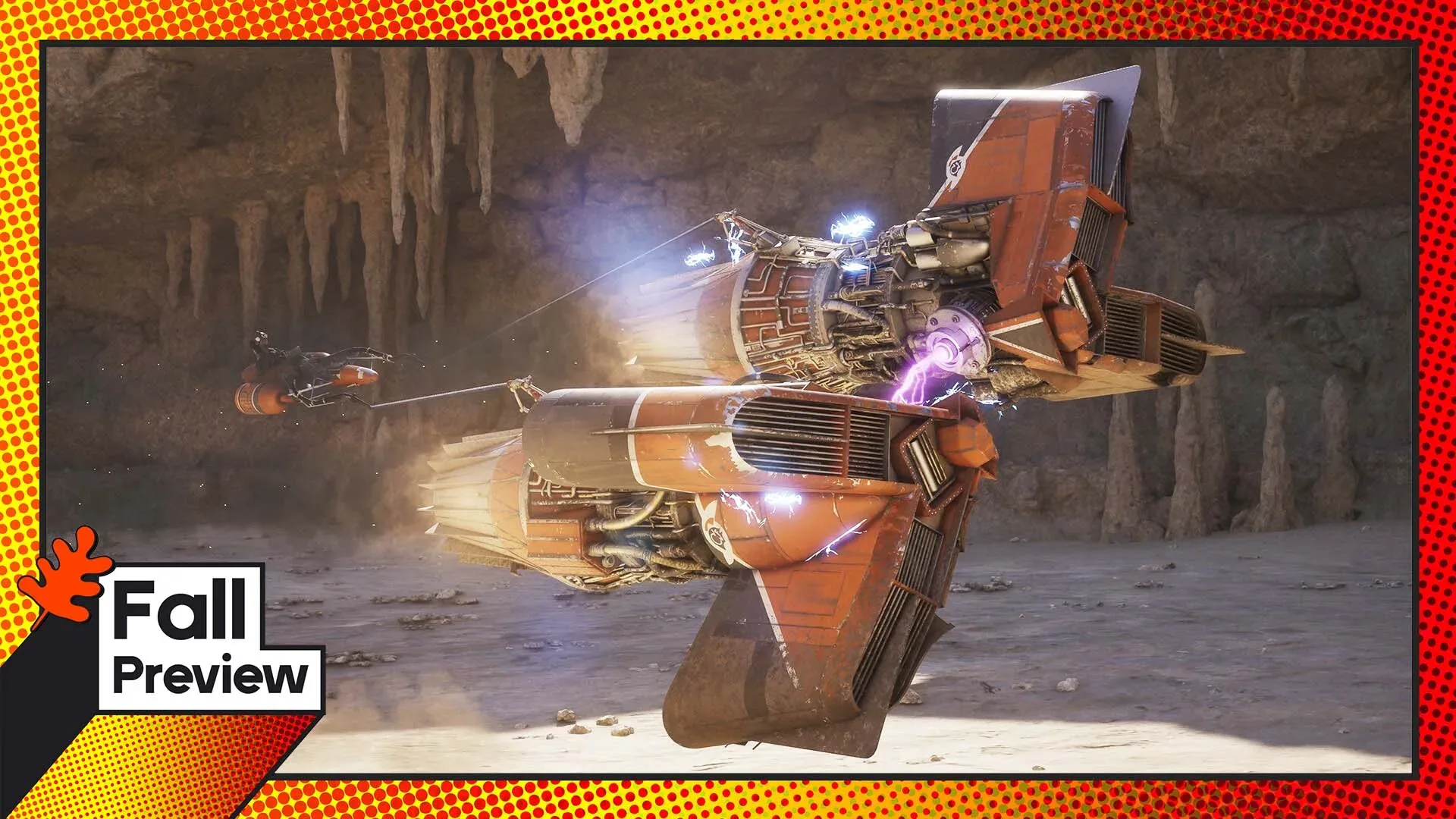
Star Wars: Galactic Racer is scheduled to arrive on October 6 for PS5, Xbox, and PC, putting a full-size arcade racer back in a galaxy that has spent much of its recent game time behind blasters or lightsabers. Developed by Fuse Games, the project combines podracing, tracks on worlds including Tatooine, and a campaign said to incorporate roguelike-style decisions around upgrades and progression.
That is a particularly interesting mixture for Star Wars. Racing is a natural fit for a setting full of distinctive vehicles, dangerous terrain, crowded ports, and impractical amounts of confidence in the face of certain mechanical catastrophe. Yet the genre has been quiet for a long time: 2002’s Racer’s Revenge was the last major Star Wars racing release identified in the available information, a 24-year gap before Galactic Racer.
Fuse Games is making its debut with Galactic Racer. The studio was founded by key people associated with the fast, crash-happy Burnout series, so it is reasonable to see the team’s genre experience as one of the project’s most consequential details. That background does not establish exactly how Galactic Racer will handle, how collisions work, or what its final quality will be. But it does mean this is not a racing game being treated as a novelty side dish next to a more familiar action format. Racing is the central proposition.
A Star Wars race game built around forward momentum
Podracing has obvious visual and mechanical potential. It is loud, exposed, fast, and fundamentally precarious: a racer is not tucked safely inside a sealed car but seemingly trying to persuade two huge engines and a thin connecting cockpit to cooperate at extreme speed. Tatooine is also a fitting location, as podracing is closely tied to its deserts in the broader Star Wars imagination.
For Galactic Racer, those elements offer more than recognizable scenery. They give a track-based game an identity that ordinary asphalt circuit racing cannot provide. The meaningful question is whether the game can translate that identity into readable competition: rapid movement is only satisfying when players can understand a course, make choices under pressure, and feel that a risky maneuver was deliberate rather than a random collision with geography.
The source material characterizes Galactic Racer as a fast-paced arcade racer. Arcade racing generally describes a style that prioritizes immediate control, speed, spectacle, and accessible competition over a strict simulation of real-world vehicle behavior. In a Star Wars setting, that approach makes sense. This is a universe of improbable engines and fictional physics; a game does not need to pretend it is a motorsport engineering seminar to create tension. It needs a clear sense of momentum, well-defined track hazards, and enough room for players to recover when their grand plan meets a canyon wall.
Fuse Games’ leaders, CEO and founder Matt Webster and creative director Kieran Crimmins, have described arriving at the project through a simple creative question: why had there not been a Star Wars racing game for so long? Crimmins said the studio viewed it as the strongest possible first game it could make, then brought the idea to Lucasfilm, with whom the team had worked previously. The response, as characterized by Crimmins, was enthusiastic rather than reluctant.
That matters because it complicates the easy assumption that a long genre absence must reflect a lack of interest from the franchise’s stewards. A 24-year pause does not, by itself, explain why something was not made. What Galactic Racer does show is that a development team with racing experience and a partner willing to pursue the premise can get a seemingly obvious idea moving again.
The campaign’s roguelike elements may be the crucial twist
The more unusual part of Galactic Racer’s pitch is its main campaign. Players will race, upgrade their vehicle, and make difficult decisions while trying to reach a grand championship. Those decisions are described as roguelike elements.
Roguelike is a broad, often loosely used game term, but in this context it points to a run- or campaign-based structure where choices, upgrades, and risk management can change the path forward. It does not necessarily tell players every detail about failure rules, resets, progression permanence, or randomness in Galactic Racer. None of those specifics have been established here. What is clear is that the campaign intends to make more than raw finishing position matter.
That could give repeated visits to a familiar track a new strategic purpose. Instead of treating every event as a disconnected contest for first place, a player may need to consider what a victory unlocks, which vehicle improvement serves the larger campaign, and whether aggressively hitting a rival is worth the possible cost. A dangerous slam may be entertaining in isolation; it becomes a genuinely tense choice when the racer has something to lose beyond a few seconds on the clock.
It is a sensible answer to one of racing games’ basic design challenges. Track repetition is not inherently bad—mastery is often the point—but a campaign benefits when each return offers a different objective, loadout decision, or tactical calculation. Galactic Racer’s upgrade-and-choice framework has the potential to supply that layer without abandoning the quick, physical immediacy that an arcade racer needs.
There is also a practical caveat. Hybrid genre labels raise expectations quickly. Players drawn by podracing may want crisp arcade competition, while players drawn by a roguelike campaign may expect choices that materially alter outcomes. Galactic Racer will need both sides of the equation to work together. Upgrades should be understandable enough to encourage experimentation, and track action must remain satisfying even for someone not looking to diagram a campaign route between races.
Why another genre shift would be valuable
Galactic Racer follows just weeks after Star Wars Zero Company, a tactical strategy game described as XCOM-like and populated by familiar Star Wars ingredients including clones, droids, and Jedi. Tactical strategy is built around turn-by-turn positioning, planning, and managing units rather than the reflex-heavy rhythm of racing. Galactic Racer moves in nearly the opposite direction, toward velocity and split-second commitment.
Together, the two projects make a useful case for a broader Star Wars game catalog. The setting is large enough to sustain different genres without every project needing to imitate the same camera angle, combat loop, or heroic power fantasy. A tactical squad game can emphasize planning and attrition; an arcade racer can emphasize routes, reflexes, and vehicle choices. Neither needs to diminish the other.
For players, genre variety is not just a slogan about “more content.” It changes who can find an entry point into the franchise. Someone who enjoys optimizing a strategy roster may have little interest in a third-person action game. Someone who likes chasing lap times may not want a long shooter campaign. A library with distinct forms gives the same fictional universe more ways to be played.
That diversity is especially worth watching as large franchises contend with crossover fatigue and familiar formulas. Even outside Star Wars, games are often asked to balance recognizable characters with mechanics that genuinely fit the setting. The discussion around a forthcoming operator filter in Warzone’s Modern Warfare 4 illustrates how strongly presentation and identity can shape player expectations. Galactic Racer’s advantage is that its core idea is already grounded in Star Wars imagery: speeders, alien locales, mechanical peril, and podracing all belong naturally in its proposed format.
What remains unknown before October 6
There is good reason to be curious, but there are also many unanswered questions. The provided details do not establish the number of tracks, the roster of racers, whether there are multiplayer modes, how extensive the campaign is, what exact form its roguelike systems take, or how vehicle customization operates. They do not establish a price, a review consensus, or how the game performs on any particular platform.
Early impressions mentioned in the available material have been positive about the broad premise and track-based racing, but early hands-on accounts are not a substitute for the finished release. The most useful promise Galactic Racer makes is straightforward: it is trying to be a Star Wars game that uses the franchise’s world to support a different kind of play, rather than applying Star Wars decoration to a formula it could use anywhere.
If that premise lands, Fuse Games will have revived a neglected corner of Star Wars gaming with a team well suited to the task. More importantly, it could reinforce the idea that the galaxy’s future in games does not have to be confined to shooters, third-person action, or one endlessly recycled blueprint. Sometimes the appropriate response to a giant fictional universe is not another solemn walk toward destiny. Sometimes it is attaching yourself to two screaming engines and attempting to avoid becoming a very expensive streak across the sand.