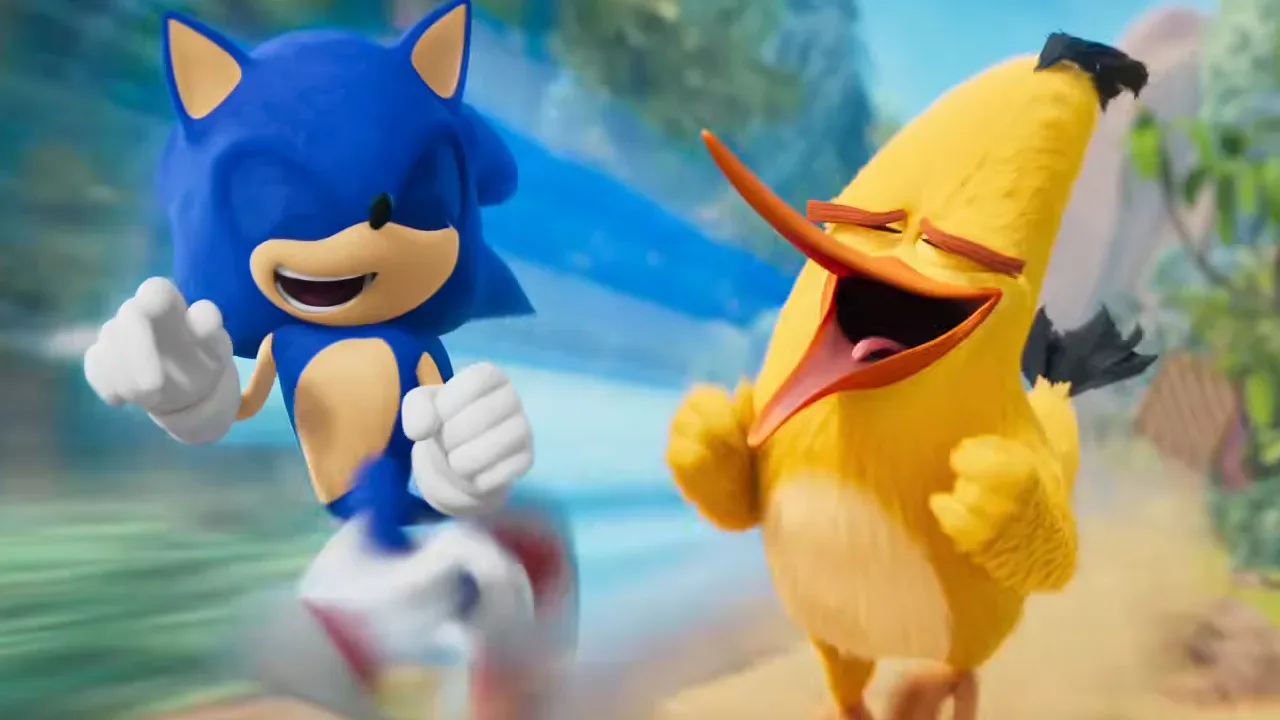
Sonic the Hedgehog has made an unexpected dash into the trailer for Angry Birds 3. The blue speedster is shown running through a wooded area alongside Chuck, the fast-moving yellow bird voiced by Josh Gad. Both characters appear to be laughing as they race, but the footage offers no explanation for why Sonic is in the Angry Birds world—or how substantial his role may be.
That uncertainty is the central curiosity around the trailer moment. Sonic’s appearance is confirmed by the footage, but its narrative purpose is not. It could be a quick visual joke, a cameo designed to surprise families who recognize both game franchises, or a setup for a larger part in the movie. Nothing currently establishes which of those possibilities is correct.
What the trailer actually confirms
The key confirmed detail is simple: Sonic and Chuck share the screen while sprinting through a forested setting. Chuck is one of the core Angry Birds characters, and Gad returns as the character’s voice. Sonic, meanwhile, comes from another major video-game property with film rights held by Paramount.
Angry Birds 3 is the first animated Angry Birds adaptation being handled by Paramount. The first two films were distributed by Sony, while Paramount acquired the rights to the third movie last year. That rights arrangement provides a straightforward business explanation for the crossover: Paramount has the ability to place two of its game-film properties in the same project.
For more context, explore Lords of the Fallen II Details Combat Overhaul With 30 Weapon Movesets and Quickfire Magic.
It is important to separate that practical explanation from a story explanation. Shared rights can make an appearance possible, but they do not reveal what Sonic is doing in the plot. The trailer has not clarified whether he arrives from his own setting, exists naturally in this version of the Angry Birds universe, or simply appears for a self-contained gag.
A cameo, explained
A cameo is a brief appearance by a recognizable person or character, often intended as a surprise, an in-joke, or a moment of audience recognition rather than a major plot development. In franchise entertainment, cameos can also work as brand synergy: the use of one property to draw attention to another property connected through shared ownership or distribution.
Sonic’s trailer shot has the hallmarks of a potential cameo. It is a compact, immediately readable image: the video-game character associated with speed runs beside the Angry Birds character known for speed. The parallel is clear without needing dialogue or a lengthy explanation. For younger viewers, it can be a recognizable-character moment; for longtime game fans, it is an odd but memorable combination of two properties that began in very different styles of mobile and console gaming.
Still, calling it definitively a cameo would go beyond what has been shown. The footage does not establish runtime, plot importance, or whether Sonic appears elsewhere. A single trailer image can be designed to preserve precisely that ambiguity. Until more official material spells it out, the safest reading is that Sonic has an appearance in the film, with the scale of that appearance unknown.
Why Sonic and Chuck make visual sense
Even without an established story connection, the pairing has an obvious visual logic. Sonic’s defining action is running at extreme speed. Chuck’s role within the Angry Birds cast also makes him the natural bird to place in a race. Putting them side by side turns the crossover into a fast, easy-to-understand image rather than requiring the trailer to explain a complicated meeting of worlds.
That does not mean the two characters necessarily have comparable roles in their respective stories. Sonic is a title character of his own series, while Chuck is part of an ensemble led by the Angry Birds cast. The trailer merely uses their shared association with speed to create a quick point of recognition.
The surrounding context matters, too. The trailer appears to lean into pop-culture references, which makes a fleeting Sonic gag plausible. But a reference-heavy tone does not rule out a more sustained appearance. The available footage supports both readings and confirms neither.
Paramount’s crossover opportunity
The shift of the third Angry Birds film to Paramount is significant because it creates room for a crossover that would have been less straightforward under the first two films’ distribution arrangement. Paramount’s control of the relevant film rights gives the studio an opportunity to connect an Angry Birds release to Sonic’s movie presence.
For audiences, that can turn a trailer into more than a preview of the immediate film. It invites speculation about whether the appearance is a one-off joke, a recurring supporting role, or a signal that additional game-character crossovers could be possible. At present, however, there is no announced wider shared universe, no confirmed additional crossover, and no evidence that Sonic’s presence changes the fundamental premise of Angry Birds 3.
The restrained takeaway is also the most useful one: rights ownership explains why the crossover can happen, while the trailer supplies a glimpse of it. Everything beyond that—the scale of the role, the reason for the visit, and whether it leads anywhere afterward—remains unanswered.
Release dates to keep straight
Angry Birds 3 is scheduled for theaters on December 23. Sonic’s next standalone movie appearance is also already on the calendar: Sonic the Hedgehog 4 is scheduled to arrive in theaters on March 19.
The timing makes the trailer cameo especially notable. Sonic can function as a familiar face within the Angry Birds marketing while retaining a separate upcoming theatrical outing. Yet viewers should not assume that one appearance confirms plot continuity between the two film series. A crossover image and a shared corporate rights arrangement are not, on their own, proof of a permanently merged fictional setting.
What viewers should watch for next
- More Sonic footage: Additional trailers or promotional material could reveal whether the running scene is Sonic’s only moment in the film.
- Story context: A synopsis or later footage may explain why Sonic and Chuck are together, if an explanation is intended.
- Other recognizable references: If the trailer’s reference-heavy approach continues, Sonic may be part of a broader collection of pop-culture gags rather than a standalone crossover plot.
- Clearer role language: Credits, cast material, or official character descriptions could distinguish a brief guest spot from a larger supporting appearance.
For now, the trailer has accomplished the immediate task of making Angry Birds 3 harder to ignore: Sonic is there, he is racing Chuck, and the movie has not yet told audiences why. That unanswered question is likely to remain part of the conversation until more footage arrives ahead of the December 23 theatrical release.