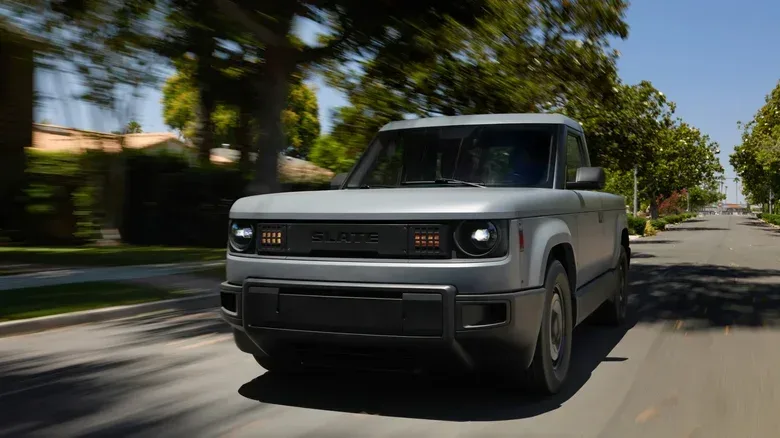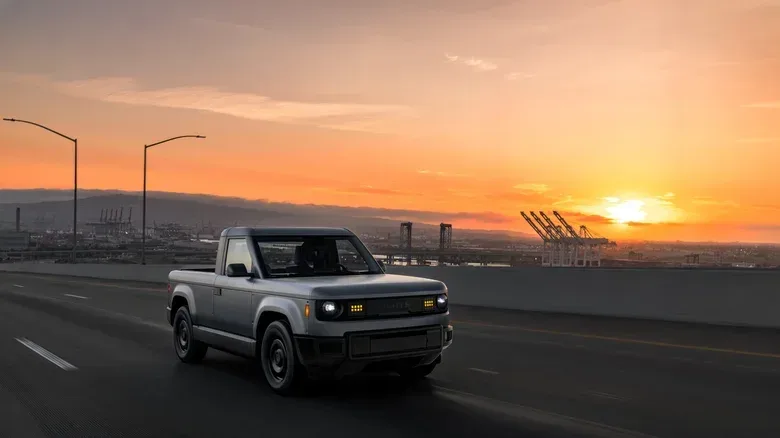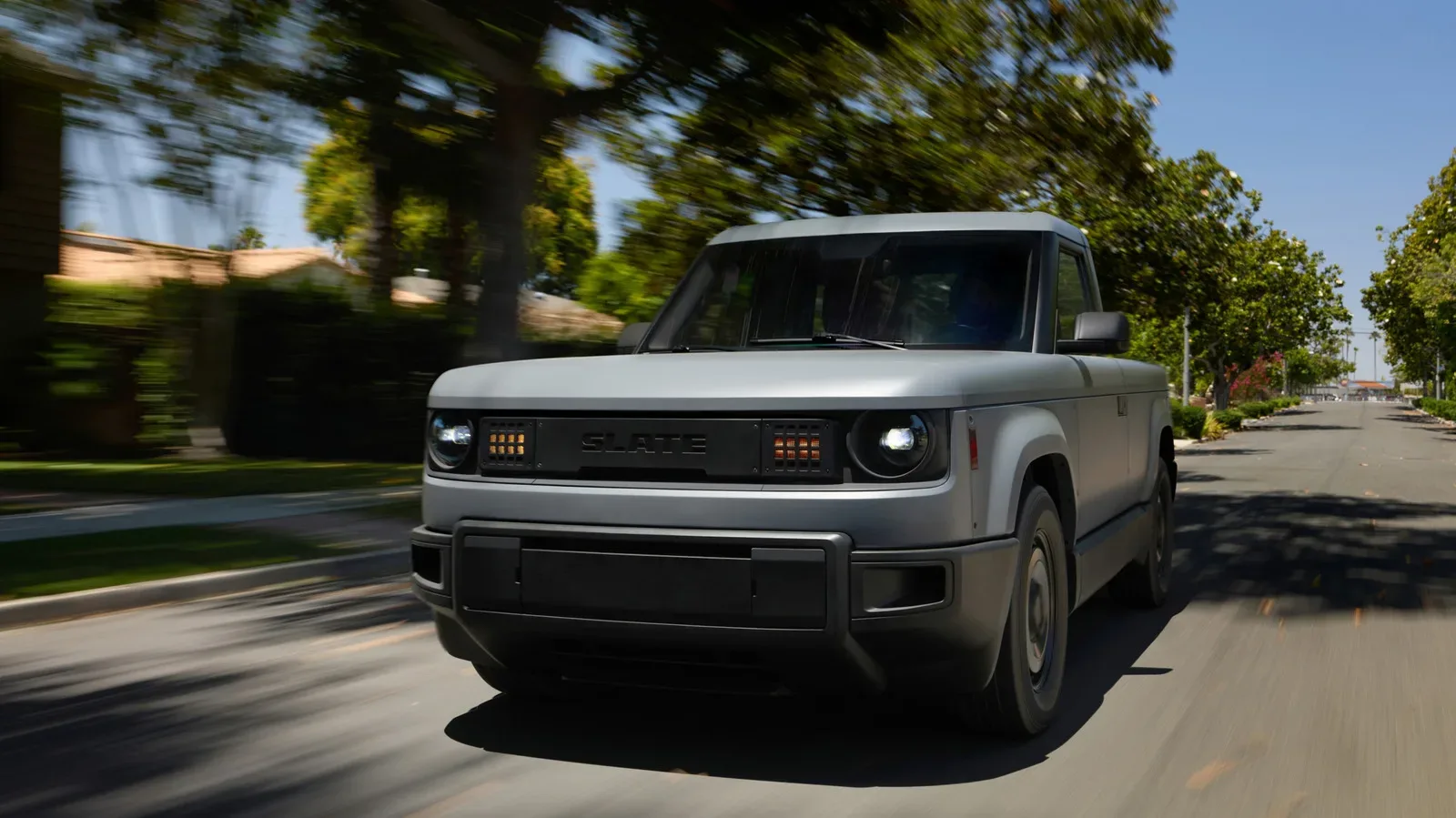
Slate’s electric truck is trying to make the pickup feel less like a luxury appliance and more like a customizable base model: start with the essentials, then add what matters. That approach produces an unusually low stated starting price of $24,950, but it also means the truck launches with a decision that will immediately divide potential buyers: it is rear-wheel drive only.
For drivers who picture a truck as a daily-runabout for small trailers, weekend gear, yard work and local utility duty, that may be a sensible compromise. For people who deal with snow, muddy jobsites, rough access roads or regular off-pavement travel, the absence of all-wheel drive or four-wheel drive could be the feature that stops the configuration screen before the vinyl-wrap choices even begin.
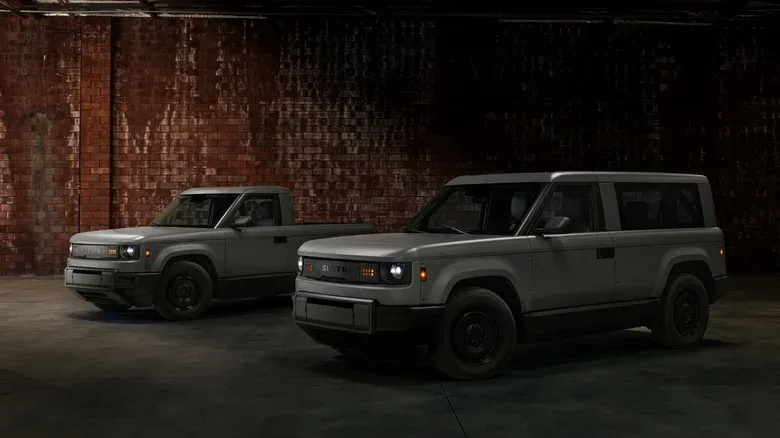
Slate’s own positioning matters here. This is not being framed as a heavy-duty tow rig or an off-road specialist. It is a modular EV aimed at everyday practicality, with a 135 kW motor rated at 181 horsepower, 195 lb-ft of torque, a claimed 205-mile range and up to 2,000 pounds of towing capacity. The company’s vehicle concept includes truck and SUV forms, plus accessories and conversion-style body options designed to let owners change the vehicle over time.
Its drivetrain choice is therefore not an accidental omission. It is central to the proposition: fewer standard systems, a lower entry price and a narrower mission than the do-everything image traditionally attached to pickups.
What rear-wheel drive means for the Slate truck
Rear-wheel drive, often shortened to RWD, sends the motor’s driving force to the rear wheels. In a two-wheel-drive vehicle, that is a meaningful distinction: the front wheels handle steering, while the rear wheels propel the vehicle.
All-wheel drive, or AWD, can direct power to all four wheels. Four-wheel drive, commonly called 4WD or 4x4, likewise supplies all four wheels and is especially associated with truck use. While the systems are not interchangeable in every engineering detail, their practical appeal is easy to understand: when the surface is slippery or uneven, more driven wheels can improve traction and control.
That makes AWD or 4WD particularly attractive to drivers facing:
- snowy or icy roads;
- unpaved access routes and campsites;
- muddy or loose-surface job sites;
- payloads or trailers that have to move across uncertain ground; and
- situations where extra traction is a priority over maximum efficiency.
For those buyers, the Slate’s drivetrain may not be a minor spec-sheet disappointment. It changes the kind of use cases the truck comfortably fits. A compact, affordable EV that works brilliantly on paved local roads can still be the wrong answer for a driver who cannot choose when a driveway, worksite or winter road becomes slick.
The important nuance is that rear-wheel drive is not automatically inadequate. It can fit a vehicle used primarily on normal roads and for lighter hauling. But it asks shoppers to be realistic about where and when they drive, rather than treating “truck” as a guarantee of all-terrain capability.
Why omitting AWD may be the point, not the problem
Slate’s minimalist setup is built around cost control. The truck omits some features many shoppers now treat as routine, including speakers and automatic windows, in service of its lower base price. An AWD or 4WD system would add hardware and complexity, pushing against the same affordability goal.
There are operating trade-offs as well. Driving all four wheels generally uses more energy than a rear-drive setup. For an EV, that additional energy demand can reduce driving range. With Slate listing a 205-mile range, range preservation is not an abstract engineering concern; it is an everyday ownership consideration.
Maintenance is another practical piece of the equation. More drivetrain components can mean more potential expense over time. Slate’s RWD-only configuration presents a simpler package, intended to balance range, towing performance, traction, stability and thermal limits rather than maximize one category at the expense of all others.
There is also a towing-specific reason not to dismiss rear drive. The supplied specifications characterize rear-wheel drive as offering more towing capacity, supporting Slate’s focus on modest, utility-oriented tasks. The truck is intended for uses such as small trailers, motorcycles, yard equipment, kayaks, camping setups and weekend jobs—not the sort of broad, heavy-duty mission many full-size pickups advertise.
That is the central bargain. Buyers get a less expensive platform that can be configured later with a large menu of add-ons, but they do not get every traditional truck capability at the starting line.
EV towing brings a second limitation into the picture
Electric motors can deliver their maximum torque immediately, which is helpful for low-speed hauling. Torque is the rotational force that gets a vehicle and its load moving, so quick access to it can make an EV feel responsive when pulling away with a trailer.
However, towing is not just about the first few feet. Sustained loads create heat, and EVs must protect the motor, inverter and battery system from overload. An inverter is the component that manages electrical power between the battery and motor. Thermal limits are, in plain terms, the operating temperatures the hardware must stay within to function safely and reliably.
For Slate shoppers, that means the 2,000-pound towing figure should be read alongside the company’s intended-use examples and the 205-mile range. The vehicle may be a capable option for nearby, smaller-scale hauling, but it is not being presented as an electric substitute for every long-distance or demanding towing scenario.
Adding AWD would not erase those heat and energy considerations. In fact, powering additional wheels can draw more energy. A future all-wheel-drive version, if it arrives, would involve its own balance of traction, price, range and capability rather than a simple universal upgrade.
Is an AWD Slate actually coming?
There is reason for cautious optimism, but not confirmation. An email attributed to Slate and shared on a fan forum says all-wheel drive is planned for a future version of the vehicle. The message acknowledges its importance for drivers in snowier areas, on jobsites and in situations where extra traction is valuable.
That is not the same as an official product announcement with a date, specifications or a price. Slate has not verified that an alternate drivetrain is in development. Potential buyers should therefore treat AWD as a possibility, not a promised configuration, and should not place an order assuming an upgrade will be available on a particular timetable.
This distinction is especially relevant because the initial vehicle is already pursuing a deliberately stripped-back formula. A future AWD model could be a different version with a different cost and capability balance, rather than an easy accessory-like addition to the launch truck.
A modular vehicle, with some choices that cannot be modular
Slate’s customization model is expansive in other directions. Buyers can choose truck or SUV body styles. The SUV can be configured with squareback, fastback and open-air kits, including options for a second row of seats. The company lists more than 200 accessories, along with vinyl wraps, starter packs and collaborations.
Crucially, buyers are not expected to select every accessory immediately. The vehicle is meant to evolve as an owner’s needs evolve, which is a more unusual approach than forcing every desired feature into the original purchase.
But drivetrain is not like a roof kit, wrap or cargo accessory. It defines the vehicle’s fundamental traction behavior and capability. That makes it one of the few decisions a shopper needs to settle before getting distracted by the fun, visibly customizable parts of the Slate formula.
The broader appeal of pared-back hardware is not limited to vehicles; even aging consumer devices can retain value when their essential purpose remains intact, as seen in this look at how an older Kindle may still have a second life. Slate is attempting a much more demanding version of that philosophy: reduce the standard equipment, preserve useful core function and leave room for owners to customize later. The challenge is that a truck’s missing traction system is more consequential than an omitted convenience feature.
What shoppers should weigh before reserving one
Pre-orders are open with a $300 deposit. Initial deliveries are expected in late 2026, while new orders are projected to begin shipping from Slate’s Warsaw, Indiana, factory as early as July 2027. The company also lists a $1,450 destination charge. Combined with the stated $24,950 base price, that is $26,400 before accessories, based solely on those two listed amounts.
Before reserving a vehicle, prospective owners should separate needs from aesthetics:
- Map the real driving environment. Regular snow, loose roads and jobsite travel make the lack of AWD or 4WD much more important.
- Be specific about towing. A small local trailer run differs greatly from sustained towing, and EV heat and range considerations still apply.
- Budget for the full configuration. The headline price reflects the base truck; destination and desired modular additions raise the actual cost.
- Do not purchase on the assumption of future AWD. It has been discussed in an unverified forum-posted email, but no official timetable or configuration has been confirmed.
- Decide whether simple is a feature. For some buyers, rear drive and fewer standard conveniences are dealbreakers. For others, they are precisely how Slate reaches a lower starting price.
Slate’s RWD-only decision is neither a trivial footnote nor an automatic flaw. It is the clearest expression of what this EV is trying to be: a lower-cost, adaptable utility vehicle for ordinary tasks rather than a universally capable truck. That mission will make sense for some drivers. For anyone whose routine demands dependable extra traction, however, the “Blank Slate” may need one more layer before it is ready to write itself into their driveway.