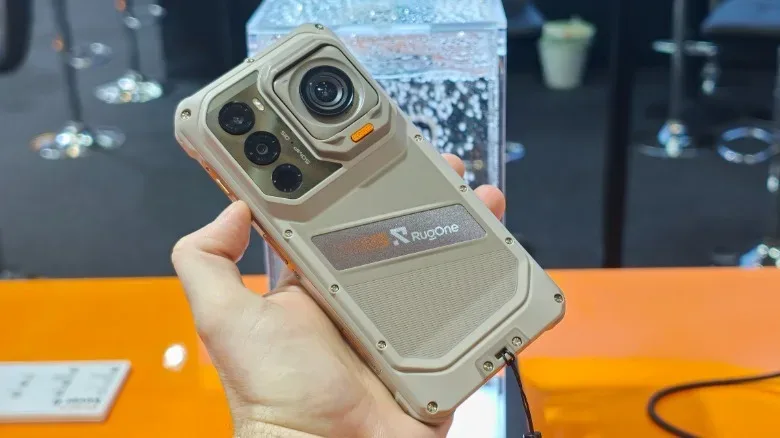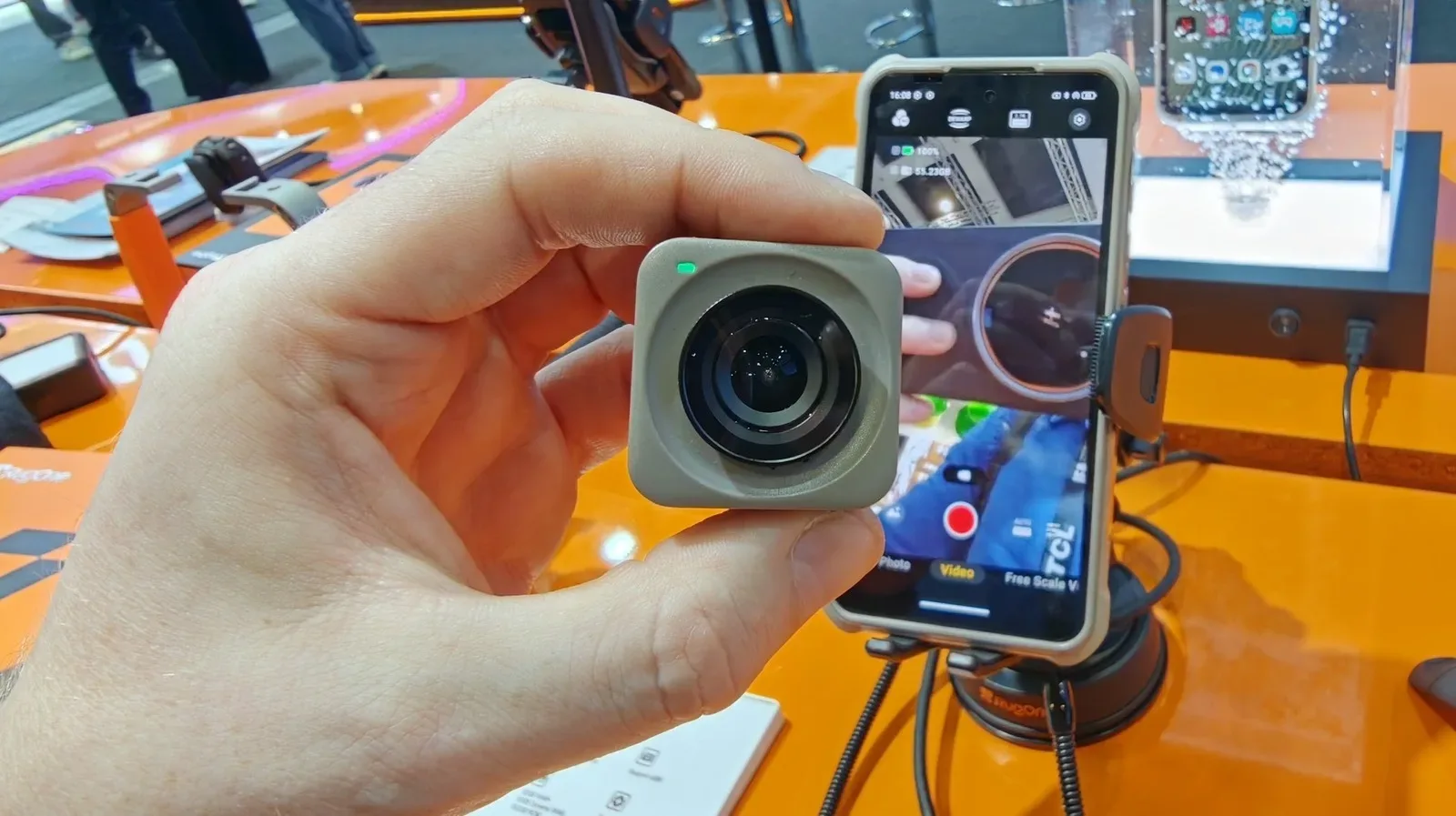
Smartphone design has spent years perfecting the same basic trick: make a smooth glass rectangle, add a camera bump large enough to qualify for local government, and offer it in a dark color with a name like “Cosmic Carbon Night.” RugOne has taken a more mischievous route with the Xsnap 7 Pro, a rugged phone whose magnetic rear camera can detach and operate as a small action camera.
It is an unusual idea precisely because it solves a very ordinary problem. A phone camera is often the camera people already have with them, but filming with the entire phone is awkward when the shot calls for a body-mounted perspective, a tricky angle, or simply keeping the handset out of harm’s way. RugOne’s answer is to let part of the phone leave the phone.
The Xsnap 7 Pro is making its official debut at IFA 2026 after a prototype appearance at MWC 2026. RugOne, a brand associated with Ulefone, says early-bird Kickstarter orders open September 7 at 799 euros, approximately $930. The planned regular global price is $999, with sales expected the following month through Amazon and RugOne’s own online store. The phone is slated to arrive in Sand Dune and Classic Black.
A camera module that wants to wander off
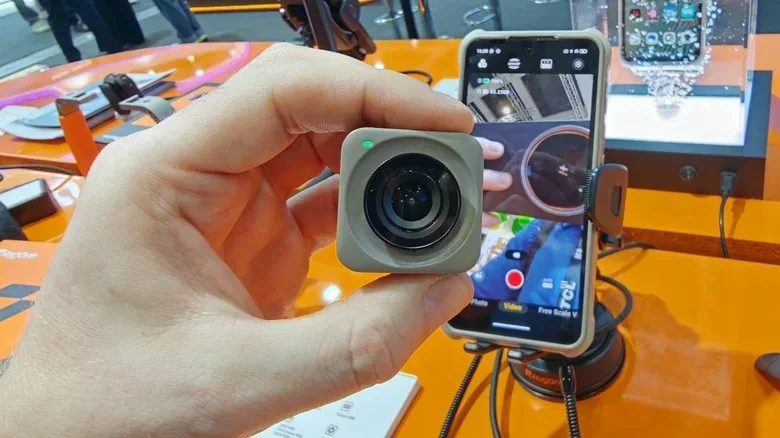
The centerpiece is a near-cube-shaped magnetic camera unit weighing 39 grams. Once removed from the handset, RugOne says it can record at up to 2.7K resolution at 30 frames per second. Those figures place it in action-camera territory in spirit, rather than positioning it as a direct spec-for-spec rival to current flagship GoPro hardware.
RugOne lists up to 40 minutes of recording time from a full charge and includes 64GB of onboard storage in the module. The dedicated storage matters: the camera is intended to keep working as a separate device instead of treating the handset as a very expensive wireless viewfinder with stage fright.
The module can send a live preview to RugOne’s companion app from as far as 50 meters away, according to the company. That could make framing easier when the camera is positioned somewhere the phone cannot comfortably go, whether that is clipped to clothing, placed at a low angle, or mounted away from the person monitoring the capture. It also means the feature’s usefulness will depend on the companion app and wireless connection behaving themselves, two variables that deserve practical scrutiny once retail hardware is available.
Software tools named by RugOne include distortion correction, horizon lock and a Freeframe mode. Freeframe records the sensor’s full area so footage can later be cropped for horizontal or vertical presentation. In a world where one clip may be headed for a conventional landscape edit, a vertical short-form post, or a group chat that will reply only with a single fire emoji, that flexibility is a sensible inclusion.
Water resistance without the extra plastic brick
RugOne rates the detachable camera itself for water resistance down to five meters without requiring an additional case. That is one of the more compelling parts of the proposition. Conventional action cameras can demand a housing for deeper-water use, while phones are generally not gadgets people want to dangle around a wet activity for long. A removable, standalone camera changes that calculation, at least on paper.
The company also plans to bundle a magnetic pendant for wearing the camera on the body. It says the module will support third-party accessories that use a universal mount. The combination suggests obvious uses for point-of-view capture, though the precise quality of the mount, magnetic hold and ecosystem compatibility will be important details to assess outside product specifications.
There is an admittedly delightful degree of gadget logic here. Instead of asking a user to buy a phone and then buy a second camera for occasional hands-free footage, RugOne is trying to turn the phone’s camera system into a tiny detachable scout. Whether that proves practical for everyday clips or remains a party trick with excellent luggage protection will come down to real-world operation, not just a particularly adventurous spec sheet.
The rest of the phone is built for hard knocks
The Xsnap 7 Pro is not solely a camera accessory wearing a phone costume. It is a full rugged smartphone with a 6.67-inch display, a stated peak brightness of 1,700 nits, and a refresh rate of up to 120Hz. Processing duties fall to a MediaTek Dimensity 8400 chip.
RugOne claims IP68 and IP69K ratings for the handset. It further says the phone can withstand submersion in water up to two meters deep for 30 minutes and survive drops of up to 1.5 meters onto concrete. As always with rugged-device ratings, the published conditions matter. A device tested for a particular depth, duration or impact is not thereby enchanted against every kind of water, fall, impact angle, port condition or unfortunate meeting with the contents of a backpack.
Still, the stated design intent is clear: this is a phone aimed at people who would prefer not to panic every time their device touches a trail, worksite, wet surface or the edge of a table. The detachable camera extends that durability-minded approach rather than merely adding another lens count to the annual megapixel arms race.
For gaming-adjacent use, the display’s 120Hz maximum refresh rate and high claimed brightness are the familiar parts of the package. The removable camera is the stranger ingredient. It could be useful for recording a tabletop session or a couch multiplayer moment without having to hold a whole phone in the air like an exhausted documentary crew. Of course, before attempting to capture the classic controller handoff argument, it may help to review the unwritten rules of couch multiplayer; no camera module has yet been certified against a friend who “accidentally” pauses during the final round.
Three cameras, three very different jobs
Along with the detachable action module, the Xsnap 7 Pro includes a 50-megapixel main camera with optical image stabilization. RugOne labels it an AI main camera. It also includes a 64-megapixel infrared night-vision camera with IR LEDs, intended to produce black-and-white detail in dark conditions.
The infrared camera is another indication that this phone is not pursuing conventional premium-phone minimalism. Most mainstream devices concentrate on improved standard photography, then add ultrawide or telephoto lenses. RugOne instead has a stabilized main camera, a night-vision option, and a removable action unit. It is less “one perfect camera array” and more “a small utility belt that happens to receive texts.”
RugOne has highlighted nighttime wildlife viewing as one possible use for the infrared hardware. The company’s described output is monochrome, as is typical of that style of night vision, rather than a promise of richly colored midnight photography. Potential buyers should also distinguish between the 64MP figure attached to this fixed infrared camera and the detached unit’s 2.7K/30fps video specification; they are separate cameras meant for separate roles.
What remains unknown before launch
The announced specifications paint a distinctive picture, but several practical questions remain unanswered until the phone is more widely available. RugOne has stated the maximum video resolution and frame rate, battery claim, storage capacity, wireless preview range and water rating for the removable module. Those details do not by themselves establish image quality, stabilization performance in motion, audio quality, magnetic security during active use, charging behavior, app reliability or how quickly clips can be moved and edited.
Likewise, IP ratings and drop claims provide useful context but are not substitutes for independent durability evaluation over time. The Xsnap 7 Pro’s appeal is partly that it combines several devices people might otherwise carry separately: a smartphone, an action camera, a night-vision camera and a ruggedized object designed to look relatively unbothered by a concrete floor.
That makes its $999 planned price easier to understand than it would be for a straightforward midrange handset, though it also means buyers will want the unusual camera system to be genuinely useful. At the 799-euro early-bird Kickstarter price, supporters are being asked to buy into RugOne’s concept before the product reaches its broader planned retail rollout.
The Xsnap 7 Pro does not need to replace every dedicated action camera to justify its existence. It only needs to make a detachable camera feel less like a novelty and more like the feature a rugged phone should have had all along. If RugOne’s claims hold up, it could be one of the rare smartphones whose rear camera bump has finally escaped the rectangle and gone on an adventure.