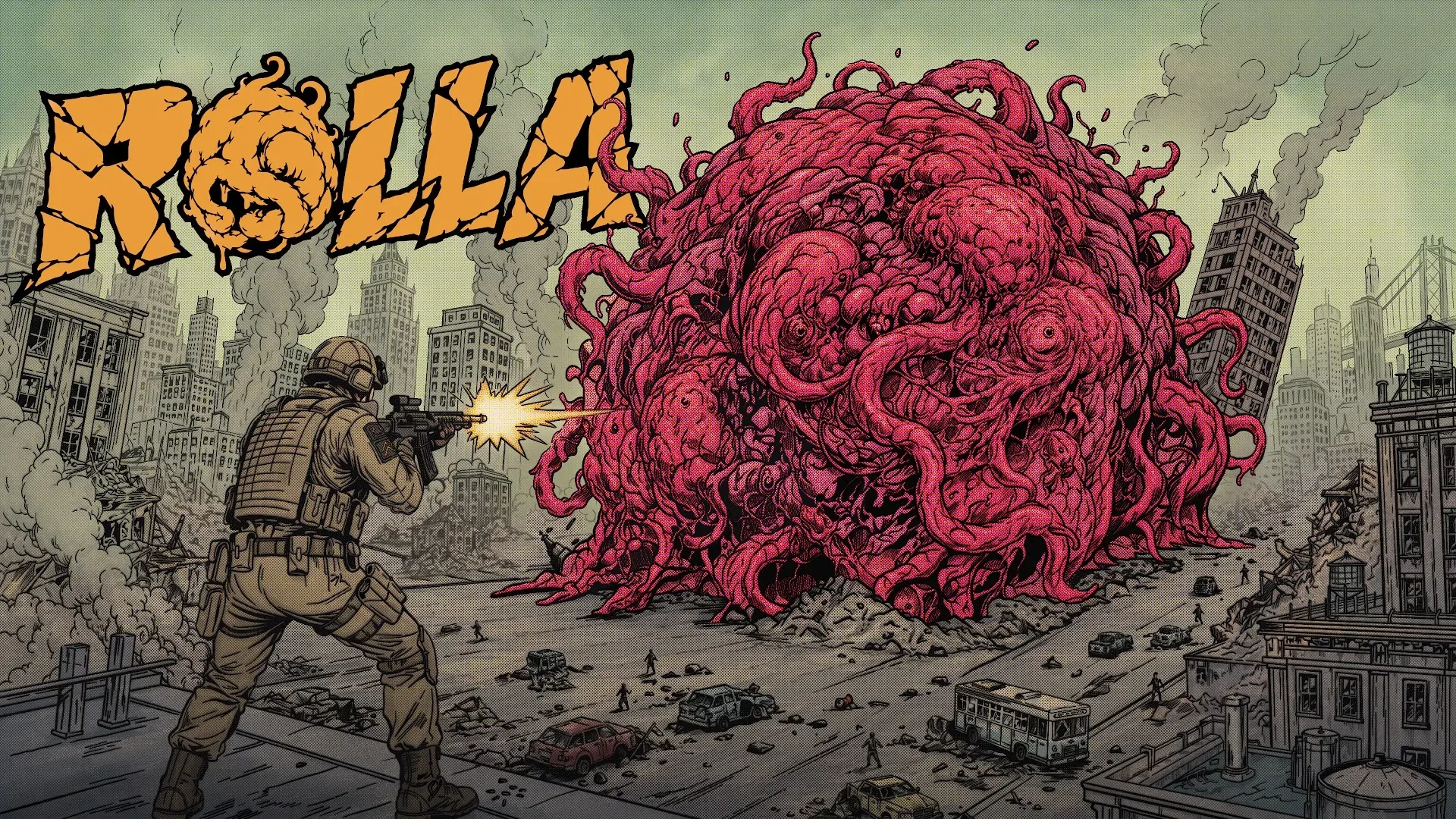
ROLLA Update 1.1 is now available, bringing a substantial set of additions and balance revisions to the arcade-horror score chaser. The update adds a new level and a new mode named Atomic Time Attack, while also changing how quickly the flesh-ball protagonist grows, how enemies arrive, how grabbing works, and how players can read the action.
The patch also resets the game’s leaderboards. That can be a painful sentence for anyone attached to an old score, but the reset follows changes to the game’s balance and pacing. Importantly, completed goals, achievements and Rolladex progress are not being removed. The competitive record starts anew; longer-term account progress remains.
ROLLA’s basic premise remains deliberately grotesque and arcade-forward: players control a giant ball of flesh that rolls through levels, eats humans, grows larger, and pursues high scores. Update 1.1 focuses on making the route from vulnerable rolling horror to escalating menace clearer and more responsive, particularly in the earlier part of a run.
Atomic Time Attack turns feeding into survival
The major new feature is Atomic Time Attack. The mode places a ticking nuclear clock over each attempt. Eating humans adds time back to the countdown, so consumption is not simply a route to growth or points: it is the direct means of staying alive in the mode.
That structure gives every target a second value. A nearby human may be an immediate reprieve from the timer, while a more distant group could represent a bigger opportunity at greater risk. The essential tension is easy to understand: stopping to line up a safer grab can cost precious seconds, but moving recklessly can waste time and put an attempted run in jeopardy.
“Time attack” generally means a mode built around completing an objective against a clock. ROLLA’s variation is more specific: the clock is replenished through play. Rather than treating time solely as a limit that declines until failure, Atomic Time Attack makes hunting the mechanism that fights back against that limit. The reported result is a mode where the player must sustain momentum rather than simply finish a route as quickly as possible.
Atomic Time Attack is available directly from the main menu. No prior progression is required to unlock it, meaning new players can try the mode immediately rather than needing to reach a particular stage or meet a score threshold first.
Growth, grabbing and spawns have been reworked
Update 1.1 makes several connected adjustments to the game’s central loop. Players now begin with one grabbing tendril and can obtain additional humans as ROLLA grows. A helping tendril also highlights humans that are within grabbing range.
Related coverage includes ROLLA Update 1.1 Adds Atomic Time Attack and Resets Leaderboards.
In practical terms, that visual prompt is intended to clarify when an attempted grab is viable. In a hectic arcade game, the difference between being near a target and being close enough for an interaction is often hard to judge from motion alone. Highlighting valid targets should make the game’s grabbing distance more legible without requiring players to infer it entirely from trial and error.
The new starting state also makes the early game more defined. Beginning with one tendril establishes a limited initial capability, while the ability to gain more as ROLLA expands reinforces the game’s growth curve. The stated change is not just cosmetic progression: it connects what the player eats to the number of targets they can potentially handle.
Humans now deliver larger growth boosts as well. That means a successful hunt has more impact on ROLLA’s size than before, at least within the revised balancing. Since growth is at the heart of the game’s premise, raising those boosts should make each collection of targets more consequential and could shorten the distance between a small starting form and a more powerful one.
Enemy waves and spawning have also been reworked. Spawning refers to the system that determines when and where enemies enter a level; waves are grouped stretches of enemy pressure. Changes to either can significantly alter a score game’s rhythm even when the controls remain the same. A level can feel more manageable or more frantic depending on how reliably threats appear, how they are grouped, and whether their arrival creates an opportunity to feed or an interruption to movement.
The patch notes specifically call out improved pacing, especially in opening levels. Pacing here means the flow of challenge and opportunity over time: how quickly a run presents meaningful actions, growth, danger and escalation. Early stages are especially important because they teach the player what a successful run looks like. Update 1.1’s changes to starting tendrils, growth boosts, enemy waves and target feedback all point toward refining that introduction.
A leaderboard reset reflects the revised rules
The leaderboard reset is tied to the new gameplay and balance changes. In score-driven games, a leaderboard is only directly comparable when participants are playing under substantially similar rules. Changing growth values, spawning patterns, target feedback and the early-game pace can affect how attainable a given score is, as well as the strategies used to reach it.
Resetting the rankings establishes a new competitive baseline for Update 1.1. It does not erase everything a player has done: goals already completed, achievements already earned and Rolladex progress all carry over. The distinction matters. A leaderboard records comparative performance under a current ruleset, while achievements and collection-style progress record a player’s accumulated milestones.
For returning players, the practical implication is straightforward: past placement will not persist on the refreshed boards, but previously earned progress does. For players arriving after the patch, everyone is competing on the updated footing rather than trying to chase scores established before the rebalancing.
Camera and control options broaden how players can read a run
The update’s wider set of changes also includes dynamic and isometric camera modes. An isometric view presents the game world from an angled, elevated perspective rather than directly from the side or behind the character. It is often useful for reading nearby space, hazards and paths around the player. ROLLA’s isometric camera includes zoom controls, giving players a way to adjust how much of the surrounding scene is visible.
A dynamic camera, by contrast, suggests a viewpoint that responds more actively to gameplay. The available information does not define every behavior of that mode, so it would be premature to claim exactly how it moves or frames encounters. What is clear is that players have multiple viewing options, alongside adjustable zoom in the isometric view.
Custom keyboard bindings are another useful accessibility and comfort feature. They allow players to assign actions to preferred keys instead of relying entirely on a fixed default layout. In a game built around movement, grabbing and reacting to enemy pressure, control layout can matter as much as raw difficulty for some players.
The pause menu now includes an objectives view, giving players a dedicated place to check what they are working toward without leaving a run to search elsewhere. Pause menu controls themselves have also received improvements.
Blood Highway fixes and wider quality-of-life changes
Two specific fixes target problems in the Blood Highway level. Update 1.1 addresses an issue where players could become stuck after airstrikes, and another where spawns could occur out of bounds. An out-of-bounds spawn means an entity appears outside the intended playable area. Depending on what spawns there, that can make targets unreachable, produce strange behavior, or otherwise disrupt the designed encounter flow.
Blood Highway also receives brighter lighting. Lighting changes can be functional as well as atmospheric: better visibility can help players distinguish routes, threats and targets amid a busy screen. Along with the grabbing-range help, the brighter presentation fits the patch’s broader emphasis on making moment-to-moment information easier to parse.
Other updates include improvements to grabbing, enemy behavior and power-up spawning. Power-up spawning describes how temporary or beneficial items appear in play; enemy behavior covers how hostile units act. The supplied details do not specify each individual adjustment, but those systems are central to how a run unfolds, making their inclusion notable alongside the more explicit pacing and growth changes.
Tracking and spotting collected R-O-L-L-A letters has been made easier. This is a navigation and progress-readability improvement rather than a new collection system. Players pursuing these letters should have a clearer way to identify what they have already found.
Finally, the Mellow Yellow skin has received a visual tweak. It is a smaller change beside the new mode and systemic revisions, but it rounds out a patch that spans presentation, interface and performance-facing gameplay systems.
What Update 1.1 changes for players
ROLLA Update 1.1 is not limited to adding another menu option. Atomic Time Attack introduces a distinct pressure loop where eating humans is directly tied to keeping the clock alive. Meanwhile, revisions to growth, tendrils, enemy waves and opening-level pacing reshape the foundations supporting standard score play.
The new camera modes, keyboard remapping, objective display and improved target visibility should also help players better understand the game’s busy action. The Blood Highway fixes address two concrete failure cases, while the retained achievements, goals and Rolladex progress soften the impact of the leaderboard reset.
For more recent oddball PC-game news, see Rat Game’s chef-versus-rats restaurant chaos. ROLLA, meanwhile, now asks one especially urgent question of score chasers: can an ever-growing flesh sphere keep its nuclear clock fed?